- Animals
- ›Chordates
- ›Vertebrates
- ›Amphibians
- ›Frogs and Toads
- ›Terraranas
- ›Rain Frogs
- ›Eleutherodactylinae
- ›Eleutherodactylus
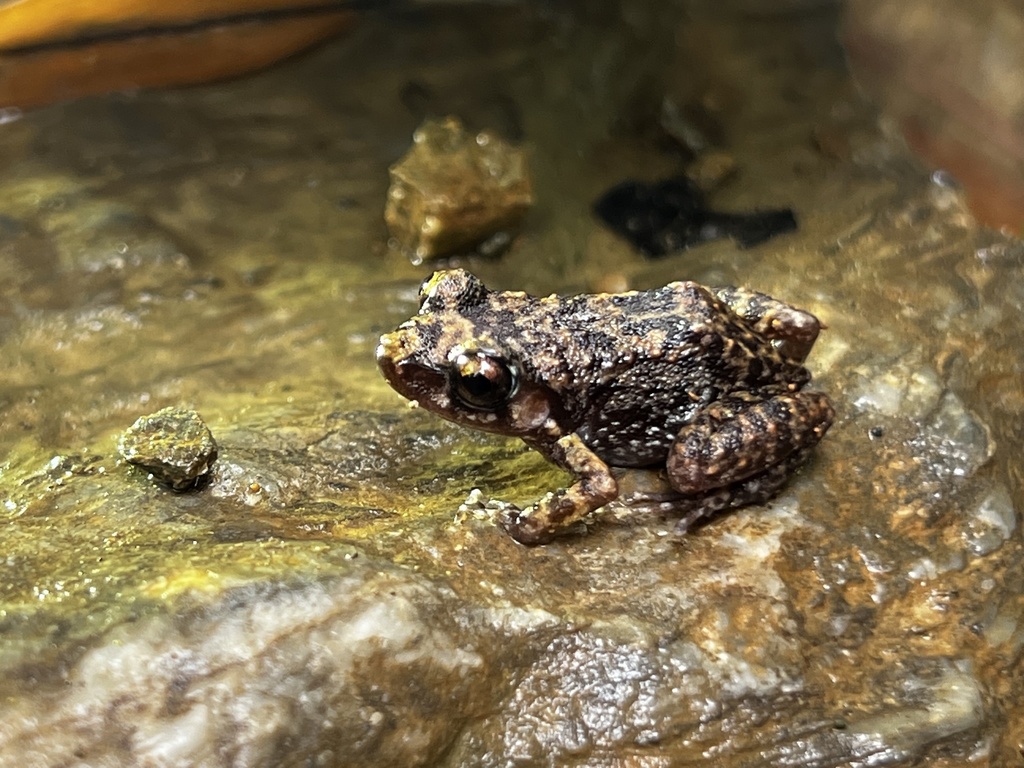
Blue Mountain Rockfrog
Eleutherodactylus glaucoreius
Eleutherodactylus glaucoreius, also known as Blue Mountain frog and Portland Parish robber frog, is a species of frog in the family Eleutherodactylidae. It is endemic to Jamaica. The specific name glaucoreius is derived from Greek glaucos ("pale blue") and oreios ("mountain"), in allusion to the occurrence of this taxon in the Blue Mountains.
From the article Eleutherodactylus glaucoreius on Wikipedia (CC BY-SA), quoted section by section
Description
Males grow to 28 mm (1.1 in) and females to 32 mm (1.3 in) in snout–vent length. The head is as wide as it is long. The snout is acuminate but sharply truncate. The tympanum is small but visible. The digital discs are moderately sized. No webbing is present. Dorsal coloration is tan to gray, with some individuals having hint of red or orange. Dorsal patterns are variable; most individuals are either mottled with dark brown or have tan or reddish tan dorsolateral stripes. Scapular W-shaped marking is almost always present, often followed by another W in mid-dorsum. Many individuals have lateral spotting. Ventral coloration is pale yellow, often with brown or back pigmenting. The throat is heavily pigmented.
Range & habitat
This species is restricted to eastern Jamaica. It is found from sea level to 1,650 m (5,410 ft) asl. It is also reported from one location on the north coast, but it is unknown whether this represents a viable population. It is a terrestrial frog that is often found on and inside rocky formations in rainforest but also in secondary forest. It can also occurs inside piles of coconut husks. Eggs are laid on the ground and it breeds by direct development (i.e., there is no free-living larval stage).
Wikipedia: “Distribution and habitat”
Listen
Looking for field recordings…
Where it lives
Recorded sightings
—
geo-referenced records in GBIF, from museums, herbaria and field observers.
Drag the globe to turn it. Dots are where records exist, not a range map; darker means more records.
In the stacks
This page is assembled live from iNaturalist, GBIF, Wikipedia, the Source Library and the Internet Archive. It is not yet part of the hand-edited codex. iNaturalist taxon 22236.