- Animals
- ›Arthropods
- ›Hexapods
- ›Insects
- ›Winged and Once-winged Insects
- ›Beetles
- ›Water, Rove, Scarab, Long-horned, Leaf, and Snout Beetles
- ›Cucujiform Beetles
- ›Snout and Bark Beetles
- ›True Weevils
- ›Bark and Ambrosia Beetles
- ›Hylurgini
- ›Dendroctonus
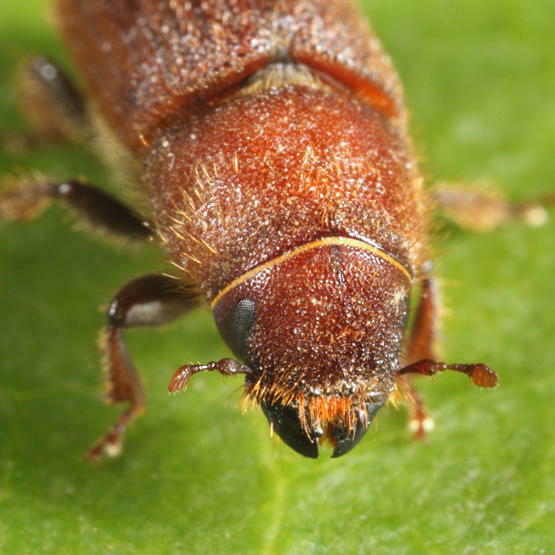
Red Turpentine Beetle
Dendroctonus valens
Dendroctonus valens, also known as the red turpentine beetle, is a species of bark beetle characterized by a dark-reddish brown hue. It is native to forests across North and Central America. In its adult form, these beetles range from six to ten millimeters in length. A notable characteristic about them is their use of acoustic signals and chemical cues when engaging in what is a very complex mating process.
While harmless in its native range, D. valens is a very destructive pest in China, where it was introduced and subsequently spread through wood shipments. It has killed more than six million pine trees across the country and biological control programs are currently being used to combat its deleterious effects on Chinese ecology.
From the article Dendroctonus valens on Wikipedia (CC BY-SA), quoted section by section
Description
The eggs are cylindrical with rounded ends, white, opaque and shiny, and about 1 mm (0.04 in) long. The larva is a white, legless grub, with a brown head and brown tip to the abdomen. As it grows, lateral rows of pale brown tubercles become apparent. The fully grown larva is 10 to 12 mm (0.39 to 0.47 in) long. The pupa is white; it is exarate, the antennae and legs being free and not enclosed in a cocoon. The adult beetle is 6 to 10 mm (0.24 to 0.39 in) long and about twice as long as it is wide. When it first emerges from the pupa, it is tan, but it soon turns dark reddish-brown.
Range & habitat
Dendroctonus valens occurs in North and Central America. Its range extends from Canada and the northern and western parts of the United States, southwards to Mexico, Guatemala and Honduras. In the mid-1990s it was accidentally introduced into China, probably in wood packaging material, where it became established; an outbreak occurred in Shanxi Province in 1999, and it has since spread to Hebei, Henan and Shaanxi Provinces. It has a wide potential host range that could allow it to spread to other parts of China and more widely across Eurasia.
Wikipedia: “Distribution”
What it does
In the southern parts of its geographic range, D. valens can be active all year with multiple generations being present in a population at once. Further north, these beetles are active from May to October and only have a single generation each year; in these regions, larvae can take more than a year to mature. On living trees, the beetles excavate a hole within a meter or two off the ground. Upon successfully reaching the cambium layer, a pair of beetles mate and the female excavates a vertical gallery, on one side of which she lays her eggs in small clusters. The beetles continue to enlarge their galleries while the eggs incubate. When the eggs hatch, the larvae tunnel out a large communal gallery in the phloem and cambium which becomes filled with frass. When they have completed their development, after two months or more, they pupate in individual cells in this chamber, or in short side galleries. The rate of development is dependent on the temperature. Galleries can span from the lower parts of the tree trunks into the upper parts of the root system and beetles inhabiting northern regions will go into the roots to hibernate in the winter months. …
Wikipedia: “Life cycle”
Listen
Looking for field recordings…
Where it lives
Recorded sightings
—
geo-referenced records in GBIF, from museums, herbaria and field observers.
Drag the globe to turn it. Dots are where records exist, not a range map; darker means more records.
In the stacks
Searching the stacks…
Every page naming Dendroctonus valens in the Biodiversity Heritage Library →
This page is assembled live from iNaturalist, GBIF, Wikipedia, the Source Library and the Internet Archive. It is not yet part of the hand-edited codex. iNaturalist taxon 218223.