- Animals
- ›Arthropods
- ›Hexapods
- ›Insects
- ›Winged and Once-winged Insects
- ›Beetles
- ›Water, Rove, Scarab, Long-horned, Leaf, and Snout Beetles
- ›Cucujiform Beetles
- ›Leaf Beetles and Allies
- ›Leaf Beetles
- ›Tortoise and Hispine Beetles
- ›Cassidini
- ›Cassida
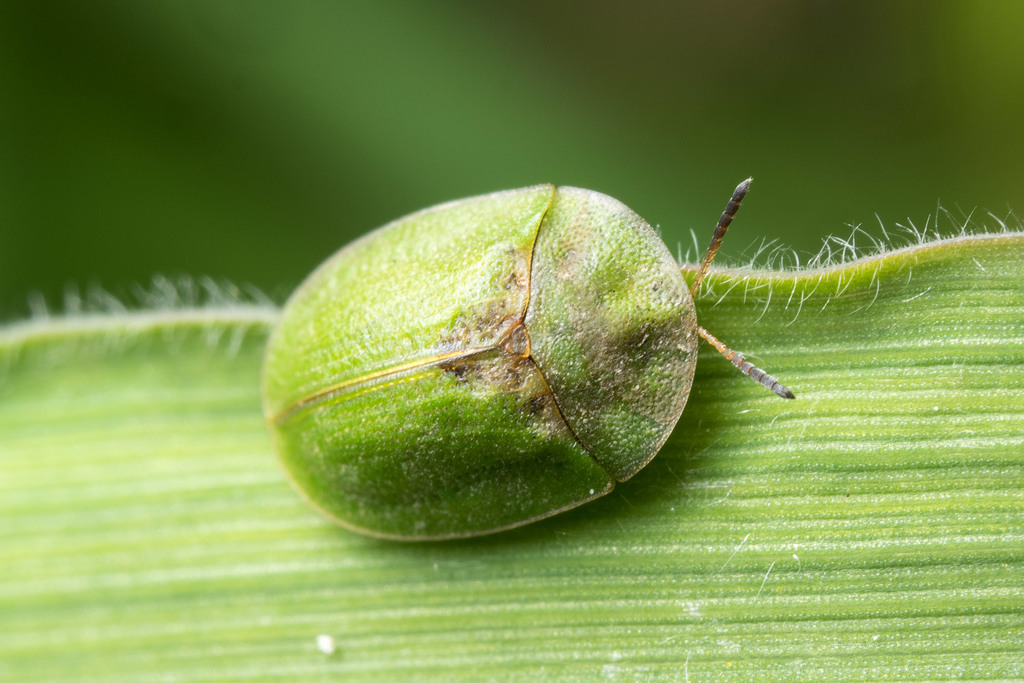
Thistle Tortoise Beetle
Cassida rubiginosa
The thistle tortoise beetle (Cassida rubiginosa) is a species of beetle in the subfamily Cassidinae (tortoise beetles) and the genus Cassida. The thistle tortoise beetle can be recognized by its green, rounded back and it can be found on thistle plants in many regions of North America and Europe. The thistle tortoise beetle was first discovered in 1902 in Lévis, Quebec. In 1931, Nellie F. Paterson was the first to document the mature larva. Later, the instar larva of this species was first recorded in 2004 by Jolanta Świętojańska. The thistle tortoise beetle exhibits multiple defense behaviors, such as a flexible shield, providing a barrier against the mandibles of predators, and an excretion that protects the eggs as well.
Its ability to massively consume and damage thistle plants has also made this beetle a well known biological control agent in many countries, including the United States, Canada, and Switzerland. However, in some cases, the impact of these beetles has been limited due to parasitism preventing their accumulation in regions of thistle targeted for biological control.
From the article Thistle tortoise beetle on Wikipedia (CC BY-SA), quoted section by section
Description
The thistle tortioise beetles measure 6.0–8.0 mm in length. Like all Cassida, its head is covered by the pronotum, and the elytra has a wide flange surrounding it. This species is highly rounded, with green or yellowish-green elytra, sometimes with a small, dark triangular spot around the scutellum. The common name may be misleading for the identification of this species as rubiginosus, which is Latin for "rusty or rust-coloured". However, in preserved conditions, the green color quickly becomes brown.
Range & habitat
This beetle inhabits North America and can be commonly found from South Dakota to Virginia within the United States. In Canada, it is found across several provinces, spanning from Alberta to New Brunswick. In Europe, it can be encountered from Fennoscandia to Greece and Spain. It is also found in Great Britain and across Siberia. In these regions, they live in areas where there are plenty of thistle. For example, these can include fields, pastures, orchards, meadows, and farmland. The types of thistles they reside on include the Canada thistle, the bull thistle, the musk thistle, the plumeless thistle, and the field thistle.
Wikipedia: “Distribution and habitat”
What it does
C. rubiginosa feeds on various Asteraceae, including thistles and many others. Thistle beetle larvae mainly stay on the leaves they were hatched on throughout their development and feed on them. The adults are usually found on the underside of the leaves and the larvae on the uppersides. The time it takes for them to begin feeding depends on a few factors relating to the leaf's structure. The larvae wait until the thistle plants grow by 30% and for the nitrogen levels in the leaves to drop by 50% before feeding. The time that they start feeding also affects the growth of the thistle plant. The plant's upward-growing capability is inhibited when feeding starts late in the season. However, no effect on the plants is detected when feeding begins in the early season. ' Adult feeding can damage the leaves more significantly than larvae feeding since they do not begin eating from the edges of the leaf but instead begin at the center and eat down from the surface. Adults may also feed on pollen of buttercups and ox-eye daisies. The beetle's consumption of these plants is facilitated by a symbiotic relationship with the bacteria Stammera, which is housed in specialized structures within the foregut and allows the beetle to digest pectin, which is indigestible to most animals.
Wikipedia: “Diet”
Listen
Looking for field recordings…
Where it lives
Recorded sightings
—
geo-referenced records in GBIF, from museums, herbaria and field observers.
Drag the globe to turn it. Dots are where records exist, not a range map; darker means more records.
In the stacks
Searching the stacks…
Every page naming Cassida rubiginosa in the Biodiversity Heritage Library →
This page is assembled live from iNaturalist, GBIF, Wikipedia, the Source Library and the Internet Archive. It is not yet part of the hand-edited codex. iNaturalist taxon 216166.