- Plants
- ›Vascular Plants
- ›flowering plants
- ›Dicots
- ›Heathers, Balsams, Primroses, and Allies
- ›primrose family
- ›Cape Myrtle subfamily
- ›Myrsine
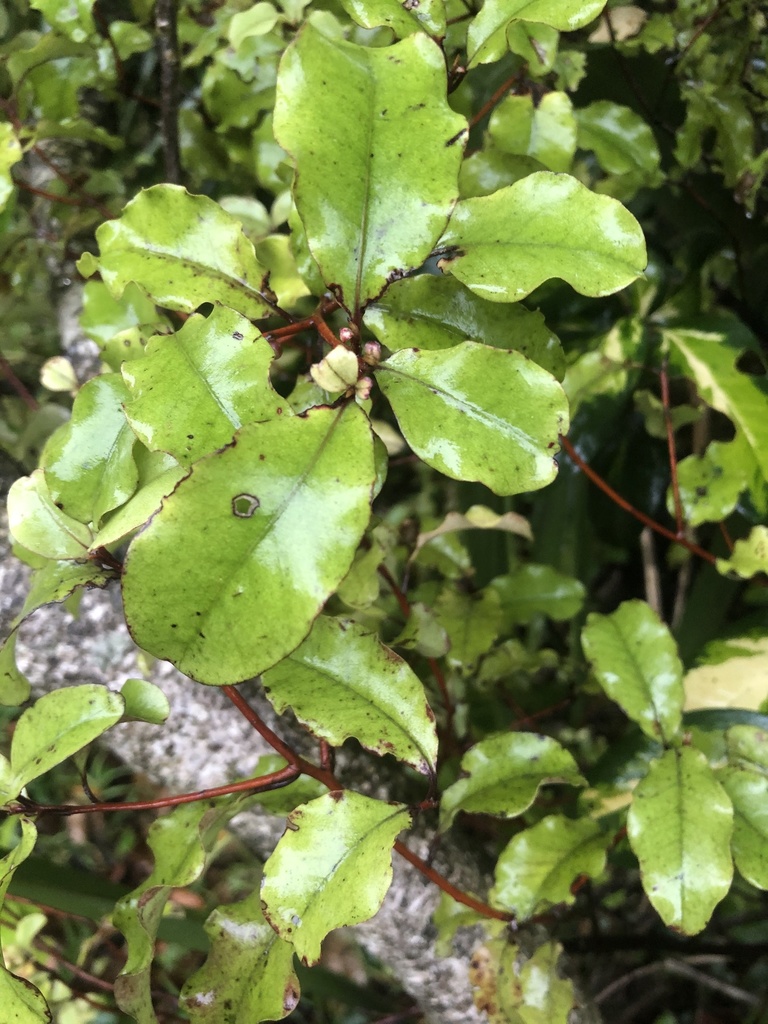
Māpou
Myrsine australis
Myrsine australis, commonly known as red matipo, māpou, māpau, tīpau, and mataira, is a species of shrub within the family Myrsinaceae. It is endemic to New Zealand, found throughout both the mainland and offshore islands.
From the article Myrsine australis on Wikipedia (CC BY-SA), quoted section by section
Description
Myrsine australis is a small shrub or tree, growing from 3–6 metres tall with short upright branches that create a compact crown. The trunk grows up to 20 cm in diameter, with the bark of the trunk and older branches a dark brown/black, whereas the juvenile branches are reddish, a distinguishing feature of this plant. The leaves are coloured pale green with a yellow tinge on the top surface, while the underside of the leaf is a paler version of this. Measuring 3–6 cm in length to 1.52.5 cm in width, the leaves are arranged alternatively on the stem and have a leathery texture. The leaf margins are normally wavy, however some uncommon forms may also have flat leaf margins. Each leaf blade is typically covered in round, translucent glands, and is connected to a red, approximately 5mm long, leaf stalk. These leaf stalks, also called petioles, can vary in colour and size as a result of environmental conditions and local population trends.
Range & habitat
Red matipo is a species native to the North, South and Stewart Islands of New Zealand, though its representative abundance is higher in Northern New Zealand Along with four other Myrsine species native to the North, South and Stewart Islands, there are four further Myrsine species native only to outlying islands separate from the New Zealand mainland; the Chatham Islands, the Three Kings Islands, and the Kermadec Islands. Outside of New Zealand, there are a further 300 Myrsine species found throughout the world.
Wikipedia: “Natural global range”
What it does
On average, Myrsine australis tends to flower between August and January, and produces fruit between September and December. Its flowers are clustered on small stalks on the branchlets where older leaves have already been lost. They are small and inconspicuous (like most other New Zealand native flowers), measuring from 1.5mm to 2.5mm in diameter, and are a cream to whitish colour, covered in small orange glands. The flowers are unisexual, therefore some individuals produce only male flowers for pollen distribution, and other individuals produce only female flowers for fertilization and fruit growth. The petals of the flowers are lanceolate, obtuse, free and revolute. Due to the occurrence of flowering and fruiting periods overlapping, some specimens can display both fruit and flowers at the same time. Red matipo’s fruits are drupes; a single seed is encased in a hard core, which is then covered in a fleshy outer layer. The fruits measure 2-4mm in diameter, are coloured dark brown to black, and are commonly dispersed by kererū, tūī, tauhou, korimako, and blackbird, who eat the fruit, and dispose of the seed once digested. The plant has the ability to retain a ‘Seed Bank’, with some seeds remaining dormant for a year or more and germinating at random intervals and amounts. …
Wikipedia: “Life cycle and phenology”
Where it lives
Recorded sightings
—
geo-referenced records in GBIF, from museums, herbaria and field observers.
Drag the globe to turn it. Dots are where records exist, not a range map; darker means more records.
In the stacks
Searching the stacks…
Every page naming Myrsine australis in the Biodiversity Heritage Library →
This page is assembled live from iNaturalist, GBIF, Wikipedia, the Source Library and the Internet Archive. It is not yet part of the hand-edited codex. iNaturalist taxon 210946.