- Animals
- ›Arthropods
- ›Hexapods
- ›Insects
- ›Winged and Once-winged Insects
- ›Grasshoppers, Crickets, and Katydids
- ›Katydids, Crickets, and Allies
- ›Katydids, wētā, and allies
- ›Tettigonioidea
- ›Katydids
- ›Leaf Katydids
- ›Ephippitythini
- ›Caedicia
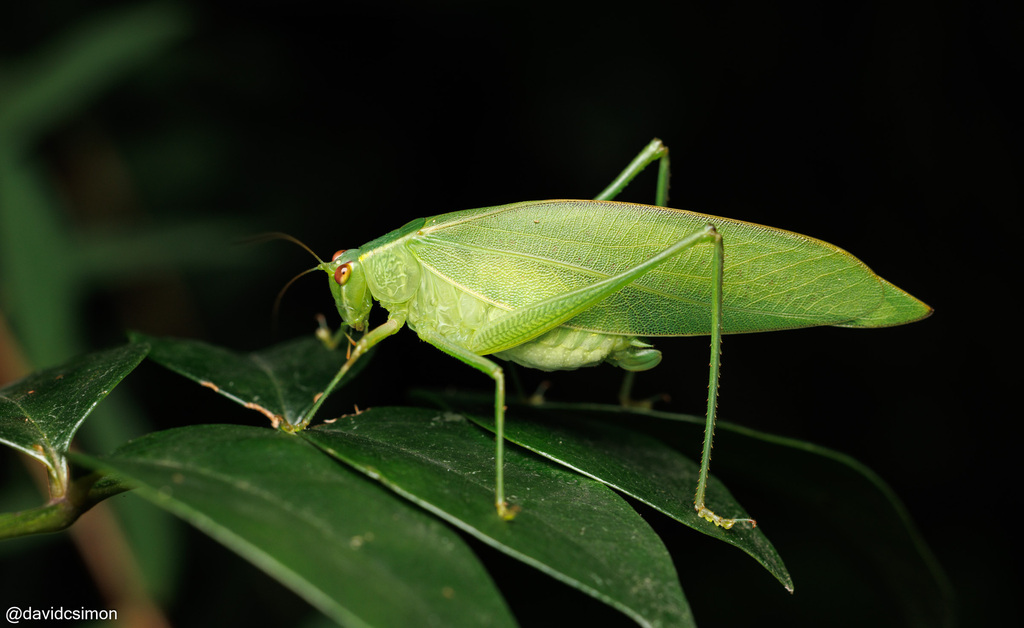
Australian Common Garden Katydid
Caedicia simplex
Caedicia simplex is a species of bush cricket or katydid, native to New Zealand and Australia. A common name is the "common garden katydid".
From the article Caedicia simplex on Wikipedia (CC BY-SA), quoted section by section
Description
Species found in the family Tettigoniidae are differentiated from other ensifera by the presence of forewings that can be held away from the body modified to help with both leaf mimicry and acoustics, as well as the female ovipositor. Generally speaking, katydids have extremely long antennae in proportion to their body size, as well as a body that is cylindrical or laterally compressed with 3 sets of long, spindly legs that are used for long-distance jumping. Among all katydids, Caedicia simplex is considered an unremarkable species in appearance. The common garden katydid strongly resembles a small leaf in appearance with a grass-like, green coloration, measuring at about 4–6 cm as an adult. In the nymph stage, however, C. simplex are sometimes a vibrant red-pink color, lacking the leaf-like appearance of their adult counterparts. Caedicia simplex has a distinctly small, oval head with a velvety green appearance and bright, orange-red eyes. The velvety pronotum on common garden katydids are distinctly keeled, marked with a yellow stripe, having an anterior notched margin and a rounded posterior.
Range & habitat
Caedicia simplex is a native insect to New Zealand and Australia. Their habitat is limited to that of New Zealand and Australia. While they are not Caedicia simplex it is worth noting that other species of katydid in the shared family of Tettigoniidae are present on all other continents excluding Antarctica.
Wikipedia: “Natural global range”
What it does
The life cycle of a katydid takes place over the course of about one year. The mating period for these insects is usually in the rainy season in this part of the world. Katydids engage in polygamous relationships, meaning they have more than one mate in their lifetime. Males begin the mating process by rubbing their wings together making the signature ‘katydid’ noise to attract a female mate. The louder this noise is the more a female will be able to ascertain the fitness of the male, which then decides who she mates with. A female will always choose a male with a larger spermatophore. During their encounter, the male deposits the spermatozoa into the female. Then the female uses her ovipositor to lay her eggs in the ground or stem of a nearby plant. From the egg, a nymph or juvenile katydid is born. Nymphs lacking the size, wings, and full green color of their adult counterparts must undergo numerous molts in order to reach maturity. Approximately two to three months after birth nymphs will enter their final molt, which results in the growth of wings and a realization of their full size. Full adulthood does not occur until late in the one year life of the katydid so their mating period is what becomes essential as soon as the final molt has finished. …
Wikipedia: “Life cycle/phenology”
Listen
Looking for field recordings…
Where it lives
Recorded sightings
—
geo-referenced records in GBIF, from museums, herbaria and field observers.
Drag the globe to turn it. Dots are where records exist, not a range map; darker means more records.
In the stacks
Searching the stacks…
Every page naming Caedicia simplex in the Biodiversity Heritage Library →
This page is assembled live from iNaturalist, GBIF, Wikipedia, the Source Library and the Internet Archive. It is not yet part of the hand-edited codex. iNaturalist taxon 210942.