- Plants
- ›Vascular Plants
- ›flowering plants
- ›Dicots
- ›pinks, cactuses, and allies
- ›pink family
- ›Chickweed Tribe
- ›Stellaria
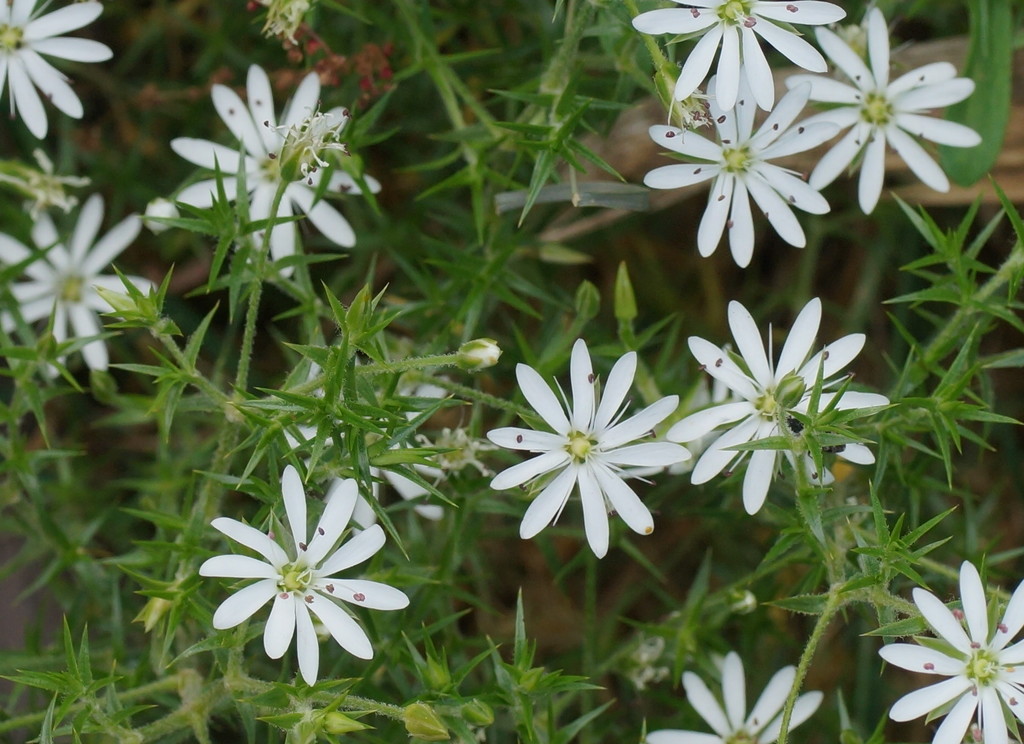
prickly starwort
Stellaria pungens
Stellaria pungens, commonly known as prickly starwort, is a flowering plant in the family Caryophyllaceae and is endemic to eastern Australia. It is a small, mat forming perennial with white star-shaped flowers and small sharply pointed, bright green leaves.
From the article Stellaria pungens on Wikipedia (CC BY-SA), quoted section by section
Description
Stellaria pungens is a sprawling or prostrate, mat forming perennial forb with angular stems that may be smooth or with occasional hairs. The leaves are arranged opposite, bright green, 5–10 mm (0.20–0.39 in) long, about 2 mm (0.079 in) wide at the base, sessile, narrowly egg-shaped, somewhat stiff, slightly curved upward, hairy edges and ending in a sharp point. The star-shaped flowers have five deeply divided petals giving the appearance of ten petals, each petal to 9 mm (0.35 in) long and ten prominent dark anthers. The flowers are borne singly at the end of the stems or in the upper leaf axils on a pedicel 5–30 mm (0.20–1.18 in) long. The sepals are more less as long as the petals, pointed, edges dry, thin and flexible. The fruit is a dry, egg-shaped capsule up to 8 mm (0.31 in) long. Flowering occurs from October to December.
Range & habitat
Prickly starwort is a moderately common species growing in steep, rocky or shaded sites in woodland in New South Wales, Victoria, Tasmania and South Australia.
== References ==
Wikipedia: “Distribution and habitat”
Where it lives
Recorded sightings
—
geo-referenced records in GBIF, from museums, herbaria and field observers.
Drag the globe to turn it. Dots are where records exist, not a range map; darker means more records.
In the stacks
Searching the stacks…
Every page naming Stellaria pungens in the Biodiversity Heritage Library →
This page is assembled live from iNaturalist, GBIF, Wikipedia, the Source Library and the Internet Archive. It is not yet part of the hand-edited codex. iNaturalist taxon 210160.