- Plants
- ›Vascular Plants
- ›flowering plants
- ›monocots
- ›Agaves, Orchids, Irises, and Allies
- ›agave and allies
- ›Century plant subfamily
- ›Agave
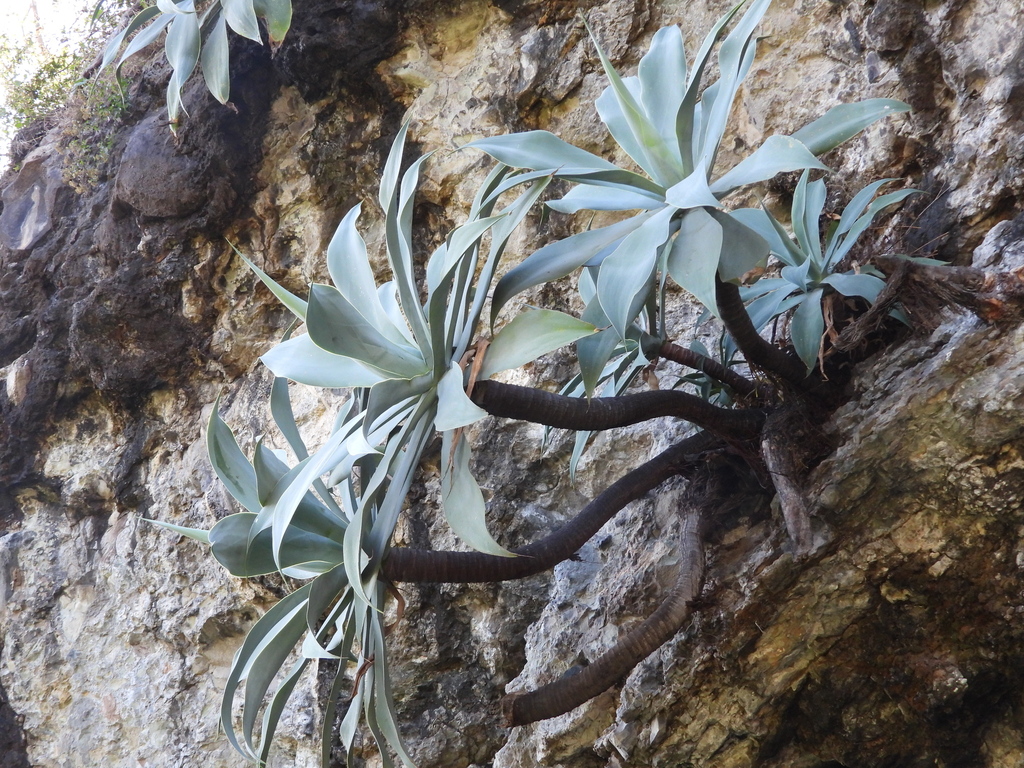
Swan-neck Agave
Agave attenuata
Agave attenuata, commonly called the foxtail or lion's tail agave or the swan's neck agave, is a species of flowering plant in the family Asparagaceae (the asparaguses, agaves and yuccas). Sometimes called the soft-leaf or soft-leaved agave, the aforementioned animal-related names are a nod to the appearance of the plant's inflorescence, which—after years, generally—rises slightly before gravity brings it back down, giving the bloom a curved, "swan"-like or "foxtail" look. The species' specific manner of flowering is unique in the genus Agave as most other species produce a towering, vertical display, reminiscent of a miniature tree.
In addition to its inflorescence, when compared with other Agave species, A. attenuata is further unique with its soft, spineless leaves and the fact that it does not rapidly asexually produce dozens of "runners" or "pups" from the rhizome of the mother plant. These factors have helped A. attenuata earn a positive reputation amongst gardeners as easy-to-manage; the species has become extremely popular as an ornamental plant in appropriate climates and zones, especially the American Southwest, Latin America and the Mediterranean.
From the article Agave attenuata on Wikipedia (CC BY-SA), quoted section by section
Description
Although particularly young or smaller plants can appear acaulescent, stems often mature to between 50 and 150 cm (20 and 59 in) in length, with older, desiccated leaves falling off and leaving the woody stems visible. The leaves are ovate-acuminate, 50–70 cm (20–28 in) long and 12–16 cm (5–6 in) wide, pale in color, ranging from a light gray to a light yellowish-green. There are neither teeth, nor terminal spines, although the leaves taper to soft points that fray with age. The numerous, broad, succulent, tapering leaves are slightly less rigid than the leaves of most Agave species; they are a bright glaucous gray to light yellowish-green and stingless. The inflorescence is a dense raceme 2.5 to 3 meters (8.2 to 9.8 ft) high (usually curved), with greenish-yellow flowers, developing after many years. As with other Agave species, the species is monocarpic, meaning that, rather than sending flowers out from the side of its stem and continuing living (like the succulent genera Crassula or Sedum, for example), the entire rosette morphs into the giant inflorescence. After many months, this blossom subsequently dies following pollination and seed development, although numerous plantlets consequently sprout, both from the base of the plant and from the flower raceme. …
Range & habitat
Specimens were sent to Kew Gardens by the explorer Galeotti in 1834 from an unspecified location in central Mexico. A more recent study has reported it from Jalisco, on the west coast and east of Mexico State, in small colonies at elevations between 1,900 to 2,500 meters (6,200 to 8,200 ft), but there have been few sightings, suggesting this species is rare in the wild. IUCN reports the species from the states of Colima, Durango, Guerrero, Jalisco, Michoacán, Nayarit and Mexico State, at altitudes between 400 and 2,500 meters (1,300 and 8,200 ft) on volcanic rock cliffs within pine forests and transitional zones of tropical dry and temperate forests types in mountains. It is reportedly naturalized in Libya and Madeira and is widely spread through the Mediterranean and the rest of Macaronesia.
Wikipedia: “Range”
How it is grown
In cultivation, Agave attenuata is said to prefer relatively moist loamy soil, although it can cope with poor soil and dry conditions. It should be protected from direct sunlight in summer and from long periods of frost. It is hardy down to USDA Zone 9b.
Wikipedia: “Cultivation”
Where it lives
Recorded sightings
—
geo-referenced records in GBIF, from museums, herbaria and field observers.
Drag the globe to turn it. Dots are where records exist, not a range map; darker means more records.
In the stacks
Searching the stacks…
Every page naming Agave attenuata in the Biodiversity Heritage Library →
This page is assembled live from iNaturalist, GBIF, Wikipedia, the Source Library and the Internet Archive. It is not yet part of the hand-edited codex. iNaturalist taxon 209357.