- Plants
- ›Vascular Plants
- ›flowering plants
- ›monocots
- ›grasses, sedges, cattails, and allies
- ›grasses
- ›Panicums, Bluestems, Paspalums, and Allies
- ›bluestems, lemon grasses, silvergrasses, and allies
- ›bluestems, thatching grasses, and allies
- ›Andropogon
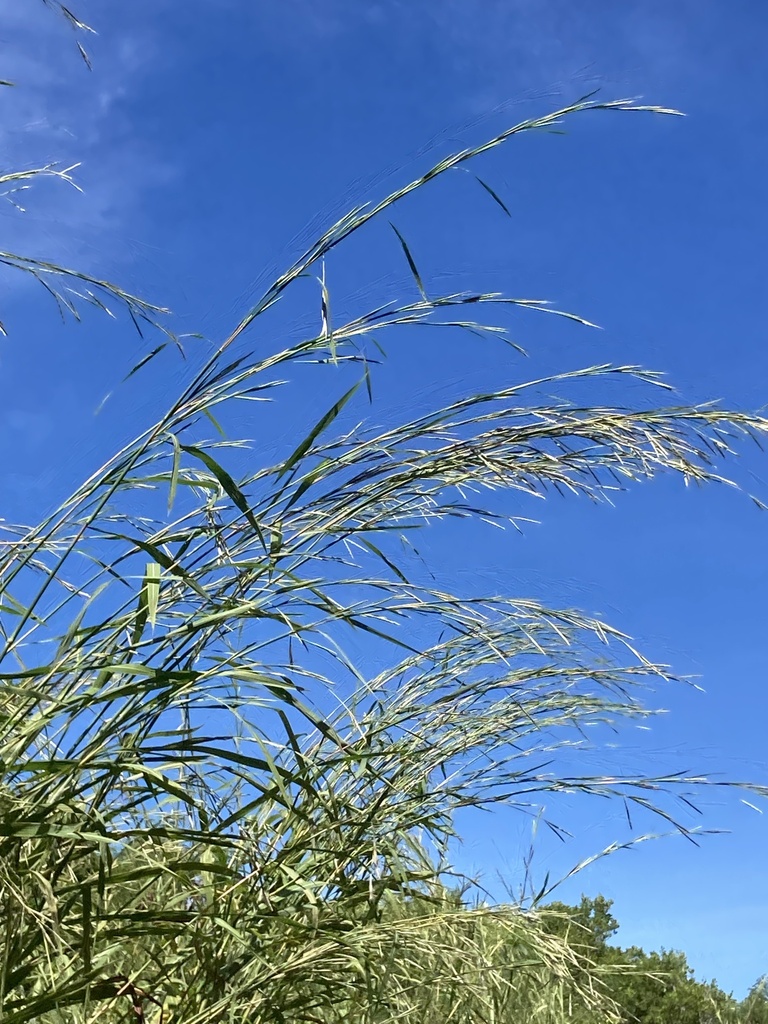
Gamba Grass
Andropogon gayanus
Andropogon gayanus, commonly known as gamba grass, Rhodesian blue grass, tambuki grass, and other names, is a species of grass native to most of the tropical and subtropical savannas of Africa.
From the article Andropogon gayanus on Wikipedia (CC BY-SA), quoted section by section
Description
This tufting perennial bunchgrass can grow 4 m (13 ft) tall and 70 cm (2.3 ft) in diameter, and has hairy leaves. Most of its roots are fibrous, spreading close to the surface of the soil for up to 1 m (3 ft 3 in), but it also has thick cord roots which store starch and anchor the plant as well as vertical roots able to extract water from a greater depth during the dry season. It produces large numbers of light, fluffy seeds (up to 244,000 seeds each year, with 65% viability), which can be spread by wind, animals or machinery. It spreads rapidly where vegetation is disturbed, but most seeds fall within 5 m (16 ft) of the parent plant.
Range & habitat
The grass is native to most of the tropical and subtropical savannas of Africa, also extending southwards into Mozambique, Botswana, Namibia and South Africa in regions with long dry seasons. It occurs naturally in xerophytic grasslands on doleritic, sandy or clay soils, at altitudes of up to 1,500 m (4,900 ft), and is very drought-tolerant. However it does not do well where mean minimum temperatures dip below 4.4 degrees Celsius, and it is not frost-tolerant. It has also been introduced around the world as a pasture crop in Australia and Brazil.
Wikipedia: “Habitat”
At the table
A. gayanus was introduced as a pasture crop in many parts of the world, including Australia, tropical countries of the Americas, as well as naturalising in Brazil It has also been introduced in Nigeria to reclaim land that has been overgrazed. Strips of the grass are also planted in millet fields help to reduce wind erosion of the soil. In some African countries, the stems are also used as thatch and for making pen.
Wikipedia: “Uses”
In human culture
Andropogon gayanus was scientifically named by 1833 from the Greek words andro (man) and pogon (beard) describing the tiny flower spikes. Its common names include gamba grass, bluestem (Africa, Australia); Rhodesian andropogon (southern Africa); Rhodesian blue grass (Zimbabwe); onga, tambuki grass (north-west Africa); and sadabahar (India).
Wikipedia: “History and naming”
Where it lives
Recorded sightings
—
geo-referenced records in GBIF, from museums, herbaria and field observers.
Drag the globe to turn it. Dots are where records exist, not a range map; darker means more records.
In the stacks
Searching the stacks…
Every page naming Andropogon gayanus in the Biodiversity Heritage Library →
This page is assembled live from iNaturalist, GBIF, Wikipedia, the Source Library and the Internet Archive. It is not yet part of the hand-edited codex. iNaturalist taxon 208518.