- Animals
- ›Arthropods
- ›Hexapods
- ›Insects
- ›Winged and Once-winged Insects
- ›True Bugs, Hoppers, Aphids, and allies
- ›True Hoppers
- ›Spittlebugs, Cicadas, Leafhoppers and Treehoppers
- ›Cicadas
- ›Typical Cicadas
- ›Cicadinae
- ›Thophini
- ›Thopha
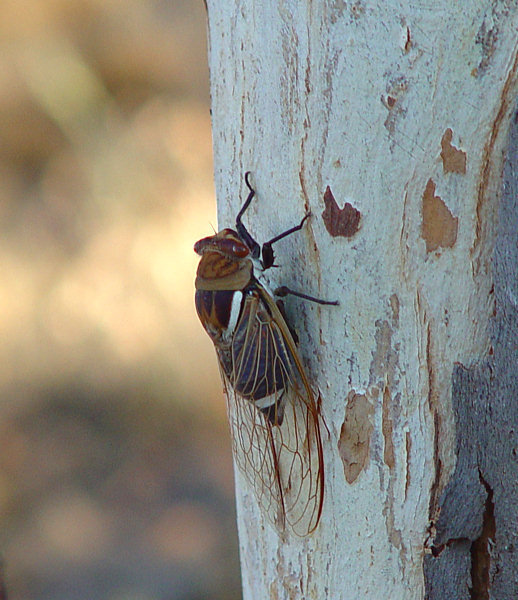
Northern Double Drummer
Thopha sessiliba
Thopha sessiliba, commonly known as the northern double drummer, is an Australian cicada native to Queensland, the Northern Territory and northern Western Australia. Adults perch almost exclusively on ghost gums.
William Lucas Distant described the northern double drummer in 1892, but incorrectly gave the type locality as Sydney.
From the article Thopha sessiliba on Wikipedia (CC BY-SA), quoted section by section
Description
The northern double drummer is a large species of cicada, the second largest in Australia, just smaller than the largest species, the double drummer. The male and female average 4.56 cm long. The thorax is 1.85 cm in diameter. The eyes are light brown tinged with purple, and the postclypeus dark red-brown. The head is variable in colour, but never black like the double drummer. The thorax is brown with lighter golden-brown markings. The mesonotum is brown tinged with purple. The underside of the thorax is red-brown and covered in fine silvery velvety hairs. The abdomen is dark brown, with the first and second segments above and underside covered with grey hairs, and also a whitish pregenital band of hair. The wings are vitreous (transparent) with light brown veins. The legs are brown and have fine grey velvety hairs. Adult cicadas emerge from September and can be seen until the end of April, though are most abundant in December and January.
Range & habitat
The northern double drummer is found from Gladstone in southeast Queensland north to Cape York and Mount Isa, and across eastern and northern Northern Territory and into northern Western Australia, across the Kimberley and Broome to Mundiwindi. It is found on eucalyptus trees, particularly smooth-barked species such as the ghost gum (Corymbia aparrerinja) in Central Australia.
Wikipedia: “Distribution”
Listen
Looking for field recordings…
Where it lives
Recorded sightings
—
geo-referenced records in GBIF, from museums, herbaria and field observers.
Drag the globe to turn it. Dots are where records exist, not a range map; darker means more records.
In the stacks
Searching the stacks…
Every page naming Thopha sessiliba in the Biodiversity Heritage Library →
This page is assembled live from iNaturalist, GBIF, Wikipedia, the Source Library and the Internet Archive. It is not yet part of the hand-edited codex. iNaturalist taxon 208180.