- Animals
- ›Arthropods
- ›Hexapods
- ›Insects
- ›Winged and Once-winged Insects
- ›True Bugs, Hoppers, Aphids, and allies
- ›True Hoppers
- ›Spittlebugs, Cicadas, Leafhoppers and Treehoppers
- ›Cicadas
- ›Typical Cicadas
- ›Cicadinae
- ›Thophini
- ›Thopha
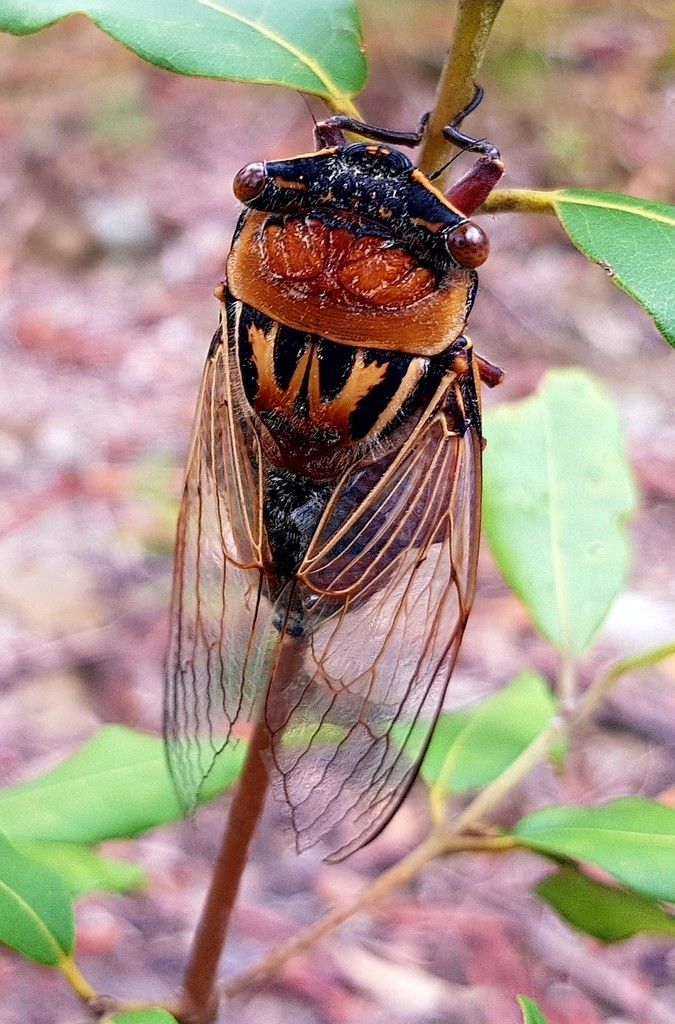
Eastern Double Drummer
Thopha saccata
Thopha saccata, the double drummer, is the largest Australian species of cicada and reputedly the loudest insect in the world. Documented by the Danish zoologist Johan Christian Fabricius in 1803, it was the first described and named cicada native to Australia. Its common name comes from the large dark red-brown sac-like pockets that the adult male has on each side of its abdomen—the "double drums"—that are used to amplify the sound it produces.
Broad-headed compared with other cicadas, the double drummer is mostly brown with a black pattern across the back of its thorax, and has red-brown and black underparts. The sexes are similar in appearance, though the female lacks the male's tymbals and sac-like covers. Found in sclerophyll forest in Queensland and New South Wales, adult double drummers generally perch high in the branches of large eucalypts. They emerge from the ground where they have spent several years as nymphs from November until March, and live for another four to five weeks. They appear in great numbers in some years, yet are absent in others.
From the article Thopha saccata on Wikipedia (CC BY-SA), quoted section by section
Description
The adult double drummer is the largest Australian species of cicada, the male and female averaging 4.75 and 5.12 cm (1.87 and 2.02 in) long respectively. The thorax is 2 cm (0.79 in) in diameter, its sides distended when compared with the thorax of other Australian cicadas. The forewings are 5–6.6 cm (2.0–2.6 in) long. The largest collected specimen has a wingspan of 15.1 cm (5.9 in), while the average is 13.3 cm (5.2 in). The average mass is 4.0 g (0.14 oz). The sexes have similar markings, but males have large dark red-brown sac-like structures on each side of their abdomens. These cover the tymbals—specialised structures composed of vertical ribs and a tymbal plate, which is buckled to produce the cicada's song. The head is much broader than that of other cicadas, and is broader than the pronotum behind it. The head, antennae and postclypeus are black, with a narrow broken pale brown transverse band across the vertex just behind the ocelli. The eyes are black in young adult cicadas upon emerging, but turn brown with black pseudopupils at the posterior edge of the eye. The ocelli are deep red. The proboscis is 1.26 cm (0.50 in) in length—very long compared with other Australian cicada species. The thorax is brown, becoming paler in older individuals. …
Range & habitat
The double drummer has a disjunct distribution, found from northern tropical Queensland, near Shiptons Flat and Cooktown south to Ingham and Sarina, and then from Gympie in southeastern Queensland to Moruya in southern New South Wales. It is found in areas of higher elevation in the northern segment of its range, as the climate there is similar to that in southeast Queensland. Walter Wilson Froggatt and Robert John Tillyard erroneously included South Australia in its distribution.
Adults are present from November to early March, prolific in some years and absent in others. They are found in dry sclerophyll forest, preferring to alight and feed on large eucalypts with diameters over 20 cm (7.9 in) and sparse foliage concentrated at a height between 10 and 25 m (33 and 82 ft), particularly rough-barked species, apples (Angophora) and Tristania. Associated trees include the grey box (Eucalyptus moluccana), snappy gum (E. racemosa) and narrow-leaved apple (Angophora bakeri) in a study at three sites in western Sydney. At Hawks Nest in coastal swampy sclerophyll woodland, adults were observed mainly on swamp mahogany (Eucalyptus robusta) and sometimes blackbutt (E. pilularis), as well as Allocasuarina littoralis and introduced pine (Pinus radiata). …
Wikipedia: “Distribution and habitat”
What it does
The narrow spindle-shaped eggs are laid in a series of slits cut by the mother's ovipositor in branches or twigs, usually of eucalypts. On average about twelve eggs are laid in each slit, for a total of several hundred. These cuts can cause significant damage to the bark of tender trees. The eggs all hatch around 70 days later—usually within a day or two of one another—but take longer in cold or dry conditions. The larvae then fall to the ground and burrow into the soil. Though the timing of the double drummer's life cycle is unknown, nymphs of cicadas in general then spend from four to six years underground. Unusual for Australian cicadas, double drummers emerge during the daytime. Emerging en masse generally, nymphs are covered in mud. This mud remains on their exuviae, which emerging cicadas leave at the bases or in burnt out hollows of eucalypts. Within a forest, successive broods may emerge in different locations each year. The cicada's body and wings desiccate and harden once free of the exuvia. The adult lifespan of the double drummer is about four or five weeks. During this time, they mate and reproduce, and feed exclusively on sap of living trees, sucking it out through specialised mouthparts. Female cicadas die after laying their eggs.
Wikipedia: “Life cycle”
Listen
Looking for field recordings…
Where it lives
Recorded sightings
—
geo-referenced records in GBIF, from museums, herbaria and field observers.
Drag the globe to turn it. Dots are where records exist, not a range map; darker means more records.
In the stacks
Searching the stacks…
Every page naming Thopha saccata in the Biodiversity Heritage Library →
This page is assembled live from iNaturalist, GBIF, Wikipedia, the Source Library and the Internet Archive. It is not yet part of the hand-edited codex. iNaturalist taxon 208179.