- Plants
- ›Vascular Plants
- ›flowering plants
- ›Dicots
- ›Nances, Willows, and Allies
- ›Leaf-flower Family
- ›Phyllanthoideae
- ›Phyllantheae
- ›Phyllanthus
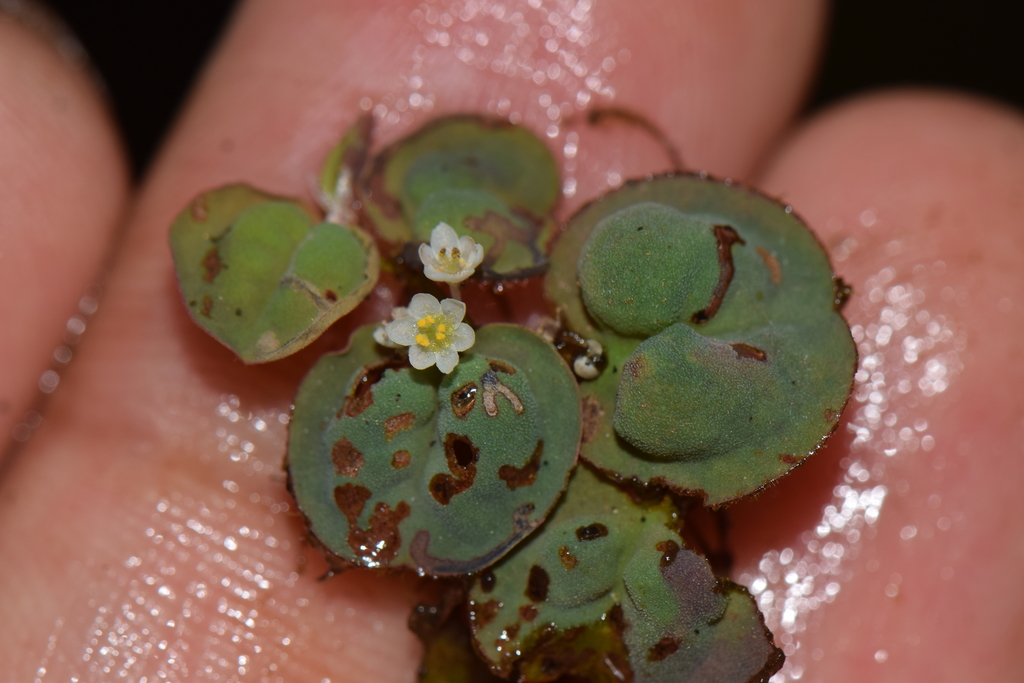
red root floater
Phyllanthus fluitans
Phyllanthus fluitans, also known as the red root floater, floating spurge, or apple duckweed (although it is neither a spurge or a duckweed), is a species of free floating aquatic plant and herbaceous perennial in the family Phyllanthaceae. This species is one of the only three non-terrestrial species in the genus Phyllanthus, with the other species being P. leonardianus and P. felicis. The generic name comes from Ancient Greek meaning leaf or a leaf (φύλλον, phúllon; phyll) flower (ἄνθος, anthos; anthus), and the specific name comes from Latin meaning floating or float (fluito; fluitans). It was described in March 1863 by George Bentham and Johannes Müller Argoviensis.
From the article Phyllanthus fluitans on Wikipedia (CC BY-SA), quoted section by section
Description
The stems are 3 to 5 cm long, with many rootlets emerging from the nodes. The leaves are sessile and are cordate-orbicular (heart shaped), the leaf surface forms a pocket on each side of the midrib that traps air and helps plants float on the water. Plants produce 2–4 small white polymerous actinomorphic unisexual flowers on a cyme inflorescence and are nearly 1.5 mm long. Seed capsules are depressed-globular in shape and nearly 3 mm wide with six triangular seeds per capsule, 1.7 mm long by 1.1 mm wide. Below the epidermis there are large cells bulging outwards, with one or two layers of green cells, sometimes slightly elongated perpendicular to the surface constituting something that resembles or is a palisade parenchyma. There are large gaps separated by walls formed from a single thickness of cells that often go from the chlorenchyma to the lower epidermis. Sometimes this epidermis is also covered by a layer of cells elongated tangentially. We can imagine that with a similar morphology and an anatomy which allows the storage of air the plant is able to float and remain horizontal in an aquatic environment. The lower epidermis is devoid of stomata with a few on the upper epidermis. The leaves vary from green to red depending on the light brightness. The leaves are also hydrophobic, probably due to the Salvinia effect.
Range & habitat
It is native to the Amazon basin with its range being in Peru, Ecuador, Colombia, Brazil, Bolivia, Venezuela, Paraguay, and northern Argentina with the type location being in the Rio Negro tributary. It has been seen outside its native range in southern Florida and Mexico (Tabasco) being naturalised where it has invaded. This species’ distribution can also potentially reach Puerto Rico, Hawaii, Louisiana, the southern parts of south east states of the US like Texas, Alabama, Georgia, and Mississippi where it has the potential to be a problematic invasive species like water fern, water lettuce and water hyacinth by covering large swaths of stagnant backwater areas. This noxious species may limit or totally block all ambient light penetration to the bottom of the system, which can stunt and potentially kill submersed plants growing below. It has also been recorded in Panama.
Wikipedia: “Distribution and habitat”
Where it lives
Recorded sightings
—
geo-referenced records in GBIF, from museums, herbaria and field observers.
Drag the globe to turn it. Dots are where records exist, not a range map; darker means more records.
In the stacks
Searching the stacks…
Every page naming Phyllanthus fluitans in the Biodiversity Heritage Library →
This page is assembled live from iNaturalist, GBIF, Wikipedia, the Source Library and the Internet Archive. It is not yet part of the hand-edited codex. iNaturalist taxon 207419.