- Plants
- ›Vascular Plants
- ›flowering plants
- ›Dicots
- ›pinks, cactuses, and allies
- ›cacti
- ›globular cacti, moonlight cacti, torch cacti, and allies
- ›Globular Cactuses
- ›Geohintonia
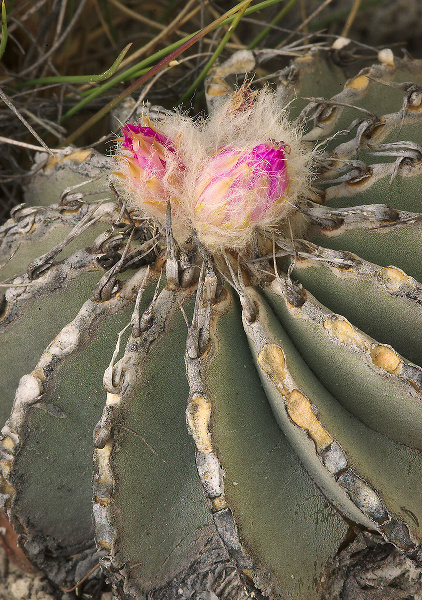
Geohintonia mexicana
Geohintonia mexicana (discovered in 1992) is a species of cacti, the only species in the genus Geohintonia. This genus is named after its discoverer George S. Hinton. As its specific epithet suggests, the plant is found in Mexico (Nuevo León), where it grows on gypsum hills near Galeana.
From the article Geohintonia on Wikipedia (CC BY-SA), quoted section by section
Description
It is a solitary, globose plant, slowly becoming columnar, up to 11 cm tall and 10 cm in diameter. grayish bluish green has between 18 and 20 very prominent ribs. The ribs have large wooly areoles with 3 curved spines about 3 to 15 mm long, yellowish in color. The hot pink, funnel-shaped flowers emerge at the apex and open after dark. The flowers are 2 to 4 cm in diameter and appear at the apex. They are open during the day and are pink to magenta in color. Fruits are ovoid 9 x 4-5 mm
Range & habitat
The plants grow exclusively in Mexico in the state of Nuevo León on gypsum hills at 1200 to 1350 meters. Aztekium hintonii and Selaginella gypsophila can also be found at the site. It is thought that the species may have arisen from a natural hybrid with Aztekium hintonii as one parent.
Wikipedia: “Distribution”
Where it lives
Recorded sightings
—
geo-referenced records in GBIF, from museums, herbaria and field observers.
Drag the globe to turn it. Dots are where records exist, not a range map; darker means more records.
In the stacks
Searching the stacks…
Every page naming Geohintonia mexicana in the Biodiversity Heritage Library →
This page is assembled live from iNaturalist, GBIF, Wikipedia, the Source Library and the Internet Archive. It is not yet part of the hand-edited codex. iNaturalist taxon 207207.