- Animals
- ›Arthropods
- ›Hexapods
- ›Insects
- ›Winged and Once-winged Insects
- ›Beetles
- ›Water, Rove, Scarab, Long-horned, Leaf, and Snout Beetles
- ›Cucujiform Beetles
- ›Lady, Fungus, Scavenger, and Bark Beetles
- ›Lady Beetles
- ›Common Lady Beetles
- ›Black-spotted Lady Beetles
- ›Coccinella
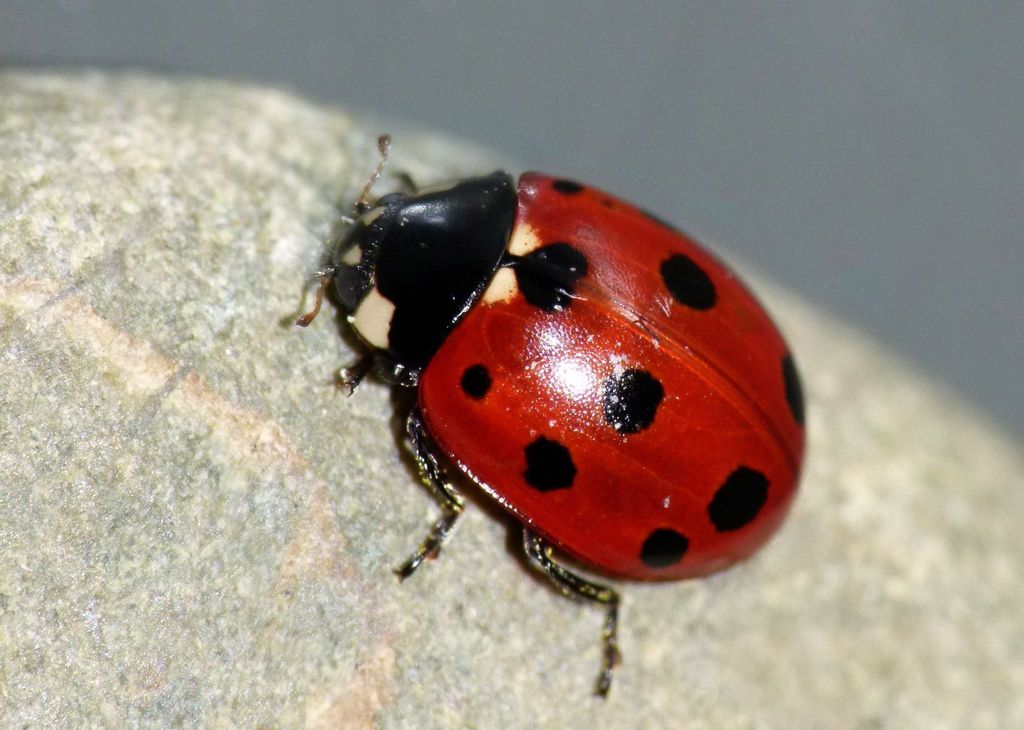
Eleven-spotted Ladybird Beetle
Coccinella undecimpunctata
Coccinella undecimpunctata, the eleven-spot ladybird or eleven-spotted lady beetle, is a ladybird species endemic to the Palearctic - Europe, North Africa, European Russia, the Caucasus, Siberia, the Russian Far East, Ukraine, Moldova, Kazakhstan, Middle Asia, Western Asia, Afghanistan, Mongolia, China, Pakistan, North India. Coccinella undecimpunctata has been introduced to Australia and New Zealand as a biological control agent. In Central Europe C. undecimpunctata feeds on aphids associated with grasses - in fields, in ruderal biotopes, on
From the article Coccinella undecimpunctata on Wikipedia (CC BY-SA), quoted section by section
Description
C. undecimpunctata is a lady beetle with eleven black spots found on its red/orange elytra. Its size can range from around 4.0 to 5.0mm. It may look as if this beetle has six spots on each elytron, but the black spot in the center of the elytra, just behind the pronotum, counts as just one.
Range & habitat
Endemic to the Palearctic - Europe, North Africa, European Russia, the Caucasus, Siberia, the Russian Far East, Ukraine, Moldova, Kazakhstan, Middle Asia, Western Asia, Afghanistan, Mongolia, China, Pakistan, and North India. C. undecimpunctata has been introduced to Australia as a biological control agent. It has been said that C. undecimpunctata was introduced to New Zealand as a form of pest control as well, but this has proven to be false.
Wikipedia: “Distribution”
What it does
C. undecimpunctata feeds on aphids associated with grasses - in fields, in ruderal biotopes, on steppe (including Pannonian steppe), stone quarries, wastelands, dry forest edges in meadows and coastal meadow, in open habitats with grasses, and near rivers. Frequently in biotopes with Ammophila arenaria it also occurs on alluvial soils, detritus, on dead grass and in biotopes with Salix purpurea. It is salt-resistant and can feed on aphids inhabiting Atriplex tatarica and other grasses associated with saline areas.
Wikipedia: “Habitat and diet”
Listen
Looking for field recordings…
Where it lives
Recorded sightings
—
geo-referenced records in GBIF, from museums, herbaria and field observers.
Drag the globe to turn it. Dots are where records exist, not a range map; darker means more records.
In the stacks
Searching the stacks…
Every page naming Coccinella undecimpunctata in the Biodiversity Heritage Library →
This page is assembled live from iNaturalist, GBIF, Wikipedia, the Source Library and the Internet Archive. It is not yet part of the hand-edited codex. iNaturalist taxon 205977.