On eBird ↗
Yellow-legged Tinamou
Live sightings near you, the range map, bar charts of when it is seen, and Macaulay Library photos and recordings.
Yellow-legged Tinamou
Crypturellus noctivagus
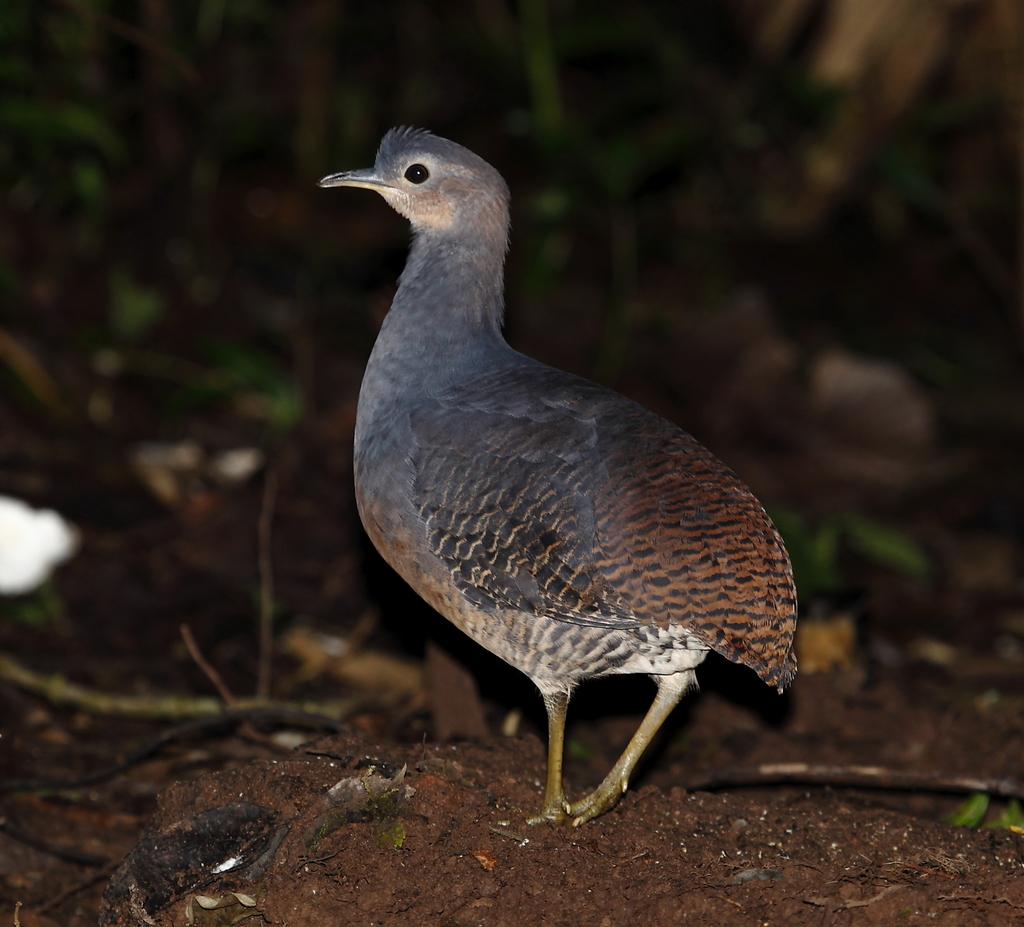
The yellow-legged tinamou (Crypturellus noctivagus) is a species of tinamou found in wooded and shrubby habitats in tropical and subtropical eastern Brazil. This superficially quail-like bird has a grey-brown plumage and two easily separated subspecies. It has declined due to human activities, and is therefore listed as Near Threatened by the IUCN.
From the article Yellow-legged tinamou on Wikipedia (CC BY-SA), quoted section by section
Description
The yellow-legged tinamou is approximately 28 to 31 cm (11.0–12.2 in) in length. Its upperparts are grey, its lower back and wings are barred black, its neck and upper breast are greyish, its lower breast is rufous and its belly is whitish. It has a blackish cap and a buffy supercilium. The supercilium is broadest and most prominent in the race zabele, which also is paler overall, has a whiter (less rufescent) throat and brighter yellow legs than the nominate race.
Range & habitat
This species has two subspecies:
C. n. noctivagus, the nominate race, occurs in southeastern Brazil: Minas Gerais (Doce River area), southern Bahia, Espírito Santo, Rio de Janeiro, São Paulo, Paraná, Santa Catarina, and Rio Grande do Sul. C. n. zabele occurs in northeastern Brazil: Northern Minas Gerais and Bahia to Paraíba and Piauí.
Wikipedia: “Subspecies and range”
What it does
Like other tinamous, the yellow-legged tinamou eats fruit off the ground or low-lying bushes. They also eat small amounts of invertebrates, flower buds, tender leaves, seeds, and roots. The male incubates the eggs which may come from as many as 4 different females, and then will raise them until they are ready to be on their own, usually 2–3 weeks. The nest is located on the ground in dense brush or between raised root buttresses.
Wikipedia: “Behavior”
Listen
Looking for field recordings…
Where it lives
Recorded sightings
—
geo-referenced records in GBIF, from museums, herbaria and field observers.
Drag the globe to turn it. Dots are where records exist, not a range map; darker means more records.
In the stacks
Searching the stacks…
Every page naming Crypturellus noctivagus in the Biodiversity Heritage Library →
This page is assembled live from iNaturalist, GBIF, Wikipedia, the Source Library and the Internet Archive. It is not yet part of the hand-edited codex. iNaturalist taxon 20574.