On eBird ↗
Little Tinamou
Live sightings near you, the range map, bar charts of when it is seen, and Macaulay Library photos and recordings.
Little Tinamou
Crypturellus soui
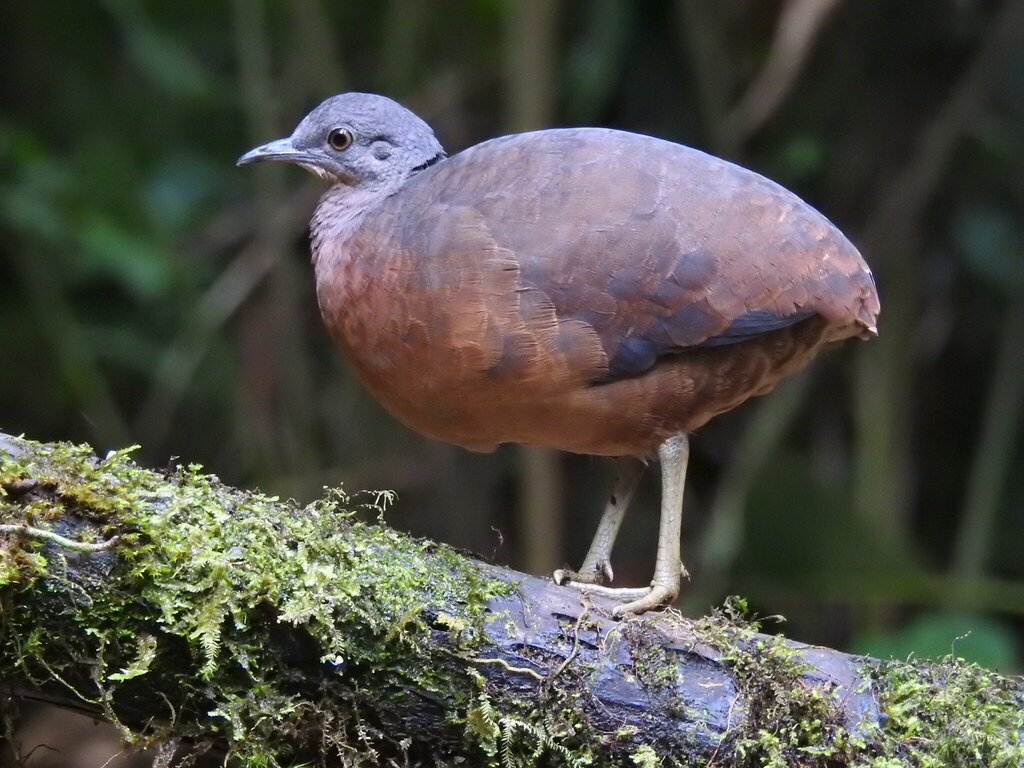
The little tinamou (Crypturellus soui) is a species of tinamou. It is found in Central and South America, as well as on the Caribbean island of Trinidad.
From the article Little tinamou on Wikipedia (CC BY-SA), quoted section by section
Description
The little tinamou is approximately 21.4 to 24 cm (8.4–9.4 in) in overall length. Males weigh around 207 g (7.3 oz), females 174–238 g (6.1–8.4 oz). Females are slightly larger and heavier than males. It has an unbarred sooty-brown plumage which transitions to grey on the head. The foreneck is whitish. While the underside of both male and female is cinnamon buff, the female is a lighter shade. The legs can be grey, olive, or yellow. Both male and female are almost tailess. The female is usually more brightly colored, the male tends to be darker and less rufescent.
Range & habitat
It is a resident breeder in tropical lowland forests, rivers-edge forests, lowland evergreen forest, secondary forest, and lowland shrublands up to an altitude of 2,000 m (6,600 ft). They are also fairly successful utilizing cleared forests and plantations or farmed land.
Wikipedia: “Distribution and habitat”
What it does
Little tinamou are shy, secretive, and pair-solitary animals. Despite their abundance, they are rarely sighted. In the field, they are detected by sound more often than sight. The whistle call is a soft, descending whinny (also a series of single notes, tempo increasing at end) produced by both sexes. They eat seeds, berries, and some insects. They can fly but will run unless flight is necessary. They are highly territorial and will attack when encroached upon if the intruding bird is not their mate.
Breeding. The breeding season of the little tinamou ranges from May to October. The eggs are laid in a small depression in the forest floor, sometimes lined with a few leaves at the base of a tree or in dense brush. The female performs a courtship behavior and the eggs are incubated by the male. Male nest attendance is strong, up to 14 days without leaving the nest in one study. The clutch is typically two glossy dark-purple eggs (up to three have been observed). The eggs are about 43.1 mm × 32.4 mm (1.70 in × 1.28 in) in size and are oval in shape, without the usual pointed and blunt ends. They are glossy and purple drab in color. The young are cared for only by the male. They are precocial, and begin pecking the ground on the first day. They can run almost as soon as they hatch. By weeks 3–4 they are capable of full flight. Egg laying begins at one year old.
Wikipedia: “Behavior”
Listen
Looking for field recordings…
Where it lives
Recorded sightings
—
geo-referenced records in GBIF, from museums, herbaria and field observers.
Drag the globe to turn it. Dots are where records exist, not a range map; darker means more records.
In the stacks
Searching the stacks…
Every page naming Crypturellus soui in the Biodiversity Heritage Library →
This page is assembled live from iNaturalist, GBIF, Wikipedia, the Source Library and the Internet Archive. It is not yet part of the hand-edited codex. iNaturalist taxon 20535.