- Animals
- ›Arthropods
- ›Hexapods
- ›Insects
- ›Winged and Once-winged Insects
- ›Butterflies and Moths
- ›Owlet Moths and Allies
- ›Cutworm Moths and Allies
- ›Bagisarinae
- ›Amyna
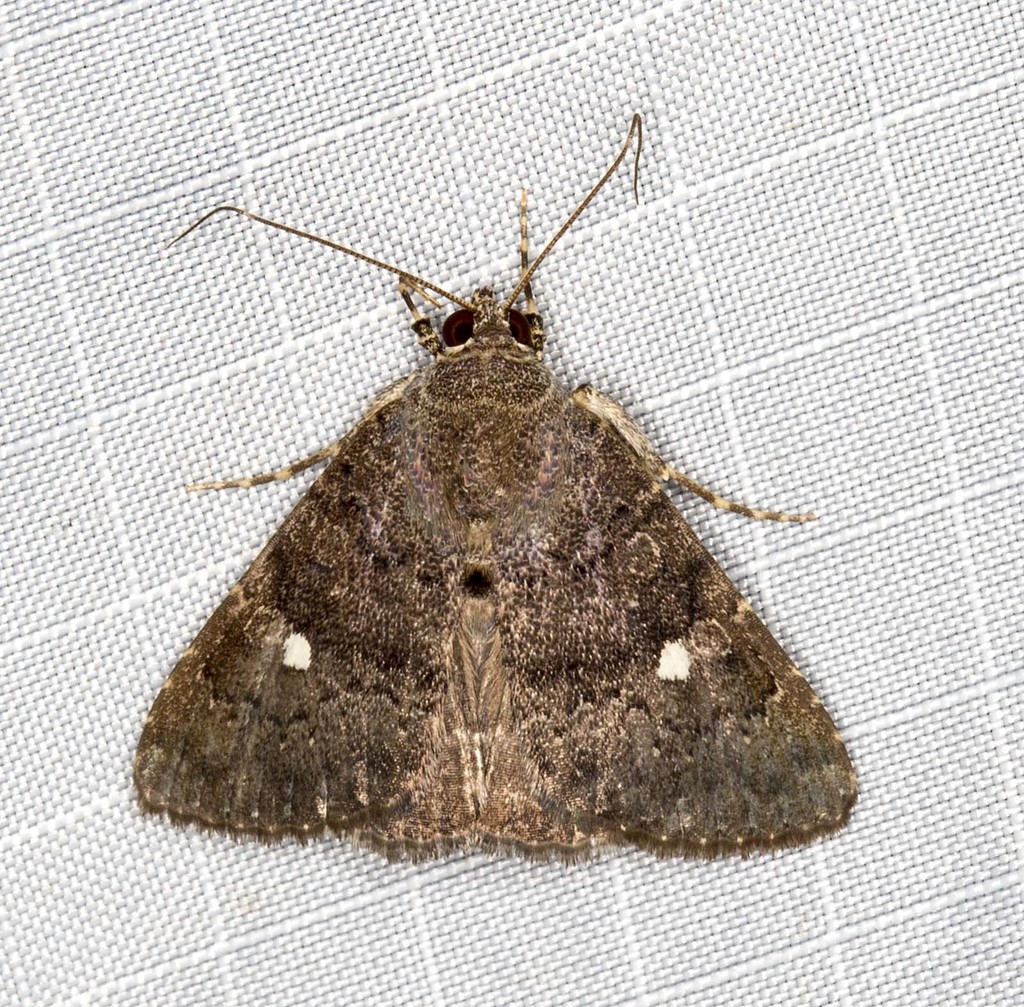
White Point
Amyna punctum
Amyna punctum is a moth of the family Noctuidae first described by Johan Christian Fabricius in 1794. This moth can be found throughout subtropical African countries such as South Africa, Madagascar and Australasian countries like India, Sri Lanka, the Philippines, Borneo and the Andaman Islands.
From the article Amyna punctum on Wikipedia (CC BY-SA), quoted section by section
Description
Its wingspan is about 30–36 mm. Forewings of the male with no vesicle in cell. Fuscous brown with an olive tinge in body. Legs ringed with ochreous. Forewings with irregularly waved black line on sub-basal, antemedial, postmedial and sub-marginal areas. Submarginal line indistinct. There is a marginal specks series can be seen. Orbicular and reniform very indistinct, where reniform with its lower part obscured by a prominent ochreous spot in the typical form. Hindwings with traces of a postmedial waved line. Ventral side suffused with white. There is a crenulate sub-marginal line of hindwings can be seen.
What it does
The larvae feed on Croton (Euphorbiaceae), Triticum vulgare, Gossypium species, and Tricitum aestivum.
Wikipedia: “Ecology”
Listen
Looking for field recordings…
Where it lives
Recorded sightings
—
geo-referenced records in GBIF, from museums, herbaria and field observers.
Drag the globe to turn it. Dots are where records exist, not a range map; darker means more records.
In the stacks
Searching the stacks…
Every page naming Amyna punctum in the Biodiversity Heritage Library →
This page is assembled live from iNaturalist, GBIF, Wikipedia, the Source Library and the Internet Archive. It is not yet part of the hand-edited codex. iNaturalist taxon 205312.