- Animals
- ›Arthropods
- ›Hexapods
- ›Insects
- ›Winged and Once-winged Insects
- ›True Bugs, Hoppers, Aphids, and allies
- ›True Hoppers
- ›Spittlebugs, Cicadas, Leafhoppers and Treehoppers
- ›Cicadas
- ›Typical Cicadas
- ›Cicadinae
- ›Cyclochilini
- ›Cyclochila
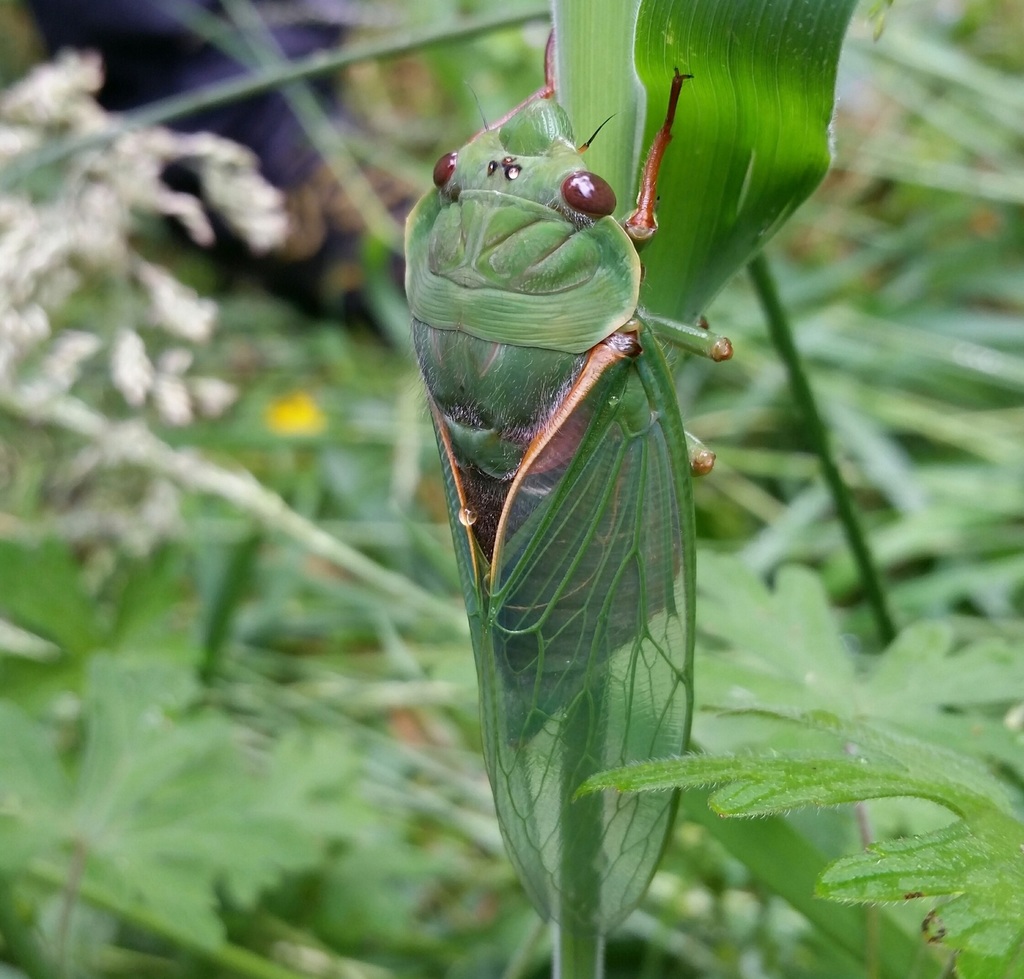
Green Grocer
Cyclochila australasiae
Cyclochila australasiae is a species of cicada and one of Australia's most familiar insects. It is distributed through coastal regions of southeastern Australia. Green specimens are commonly known as green grocers and yellow ones as yellow mondays.
It is one of the loudest insects in the world.
From the article Cyclochila australasiae on Wikipedia (CC BY-SA), quoted section by section
Description
Cyclochila australasiae measures about 4 cm (1.6 in) in length, with a wingspan of 11–13 cm (4.3–5.1 in). Diverse colour forms are seen, the most common being predominantly green or brownish yellow. It has red eyes. The exuvia, or discarded empty exoskeleton of the nymph form, is commonly seen on tree trunks in gardens and bushland during the summer months. The loud calls of the male are heard over the summer months; harsh and high-pitched, these may reach 120 decibels. The sound is made by the rapid buckling of the timbal ribs, and amplified by resonation in an air sac; the frequency is around 4.3 kHz. Calls occur in the afternoon and dusk of warm days.
Range & habitat
Cyclochila australasiae is found from Kroombit Tops in southeastern Queensland through eastern New South Wales and Victoria to the Grampians, and through to Mount Gambier in southeastern South Australia. It is common along the Great Dividing Range, and is also found in the Warrumbungles. It is commonly seen (and heard) around Sydney and Melbourne, the Blue Mountains and Gippsland. In Brisbane, it is only encountered at elevations above 300 m (1000 ft). It was associated with the white stringybark (Eucalyptus globoidea) in a study at three sites in western Sydney.
Wikipedia: “Distribution and habitat”
What it does
Their median total life cycle length is around six to seven years, this being from egg to a natural adult death. Most of this spent as a nymph. The cicada spends seven years in nymph form drinking sap from plant roots underground before emerging from the earth as an adult. The adults, who live for six weeks, fly around, mate, and breed over the summer.
Wikipedia: “Life cycle”
At the table
Live cicadas are often collected by climbing trees and can be kept temporarily as pets in shoeboxes. They cannot easily be kept for longer than a day or two, given that they need flowing sap for food.
== References ==
Wikipedia: “Human uses”
Listen
Looking for field recordings…
Where it lives
Recorded sightings
—
geo-referenced records in GBIF, from museums, herbaria and field observers.
Drag the globe to turn it. Dots are where records exist, not a range map; darker means more records.
In the stacks
Searching the stacks…
Every page naming Cyclochila australasiae in the Biodiversity Heritage Library →
This page is assembled live from iNaturalist, GBIF, Wikipedia, the Source Library and the Internet Archive. It is not yet part of the hand-edited codex. iNaturalist taxon 205176.