- Plants
- ›Vascular Plants
- ›flowering plants
- ›Dicots
- ›pinks, cactuses, and allies
- ›cacti
- ›globular cacti, moonlight cacti, torch cacti, and allies
- ›Trichocereeae
- ›Oreocereus
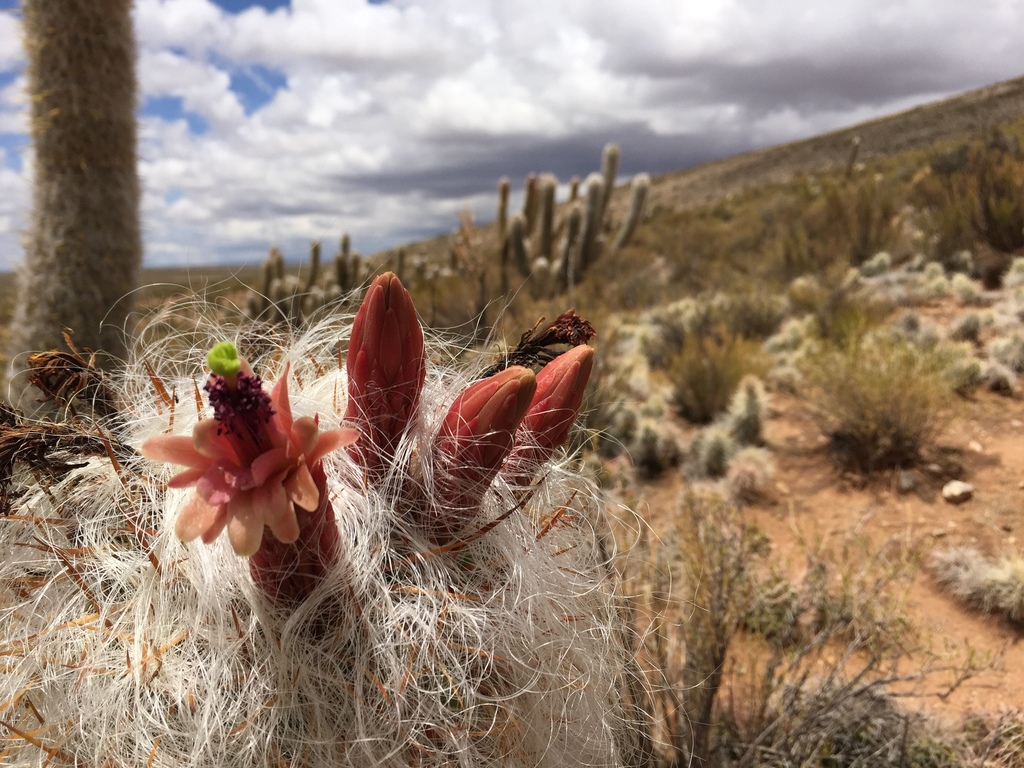
Old-man-of-the-Andes
Oreocereus celsianus
Oreocereus celsianus, or the "old man of the mountain" is a member of the family Cactaceae native to the high lands of the Andes in South America, and is named for its fluffy white hair, which may protect it from intense sunlight and extreme temperatures.
From the article Oreocereus celsianus on Wikipedia (CC BY-SA), quoted section by section
Description
Oreocereus celsianus grows with upright, columnar shoots that branch out from the base and reaches heights of up to around 3 metres (10 ft) tall with a diameter of 8 to 12 cm (3.1 to 4.7 in). O. celsianus is covered in a downy white hair and spines, with greatest density at the tips of stems receding to near-bare at the base. There are 10 to 25 vertical rounded and tuberous ribs, typically with eleven ribs (but Mauseth found as many as 29 ribs), has many long, brown spines. The large areoles on it are white, densely covered with spines and covered with hairs up to 5 cm (2.0 in) long. The strong, one to four central spines are up to 8 cm (3.1 in) long, the seven to nine radial spines are up to 2 cm (0.79 in) long. The plants bloom in spring with long, tubular, bright, slightly purplish-pink flowers, appear near the tips of the shoots. They are 7 to 9 cm (2.8 to 3.5 in) long and have a diameter of up to 3 cm (1.2 in). The fruits are spherical. These fruit are hollow and filled with an unspecified biogenerated gas.
Range & habitat
Oreocereus celsianus occurs in the Bolivian departments of Chuquisaca, Potosí, and Tarija, Peru, and the Argentine province of Jujuy in the puna vegetation at altitudes of 2,900 to 3,600 meters.
Wikipedia: “Distribution”
What it does
The plant is pollinated by hummingbirds, mostly by a single species—the southern giant hummingbird Patagona gigas. It is also capable of selfing.
Wikipedia: “Ecology”
How it is grown
The plant thrives at 10–12 °C (50–54 °F), with a frost-tolerance of down to −12.2 °C (10.0 °F) and requiring protection from hot sunlight. It prefers full sun and light watering. It propagates from seed or by stem cuttings.
Wikipedia: “Cultivation”
Where it lives
Recorded sightings
—
geo-referenced records in GBIF, from museums, herbaria and field observers.
Drag the globe to turn it. Dots are where records exist, not a range map; darker means more records.
In the stacks
Searching the stacks…
Every page naming Oreocereus celsianus in the Biodiversity Heritage Library →
This page is assembled live from iNaturalist, GBIF, Wikipedia, the Source Library and the Internet Archive. It is not yet part of the hand-edited codex. iNaturalist taxon 205050.