On eBird ↗
Cinnamon Quail-thrush
Live sightings near you, the range map, bar charts of when it is seen, and Macaulay Library photos and recordings.
Cinnamon Quailthrush
Cinclosoma cinnamomeum
The cinnamon quail-thrush (Cinclosoma cinnamomeum) is cryptic arid-zone species that is endemic to Australia. This small to medium-sized species of bird is found in the arid and semi-arid regions of central Australia.
From the article Cinnamon quail-thrush on Wikipedia (CC BY-SA), quoted section by section
Description
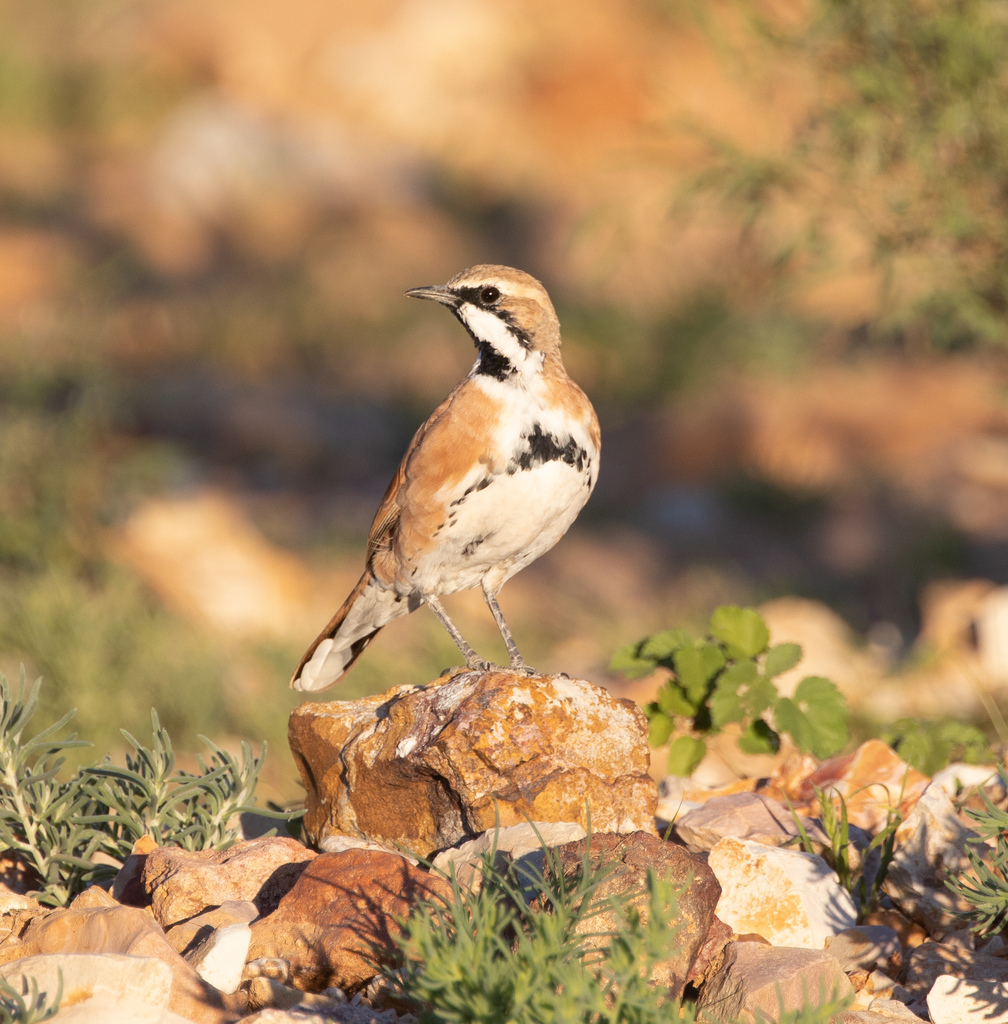
Cinnamon quail-thrush have a body length of 20 cm (7.9 in), and weigh up to 50 grams (1.8 oz) when fully grown. Male birds are characterised by a white eyebrow, black face, and a broad white streak down the sides of a black throat. The upper parts of their body are plain cinnamon-rufous with buff-white patches on the upper breast and a broad black band below. The outer tail feathers are black with white tips. The female has similar features but duller with a buff-white throat and eyebrow. Their upper breast is grey and they have no black on the underside. Juveniles have the same markings but males may have an indistinct breast band. They have high-pitched, slightly hissing calls (voices).
Range & habitat
The cinnamon quail-thrush is an Australian endemic that is typically found in arid and semi-arid regions of central Australia. These regions are defined by the presence of desert vegetation and land forms as well as by low rainfall, with less than 500 mm (20 in) per annum in most areas. Its distribution size is estimated to be 831,000 km2 (321,000 sq mi), spanning over southwest Queensland, northwest New South Wales, northeastern South Australia and the southeast of the Northern Territory. Within these areas the cinnamon quail-thrush has been found in grass and shrublands; however, it is more commonly found among dry stony areas, especially around dry creek lines.
Wikipedia: “Distribution and habitat”
What it does
These terrestrial birds are fairly weak fliers and prefer to squat or run when disturbed.
Wikipedia: “Behaviour”
Listen
Looking for field recordings…
Where it lives
Recorded sightings
—
geo-referenced records in GBIF, from museums, herbaria and field observers.
Drag the globe to turn it. Dots are where records exist, not a range map; darker means more records.
In the stacks
Searching the stacks…
Every page naming Cinclosoma cinnamomeum in the Biodiversity Heritage Library →
This page is assembled live from iNaturalist, GBIF, Wikipedia, the Source Library and the Internet Archive. It is not yet part of the hand-edited codex. iNaturalist taxon 204486.