- Plants
- ›Vascular Plants
- ›flowering plants
- ›Dicots
- ›Heathers, Balsams, Primroses, and Allies
- ›heath family
- ›typical heathers, azaleas, and allies
- ›Phyllodoceae
- ›Kalmia
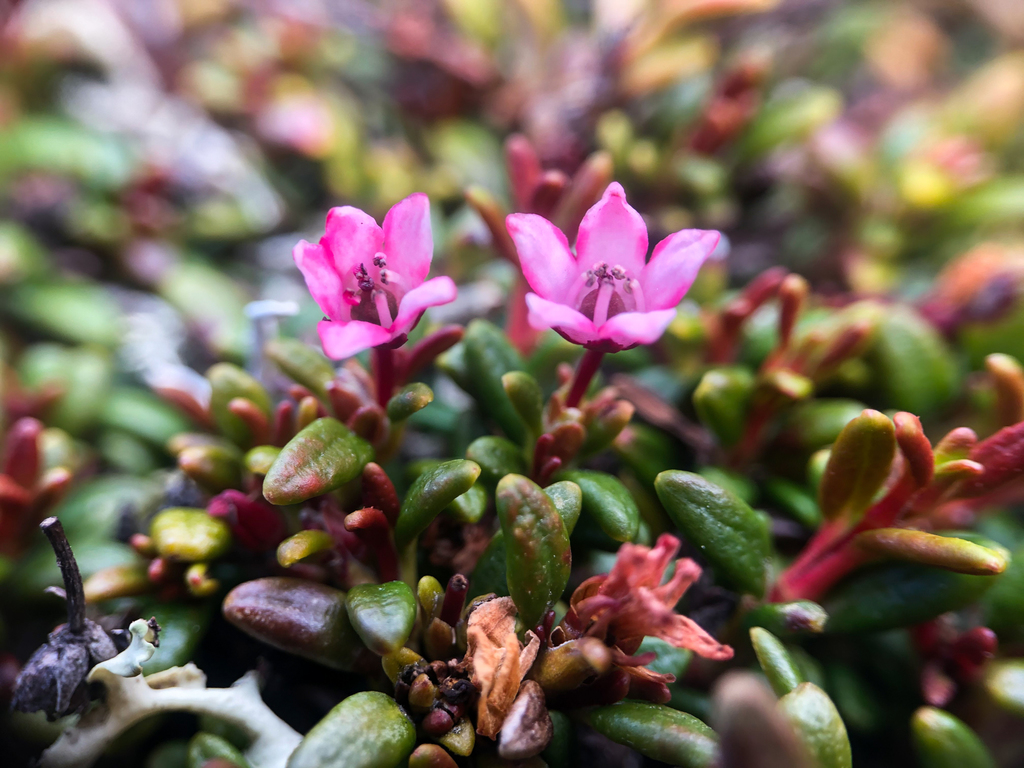
alpine azalea
Kalmia procumbens
Kalmia procumbens, commonly known as alpine azalea or trailing azalea, is a dwarf shrub of high mountain regions of the Northern Hemisphere that usually grows no more than 10 centimeters (4 in) tall. Originally named by Linnaeus as Azalea procumbens, it is also named after French botanist L.L.A. Loiseleur-Deslongchamps - Loiseleuria procumbens.
From the article Kalmia procumbens on Wikipedia (CC BY-SA), quoted section by section
Description
Individuals of this species are shrubs grown for two to five rose-pink flowers. Its leaves are opposite and its evergreen leaves are leathery blades to 8mm long and have incised margin. Edges are rolled under green on the top and white with dense short hairs underneath.
Wikipedia: “Morphology”
Range & habitat
Kalmia procumbens is not well known though it is widely distributed. These plants are common in the subarctic regions and high mountains of the northern hemisphere. In North America it reaches the southern limit of its range in the mountains of Maine, New Hampshire, New York, and Washington. It is easy to propagate.
Wikipedia: “Distribution”
What it does
Kalmia procumbens prefers alpine or subalpine, rocky exposed habitat. It grows above treeline with mountain heathers and at lower elevations in bogs. It is a known host to the microfungus Delphinella polyspora, which grows on its pedicels and fruit.
Wikipedia: “Habitat and ecology”
Where it lives
Recorded sightings
—
geo-referenced records in GBIF, from museums, herbaria and field observers.
Drag the globe to turn it. Dots are where records exist, not a range map; darker means more records.
In the stacks
Searching the stacks…
Every page naming Kalmia procumbens in the Biodiversity Heritage Library →
This page is assembled live from iNaturalist, GBIF, Wikipedia, the Source Library and the Internet Archive. It is not yet part of the hand-edited codex. iNaturalist taxon 204337.