- Animals
- ›Arthropods
- ›Hexapods
- ›Insects
- ›Winged and Once-winged Insects
- ›True Bugs, Hoppers, Aphids, and allies
- ›True Hoppers
- ›Spittlebugs, Cicadas, Leafhoppers and Treehoppers
- ›Leafhoppers and Treehoppers
- ›Typical Leafhoppers
- ›Microleafhoppers
- ›Empoascini
- ›Empoascina
- ›Empoasca
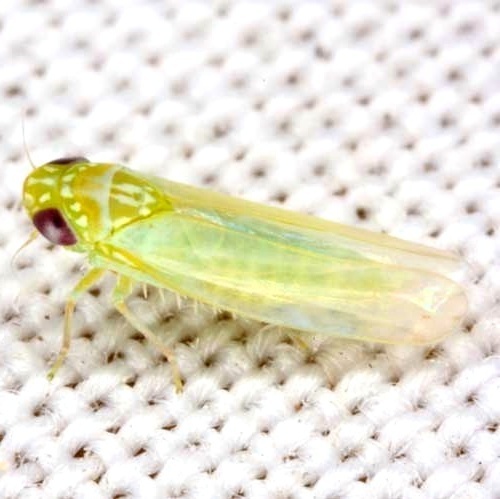
Potato Leafhopper
Empoasca fabae
Empoasca fabae belongs to family Cicadellidae and genus Empoasca within order Hemiptera. They are more commonly referred to as the potato leafhopper. In North America they are a serious agricultural pest. Every year millions of dollars are lost from reduced crop yields and on pest management. Crops that are impacted the most are potatoes, clover, beans, apples and alfalfa.
From the article Potato leafhopper on Wikipedia (CC BY-SA), quoted section by section
Description
Adults have pale to iridescent green bodies with 6 or 8 white spots on their pronotum. They have a distinctive white H shape mark between their head and wing base. Their bodies are approximately 3 mm long and have on their front wings near its tip a crossvein. Adults and nymphs move by hopping among host plants. However, only adults can fly.
Wikipedia: “Appearance”
What it does
They are able to feed and reproduce on at least 200 different plant species across twenty-six families. In total herb genera represent 64% of their hosts. Adults prefer to feed on the leaves and stems, while the nymphs prefer the leaves. Their specialized mouth parts are able to pierce into the plant tissue and remove its sap. The ability to inhabit a wide range of hosts is due to the variation in their feeding behaviors.
Wikipedia: “Diet”
Listen
Looking for field recordings…
Where it lives
Recorded sightings
—
geo-referenced records in GBIF, from museums, herbaria and field observers.
Drag the globe to turn it. Dots are where records exist, not a range map; darker means more records.
In the stacks
Searching the stacks…
Every page naming Empoasca fabae in the Biodiversity Heritage Library →
This page is assembled live from iNaturalist, GBIF, Wikipedia, the Source Library and the Internet Archive. It is not yet part of the hand-edited codex. iNaturalist taxon 203303.