- Animals
- ›Arthropods
- ›Hexapods
- ›Insects
- ›Winged and Once-winged Insects
- ›Grasshoppers, Crickets, and Katydids
- ›Katydids, Crickets, and Allies
- ›Katydids, wētā, and allies
- ›Tettigonioidea
- ›Katydids
- ›Armoured Ground-crickets
- ›Ephippigerini
- ›Ephippiger
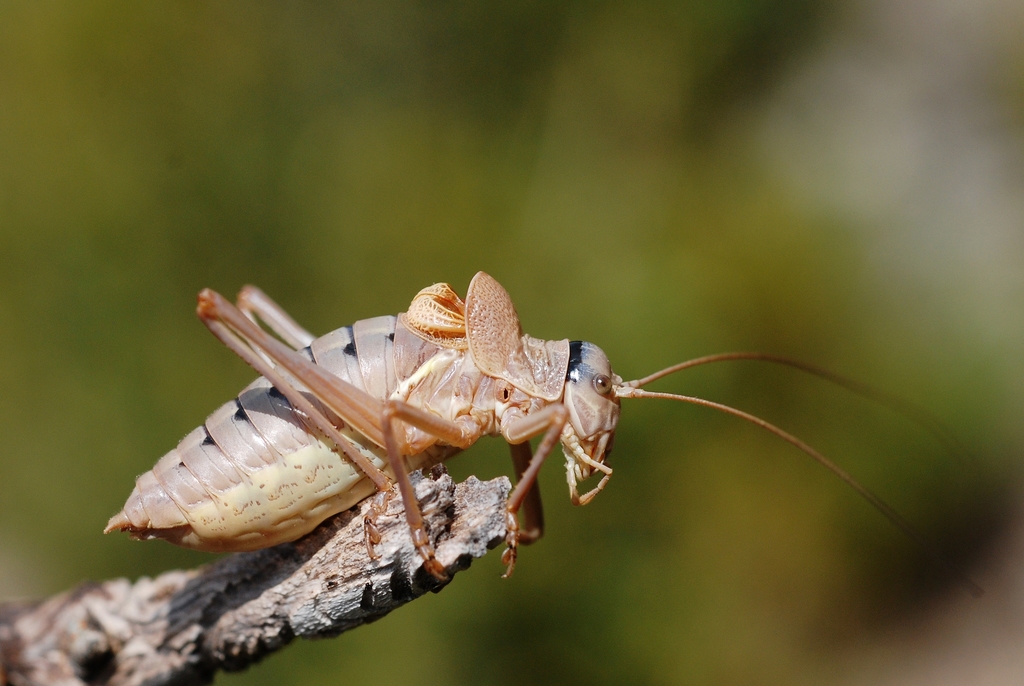
Alpine Saddle-backed Bush-cricket
Ephippiger terrestris
Ephippiger terrestris, common name Alpine saddle-backed bush-cricket, is a bush cricket species belonging to the family Tettigoniidae, subfamily Bradyporinae.
From the article Ephippiger terrestris on Wikipedia (CC BY-SA), quoted section by section
Description
Ephippiger terrestris can reach a body length of about 23–28 mm (0.91–1.10 in) in males, of about 28–32 mm (1.1–1.3 in) in females, while ovipositor can reach about 25–28 mm (0.98–1.10 in). These bush crickets are usually bluish-green. However, in both sexes the body color is quite variable and often olive-green, beige and sepia-brown color variations occur. A yellowish line runs from the lower edge of the pronotum to the abdomen end. Two bright longitudinal lines run along the back sides. The back of the head is black. The form of the pronotum is rather smooth and gently concave and resembles a saddle (the Latin name ephippium means 'saddle of a horse'). They have round small atrophied wings, protruding a few millimeters below the pronotum, that are unfit to flight and only used for the emission of sounds (stridulation). In the females the ovipositor is long and slightly curved upwards. In the male cerci stand out clearly and are cylindrical and relatively long.
Range & habitat
This species is present in Middle and Southwestern Europe (France, Italy and Switzerland). The subspecies E. terrestris bormansi occurs only in northern Italy and southern Switzerland.
Wikipedia: “Distribution”
Listen
Looking for field recordings…
Where it lives
Recorded sightings
—
geo-referenced records in GBIF, from museums, herbaria and field observers.
Drag the globe to turn it. Dots are where records exist, not a range map; darker means more records.
In the stacks
Searching the stacks…
Every page naming Ephippiger terrestris in the Biodiversity Heritage Library →
This page is assembled live from iNaturalist, GBIF, Wikipedia, the Source Library and the Internet Archive. It is not yet part of the hand-edited codex. iNaturalist taxon 203146.