On eBird ↗
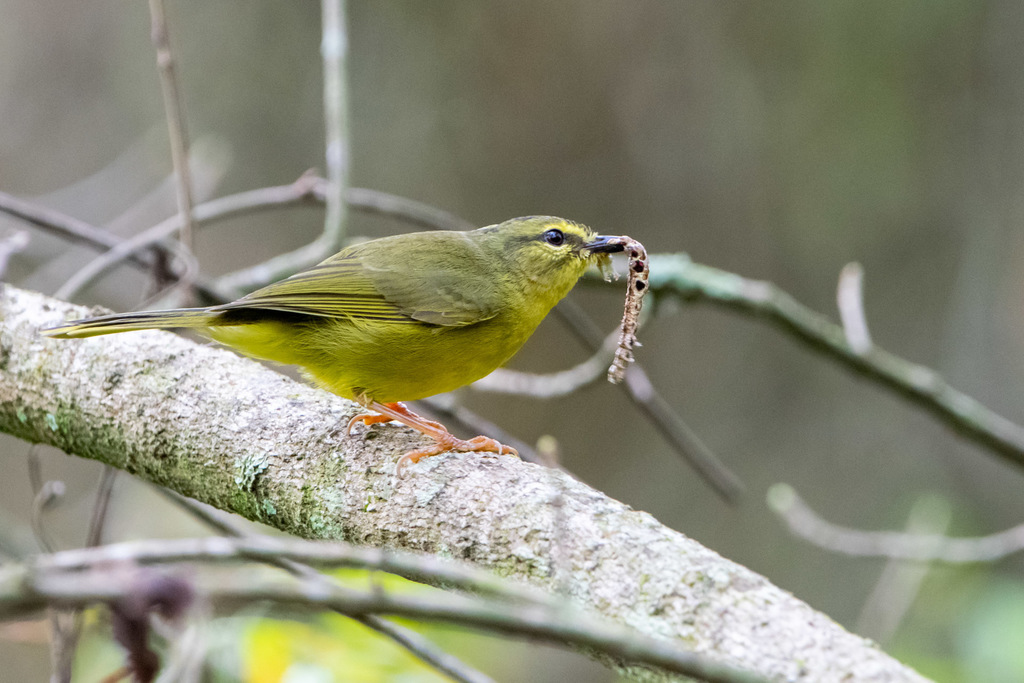
Two-banded Warbler
Live sightings near you, the range map, bar charts of when it is seen, and Macaulay Library photos and recordings.
Two-banded Warbler
Myiothlypis bivittata
The two-banded warbler (Myiothlypis bivittata) is a species of bird in the family Parulidae. It is found in Argentina, Bolivia, Brazil, Guyana, Peru, and Venezuela. Its natural habitats are subtropical or tropical moist montane forests and heavily degraded former forest.
From the article Two-banded warbler on Wikipedia (CC BY-SA), quoted section by section
Description
The two-banded warbler is 12.5 to 14 cm (4.9 to 5.5 in) long and weighs 11 to 17 g (0.39 to 0.60 oz). The sexes have the same plumage. Adults of the nominate subspecies M. b. bivittata have a black crown with olive tips on some feathers and an orange-rufous stripe in its middle. They have dusky lores, a yellow supercilium that becomes a crescent over the eye, and a buffy white to yellow crescent below the eye on an otherwise olive-green face. Their nape and upperparts are olive-green. Their throat and underparts are mostly yellow with a very pale olive wash on the sides of the breast and the flanks. Subspecies M. b. argentinae has a mostly yellow central crown stripe, more olive on the crown's feather tips, a wider supercilium, and slightly paler upperparts than the nominate. M. b. roraimae has no olive on the black crown feathers. Their supercilium becomes yellowish olive past the eye, their lores extend as a short dusky line through the eye, and their eye crescents are fainter than the nominate's. Their underparts are a darker olive on the sides of the breast and the flanks. Adults of all subspecies have a dark brown iris, a blackish brown maxilla, a brown mandible with a pinkish base, and yellowish brown to yellowish pink legs and feet.
Range & habitat
The two-banded warbler has a disjunct distribution. The range of M. b. roraimae is very distant from the contiguous ranges of the other two subspecies and has gaps within it. That subspecies is found on the tepuis of southeastern Venezuela's Amazonas and Bolívar states, western Guyana, and extreme northern Brazil. There are also scattered records in Brazil south and east of its core range. The nominate subspecies is found on the eastern slope of the Andes from western Madre de Dios and eastern Cuzco departments of southeastern Peru southeast to Bolivia's western Santa Cruz Department. M. b. argentinae continues on the eastern Andean slope from Santa Cruz south to northern Argentina's Jujuy and Salta provinces. The two-banded warbler's subspecies M. b. roraimae inhabits the interior and edges of humid primary and secondary forest. In Venezuela it ranges in elevation between 800 and 1,800 m (2,600 and 5,900 ft) and in Brazil between 700 and 1,800 m (2,300 and 5,900 ft). The other two subspecies inhabit a wider variety of dry, humid, and wet forest. They favor areas with a dense understory, and in Peru at least is often associated with thickets of bamboo. In Peru it ranges in elevation between 750 and 1,500 m (2,500 and 4,900 ft) and in Bolivia between 300 and 2,200 m (1,000 and 7,200 ft).
Wikipedia: “Distribution and habitat”
What it does
The two-banded warbler's diet has not been studied but is believed to be mostly or entirely invertebrates. Pairs and family groups usually forage in the forest understory between about 2 and 10 m (7 and 33 ft) above the ground but will go all the way to the canopy. The species mostly gleans its prey from vegetation and branches. It only infrequently joins mixed-species feeding flocks.
Wikipedia: “Feeding”
Listen
Looking for field recordings…
Where it lives
Recorded sightings
—
geo-referenced records in GBIF, from museums, herbaria and field observers.
Drag the globe to turn it. Dots are where records exist, not a range map; darker means more records.
In the stacks
Searching the stacks…
Every page naming Myiothlypis bivittata in the Biodiversity Heritage Library →
This page is assembled live from iNaturalist, GBIF, Wikipedia, the Source Library and the Internet Archive. It is not yet part of the hand-edited codex. iNaturalist taxon 201227.