On eBird ↗
Kurrichane Thrush
Live sightings near you, the range map, bar charts of when it is seen, and Macaulay Library photos and recordings.
Kurrichane Thrush
Turdus libonyana
The Kurrichane thrush (Turdus libonyana) is a species of bird in the family Turdidae. It is found in Angola, Botswana, Burundi, Democratic Republic of the Congo, Lesotho, Malawi, Mozambique, Namibia, South Africa, Swaziland, Tanzania, Zambia, and Zimbabwe. Its natural habitat is dry savanna. Its name is derived from Kaditshwene (rendered as 'Kurrichane') in Botswana.
From the article Kurrichane thrush on Wikipedia (CC BY-SA), quoted section by section
Description
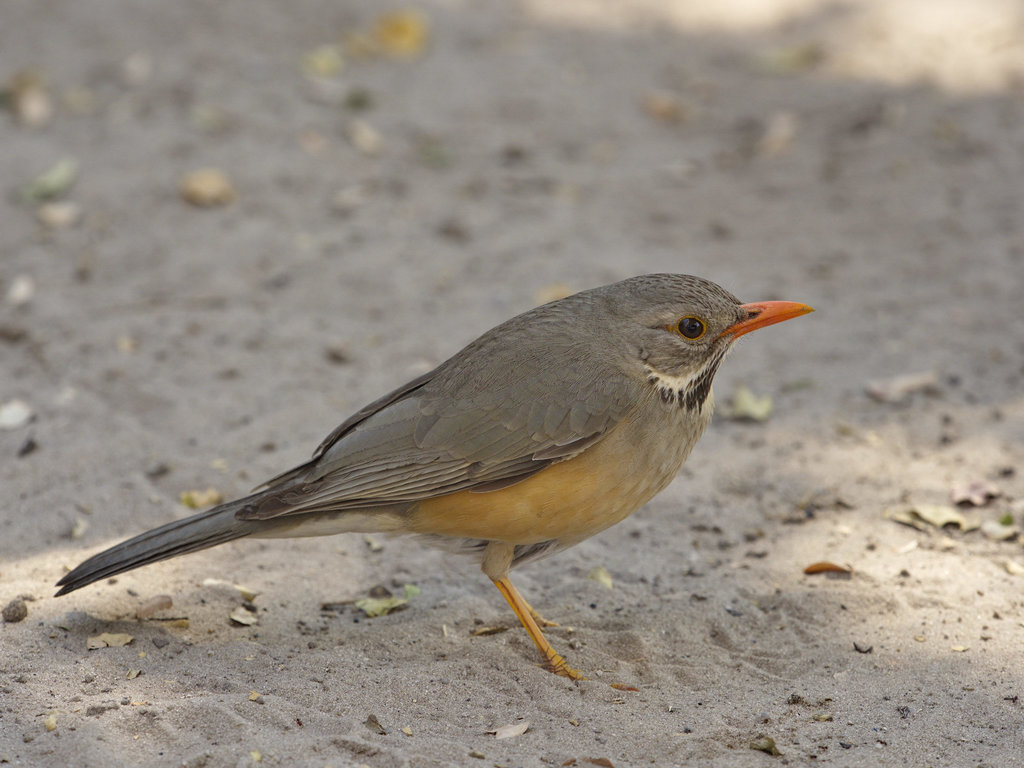
The Kurrichane thrush is 21 to 23 cm (8.3–9.1 in) long and weighs around 46–82 g (1.6–2.9 oz). The head, upperparts and breast are grey, and the belly is whitish with orange flanks. The throat is white with black streaks on the side. The bill is orange, tending to a paler yellow at the base. The legs tend to vary in colour. Both sexes are alike.
Range & habitat
It is found in Angola, Botswana, Burundi, Democratic Republic of the Congo, Eswatini, Lesotho, Malawi, Mozambique, Namibia, South Africa, Tanzania, Zambia, and Zimbabwe.
Wikipedia: “Distribution and habitat”
In human culture
The Kurrichane thrush was described in 1836 by the zoologist Andrew Smith, on the basis of a specimen collected in the Transvaal in South Africa. It was originally assigned to the defunct genus Merula. The species is a sister species to the Comoro thrush. The specific epithet of the Kurrichane thrush, libonyana, is derived from the Tswana name for the red-billed buffalo weaver, Lebonyana. It was given by mistake to this species, possibly because it also has a reddish bill. Its common name is derived from a corruption of Kaditshwene (rendered as 'Kurrichane'), a former town in northern South Africa where the original specimen was collected.
Wikipedia: “Taxonomy and etymology”
Listen
Looking for field recordings…
Where it lives
Recorded sightings
—
geo-referenced records in GBIF, from museums, herbaria and field observers.
Drag the globe to turn it. Dots are where records exist, not a range map; darker means more records.
In the stacks
Searching the stacks…
Every page naming Turdus libonyana in the Biodiversity Heritage Library →
This page is assembled live from iNaturalist, GBIF, Wikipedia, the Source Library and the Internet Archive. It is not yet part of the hand-edited codex. iNaturalist taxon 201216.