On eBird ↗
Pale-billed Sicklebill
Live sightings near you, the range map, bar charts of when it is seen, and Macaulay Library photos and recordings.
Pale-billed Sicklebill
Drepanornis bruijnii
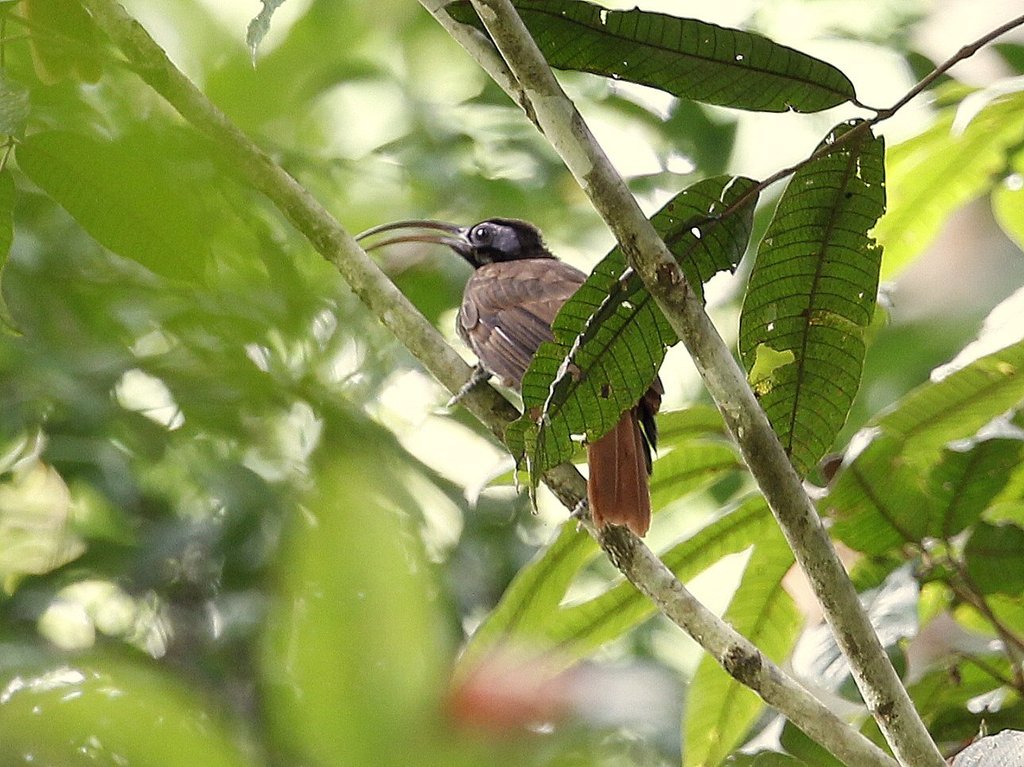
The pale-billed sicklebill (Drepanornis bruijnii) is a species of sicklebill that belongs to the family Paradisaeidae, which contains the birds-of-paradise.
From the article Pale-billed sicklebill on Wikipedia (CC BY-SA), quoted section by section
Description
Pale-billed sicklebills are on the more medium-sized side of the family Paradisaeidae; they seldom reach over 35 cm, or 13.7 inches, in length. They are among the least attractive birds-of-paradise, being a dull brownish-olive on their upperside, with a greyish-brown underside. Their heads are dark brown, and one of their most noticeable features are lead-grey bare facial patches surrounding each eye and covering most of the head; there are also two iridescent tufts rising above the head. Unlike their congener's bill, they have a pale, ivory-ish colored, downcurved bill. The ornaments present on the male are relatively extensive pectoral feathers in rows on the sides of the breast and belly. The pectoral feathers highest on the breast (on each side) are dark greyish with coppery red to reddish iridescent tips; the rest of the pectoral plumes on the sides have more of a greenish-copper iridescence to their tips. The female of this species is, for the most part, similar to the male. She has no iridescent feathers, and is of lighter weight than the male. She does have the bare facial patches like the male, but not as extensive. Instead of a greyish underside, she is barred below, starting from her chin to her rump. Her wings and lower neck are also a lighter dull brownish-olive. …
What it does
The pale-billed sicklebill is distributed to lowland rainforests of northern and northwestern New Guinea. Its diet consists mainly of fruits and arthropods. Due to deforestation and habitat lost on this limited range species, the pale-billed sicklebill is evaluated as Least Concern on the IUCN Red List of Threatened Species. It is listed on Appendix II of CITES.
Wikipedia: “Behaviour and ecology”
In human culture
The scientific nomenclature, or name, of this species is Drepanornis bruijni, consisting of "Drepanornis", which means "sickle bird", that refers to the birds' sickle-shaped bill, and bruijni, which commemorates Antonie Augustus Bruijn, a Dutch plume merchant.
Wikipedia: “Etymology”
Listen
Looking for field recordings…
Where it lives
Recorded sightings
—
geo-referenced records in GBIF, from museums, herbaria and field observers.
Drag the globe to turn it. Dots are where records exist, not a range map; darker means more records.
In the stacks
Searching the stacks…
Every page naming Drepanornis bruijnii in the Biodiversity Heritage Library →
This page is assembled live from iNaturalist, GBIF, Wikipedia, the Source Library and the Internet Archive. It is not yet part of the hand-edited codex. iNaturalist taxon 201168.