- Animals
- ›Arthropods
- ›Hexapods
- ›Insects
- ›Winged and Once-winged Insects
- ›Ants, Bees, Wasps, and Sawflies
- ›Narrow-waisted Wasps, Ants, and Bees
- ›Ants, Bees, and Stinging Wasps
- ›Vespoid Wasps
- ›Hornets, Paper Wasps, Potter Wasps, and Allies
- ›Paper Wasps
- ›Polistini
- ›Polistes
- ›Polistes
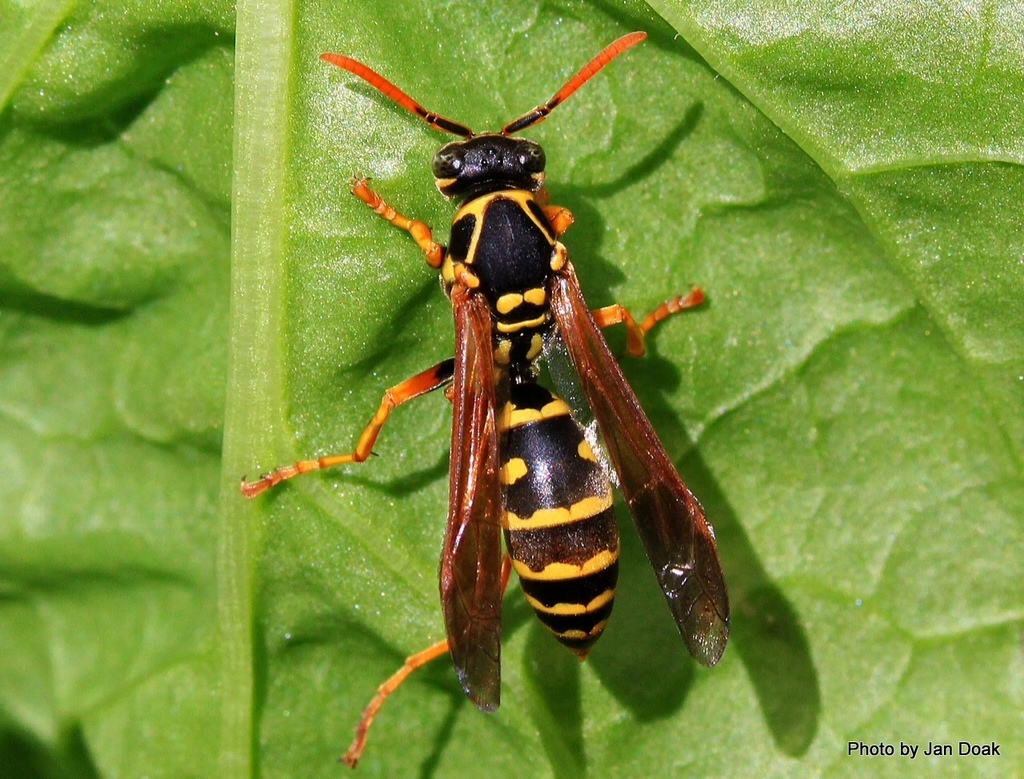
Asian Paper Wasp
Polistes chinensis
Polistes chinensis is a polistine vespid wasp in the cosmopolitan genus Polistes, and is commonly known as the Asian, Chinese or Japanese paper wasp. Approximately 300 species of paper wasps have been identified worldwide. Polistes chinensis is found in East Asia, in particular China and Japan. The subspecies P. chinensis antennalis is an invasive species in New Zealand, having arrived in 1979, and more recently Australia.
The wasps prey on invertebrates, especially caterpillars. In this species, queens destroy up to 70% of worker-laid eggs and are aided by workers in a process known as worker policing.
From the article Polistes chinensis on Wikipedia (CC BY-SA), quoted section by section
Description
The Asian paper wasp has a slender body about 13 to 25 mm (0.51 to 0.98 in) in length. Their bodies are reddish brown or black, with yellow rings and reddish areas on the abdomen. Their wings are reddish or amber brown, and they have long legs that hang down during flight. The general morphology of the spermatheca is similar in both reproductive and non-reproductive individuals. The spermathecal gland attaches to the central region of the spermatheca.
Wikipedia: “Description and identification”
Range & habitat
The Asian paper wasp frequently constructs nests on man-made structures including houses and buildings. It will also build nests on trees or bushes, usually on branches, but sometimes on leaves as well. P. chinensis prefers to colonize urban habitats, but nests have also been recorded near forest clearings. They sometimes build their nests in dense shrubs, making them difficult to locate. Large populations usually develop in warm, lowland areas with open habitat such as shrublands, swamps and meadows. The paper wasp is native to East Asia. It has been recorded in China, Japan, Korea and Mongolia. The subspecies P. chinensis antennalis is invasive in New Zealand. It is widespread in the North Island and the northern South Island and competes with native species for food, It has since been recorded in Norfolk Island and New South Wales. At least two independent invasion events, linked to Kanto and Kyushu, Japan, have been proposed as sources of the New Zealand wasps. The Asian paper wasp was first recorded in New Zealand in 1979, in Kohimarama and the Whangaparāoa Peninsula. It remained confined to these areas of Auckland until 1984, when it began appearing in inner city areas and western suburbs.
Wikipedia: “Distribution and habitat”
What it does
Workers police each others' eggs. 88.5% of queens' eggs survive to hatching vs 1.4% of workers'. Worker reproduction is frequent in queen-right colonies in which the queen is alive. Both queen and workers replaced workers' eggs. Polistes chinensis was studied alongside Polistes snelleni for comparison in this conflict. In P. snelleni, queens monopolize egg production. Queens contributed 2.4 times more to replacing than workers. Workers sequentially perform oophagy and oviposition in the same cells. The ratio of worker-produced eggs to eggs laid by the queen is 3 or 4 times to one in a colony having between 100 and 500 wasps.
Wikipedia: “Reproduction conflict”
Listen
Looking for field recordings…
Where it lives
Recorded sightings
—
geo-referenced records in GBIF, from museums, herbaria and field observers.
Drag the globe to turn it. Dots are where records exist, not a range map; darker means more records.
In the stacks
Searching the stacks…
Every page naming Polistes chinensis in the Biodiversity Heritage Library →
This page is assembled live from iNaturalist, GBIF, Wikipedia, the Source Library and the Internet Archive. It is not yet part of the hand-edited codex. iNaturalist taxon 199179.