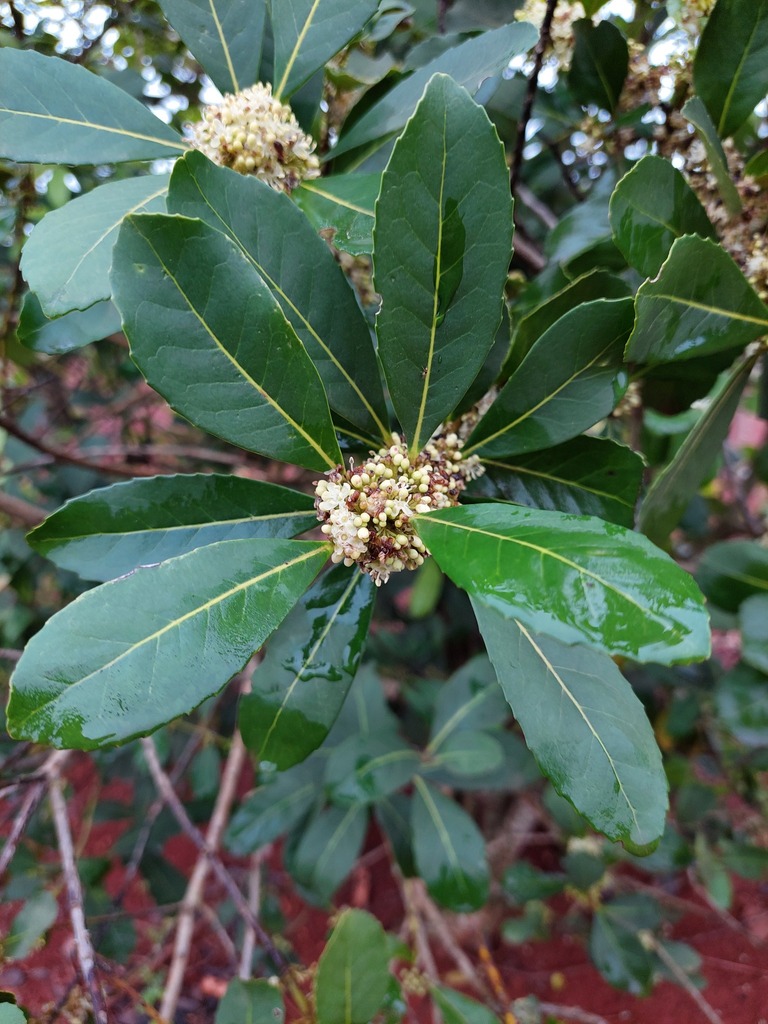
yerba mate
Ilex paraguariensis
Yerba mate or yerba maté ( YUR-bə MAH-tay), Ilex paraguariensis, is a plant species of the holly genus native to South America. The leaves of the plant can be steeped in hot water to make a beverage known as mate. Brewed cold, it is used to make tereré. Both the plant and the beverage contain caffeine.
The indigenous Guaraní and some Tupi communities (whose territory covered modern Paraguay) first cultivated and consumed yerba mate prior to European colonization of the Americas. Its consumption was exclusive to the natives of two regions of the territory that became Paraguay, specifically the departments of Amambay and Alto Paraná. After the Jesuits discovered its commercialization potential, yerba mate became widespread throughout the province and even elsewhere in the Spanish Crown. The plant was named by the French botanist Augustin Saint-Hilaire.
From the article Yerba mate on Wikipedia (CC BY-SA), quoted section by section
Description
Ilex paraguariensis begins as a shrub and then matures to a tree, growing up to 15 meters (50 ft) tall. The leaves are evergreen, 7–110 millimeters (1⁄4–4+3⁄8 in) long and 30–55 millimeters (1+1⁄8–2+1⁄8 in) wide, with serrated margins. The leaves are often called yerba (Spanish) or erva (Portuguese), both of which mean "herb". They contain caffeine (known in some parts of the world as mateine) and related xanthine alkaloids, and are harvested commercially. The flowers are small and greenish-white with four petals. The fruit is a red drupe 4–6 millimeters (5⁄32–1⁄4 in) in diameter. Junqueira 2001 reported extrafloral nectaries on its leaves.
How it is grown
The yerba mate plant is grown and processed in its native regions of South America, specifically in Paraguay, some parts of northern Argentina (Misiones), Uruguay, and southern Brazil (Rio Grande do Sul, Santa Catarina, Paraná, and Mato Grosso do Sul). Cultivators are known as yerbateros (Spanish) or ervateiros (Brazilian Portuguese). Seeds used to germinate new plants are harvested after they have turned dark purple, typically from January to April. After harvest, they are submerged in water in order to eliminate floating non-viable seeds and detritus like twigs, leaves, etc. New plants are started between March and May. For plants established in pots, transplanting takes place April through September. Plants with bare roots are transplanted only during the months of June and July. Many of the natural enemies of yerba mate are difficult to control in plantation settings. Insect pests include Gyropsylla spegazziniana, a true bug that lays eggs in the branches; Hedyphates betulinus, a type of beetle that weakens the tree and makes it more susceptible to mold and mildew; Perigonia lusca, a moth whose larvae eat the leaves; and several species of mites. P. lusca may be controlled with a nuclear polyhedrosis virus used as a biopesticide. This was first applied in 1992. When I. paraguariensis is harvested, the branches are often dried by a wood fire, imparting a smoky flavor. …
Wikipedia: “Cultivation”
In human culture
Mate was first consumed by the indigenous Guaraní people and also spread in the Tupí people that lived in the departments of Amambay and Alto Paraná the territory of Paraguay. Its consumption became widespread during European colonization, particularly in the Spanish colony of Paraguay in the late 16th century, among both Spanish settlers and indigenous Guaraní, who had, to some extent before the Spanish arrival, consumed it. This widespread consumption turned it into Paraguay's main commodity above other wares, such as tobacco, and the labour of indigenous peoples was used to harvest wild stands. In the mid-17th century, Jesuits managed to domesticate the plant and establish plantations in their Indian reductions in Misiones, Argentina, sparking severe competition with the Paraguayan harvesters of wild stands. It is here when the plant began its incursion into other non-Paraguayan territories. After their expulsion in the 1770s, their plantations fell into decay, as did their domestication secrets. The industry continued to be of prime importance for the Paraguayan economy after independence, but development in benefit of the Paraguayan state halted after the War of the Triple Alliance (1864–1870) that devastated the country both economically and demographically. …
Wikipedia: “History”
Where it lives
Recorded sightings
—
geo-referenced records in GBIF, from museums, herbaria and field observers.
Drag the globe to turn it. Dots are where records exist, not a range map; darker means more records.
In the stacks
Searching the stacks…
Every page naming Ilex paraguariensis in the Biodiversity Heritage Library →
This page is assembled live from iNaturalist, GBIF, Wikipedia, the Source Library and the Internet Archive. It is not yet part of the hand-edited codex. iNaturalist taxon 193722.