- Plants
- ›Vascular Plants
- ›flowering plants
- ›Dicots
- ›Gentians, Dogbanes, Madders, and Allies
- ›madder family
- ›Ixoroideae
- ›Coffeeae
- ›Coffea
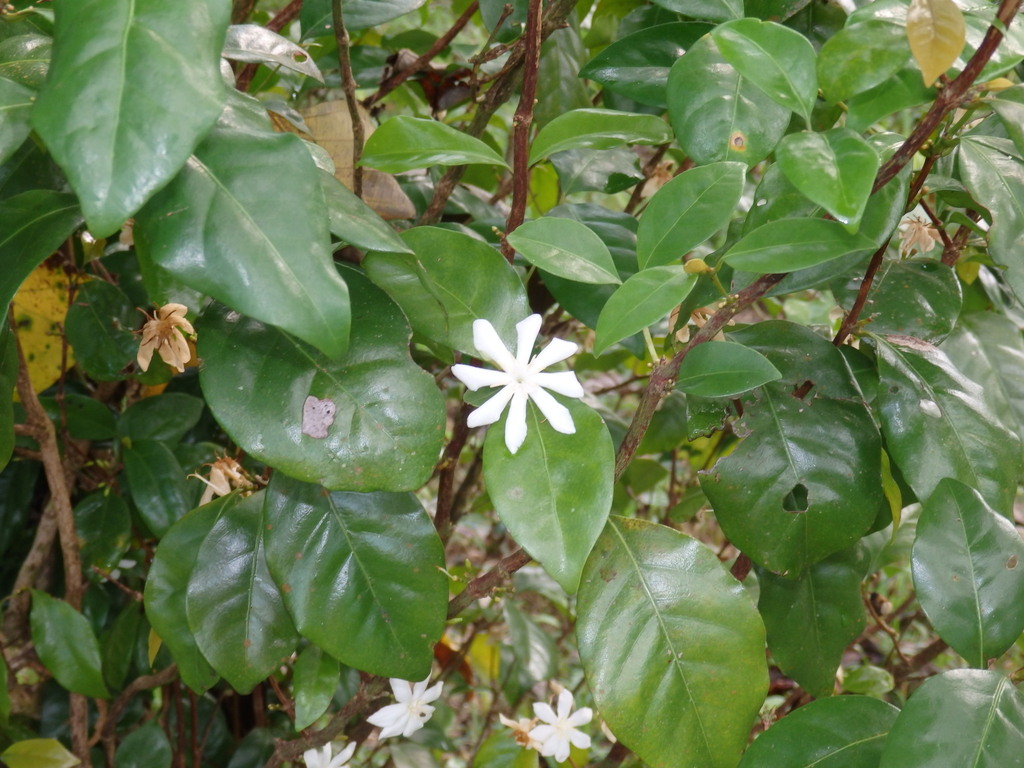
Coffea pseudozanguebariae
Coffea is a genus of flowering plants in the family Rubiaceae. Coffea species are shrubs or small trees native to tropical and southern Africa and tropical Asia. The seeds of some species, called coffee beans, are roasted and ground to brew into various coffee beverages. The fruits, like the seeds, contain a large amount of caffeine, and have a distinct sweet taste.
The plant ranks as one of the world's most valuable and widely traded commodity crops and is an important export product of several countries, including those in Central and South America, the Caribbean and Africa. The coffee trade relies heavily on two of the over 120 species, Coffea arabica (commonly known simply as "Arabica"), which accounts for around 55% of the world's coffee production, and Coffea canephora (known as "Robusta"), which accounts for around 45%.
From the article Coffea on Wikipedia (CC BY-SA), quoted section by section
Description
When grown in the tropics, coffee is a vigorous bush or small tree that usually grows to a height of 3–3.5 m (10–11+1⁄2 ft). Most commonly cultivated coffee species grow best at high elevations, but do not tolerate freezing temperatures.
The white flowers are highly scented. The trees produce edible red or purple fruits that are either epigynous berries or indehiscent drupes. The fruit is often referred to as a "coffee cherry", and it contains two seeds, called "coffee beans". Despite these terms, coffee is neither a true cherry (the fruit of certain species in the genus Prunus) nor a true bean (seeds from plants in the family Fabaceae). The fruit takes about nine months to ripen. In any coffee crop, about 5–10% of fruits contain only a single bean. Called a peaberry, it is smaller and rounder than a normal coffee bean. The Coffea arabica tree grows fruit after three to five years, producing for an average of 50 to 60 years, though up to 100 years is possible.
What it does
The caffeine in coffee beans serves as a toxic substance that protects against insects and other pests, a form of natural plant defense against herbivory. Caffeine simultaneously attracts pollinators, specifically honeybees, by creating an olfactory memory that signals bees to return to the plant's flowers. Not all Coffea species contain caffeine, and the earliest species had little or no caffeine content. Caffeine has evolved independently in multiple lineages of Coffea in Africa, perhaps in response to high pest predation in the humid environments of West-Central Africa. Caffeine has also evolved independently in the more distantly related genera Theobroma (cacao) and Camellia (tea). This suggests that caffeine production is an adaptive trait in coffee and plant evolution. The fruit and leaves also contain caffeine, and can be used to make coffee cherry tea and coffee-leaf tea. The fruit is also used in many brands of soft drink as well as pre-packaged teas. Several insect pests affect coffee production, including the coffee borer beetle (Hypothenemus hampei) and the coffee leafminer (Leucoptera caffeina). Coffee is used as a food plant by the larvae of some Lepidoptera (butterfly and moth) species, Dalcera abrasa, turnip moth and some members of the genus Endoclita, including E. damor and E. malabaricus.
Wikipedia: “Ecology”
How it is grown
There are over 130 species of Coffea, which is grown from seed. The two most popular are Coffea arabica (commonly known simply as "Arabica"), which accounts around 55% of the world's coffee production, and Coffea canephora (known as "Robusta"), which accounts for about 45%. C. arabica is preferred for its sweeter taste, while C. canephora has a higher caffeine content. C. arabica has its origins in the highlands of Ethiopia and the Boma Plateau of Sudan, and came about as the result of a hybrid between C. canephora and C. eugenioides.
Wikipedia: “Cultivation and use”
Where it lives
Recorded sightings
—
geo-referenced records in GBIF, from museums, herbaria and field observers.
Drag the globe to turn it. Dots are where records exist, not a range map; darker means more records.
In the stacks
Searching the stacks…
Every page naming Coffea pseudozanguebariae in the Biodiversity Heritage Library →
This page is assembled live from iNaturalist, GBIF, Wikipedia, the Source Library and the Internet Archive. It is not yet part of the hand-edited codex. iNaturalist taxon 190746.