Chilean citronella tree
Citronella mucronata
Citronella mucronata, the huillipatagua (Spanish pronunciation: [wiʝipaˈtaɣwa]), naranjillo, or Chilean citronella tree, is an evergreen tree in the family Cardiopteridaceae. It is endemic to Chile and grows in the Chilean matorral region of central Chile from 30º to 40° south latitude.
From the article Citronella mucronata on Wikipedia (CC BY-SA), quoted section by section
Description
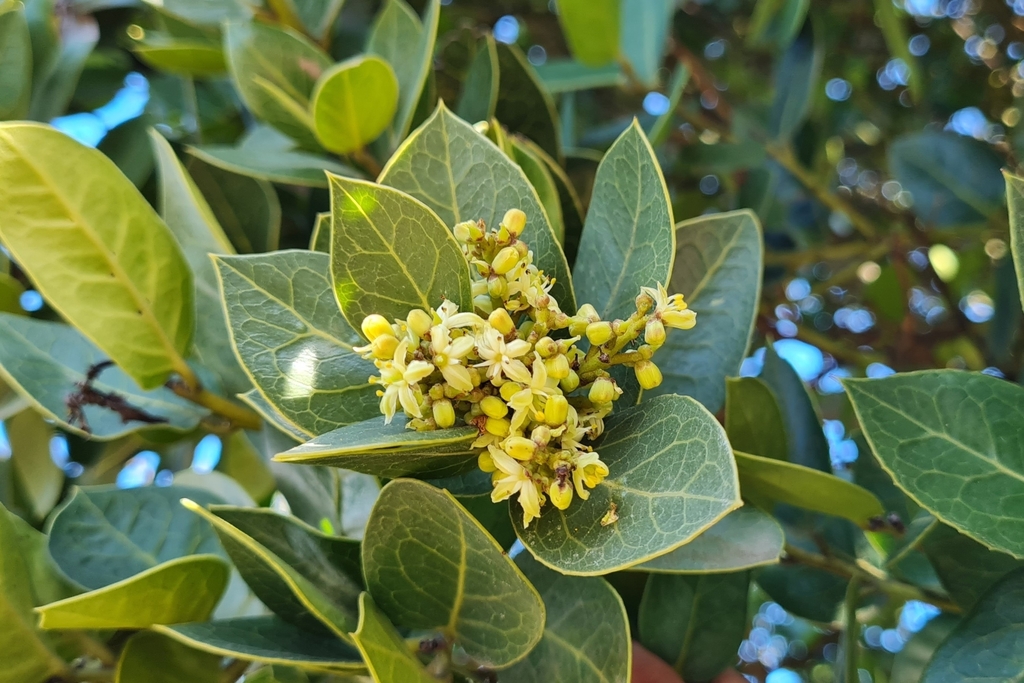
It reaches up to 10 m (30 ft) and 1 m (3 ft) in diameter. The bark is dark gray and rough. The leaves are alternate, leathery, the edge is entire or toothed, ovate or oblong with an acute apex (tip) which ends in a mucro (sharp point). The leaves are about 4.5–6 cm (1.8–2.4 in) long and 2.5–4 cm (0.98–1.6 in) wide, with domatia in the axils of the side veins, and the veins are yellow, the leaves are glossy green above, and paler below. Small petioles. The flowers are hermaphrodite and whitish yellow and arranged in terminal panicles 4–8 cm (1.6–3.1 in) long. The calyx is made up by 5 sepals, the corolla has 5 free petals. The fruit is a spherical drupe about 1–1.2 cm (0.39–0.47 in) in diameter which is purple when mature.
Range & habitat
Citronella mucronata is native to the Mediterranean climate Chilean matorral ecoregion, and grows discontinuously from Limari Province (30°40'S) to Osorno Province (40°30'S), between 15 and 1,050 meters (49 and 3,445 ft) elevation. It is common in the Chilean Coastal Range, and less common to the east in the foothills of the Andes. It generally grows in sclerophyllous forest, most frequently in the Roble–Hualo forest type, where it can grow with Nothofagus dombeyi and Nothofagus alpina depending on the latitude. In northern coastal habitats it is often associated with Aextoxicon punctatum, Beilschmiedia miersii, Cryptocarya alba, and Schinus latifolia. In Los Bellotos del Melado National Reserve in the Andes it grows with Beilschmiedia berteroana, Cryptocarya alba, Nothofagus glauca, and Quillaja saponaria.
Wikipedia: “Range and habitat”
Where it lives
Recorded sightings
—
geo-referenced records in GBIF, from museums, herbaria and field observers.
Drag the globe to turn it. Dots are where records exist, not a range map; darker means more records.
In the stacks
Searching the stacks…
Every page naming Citronella mucronata in the Biodiversity Heritage Library →
This page is assembled live from iNaturalist, GBIF, Wikipedia, the Source Library and the Internet Archive. It is not yet part of the hand-edited codex. iNaturalist taxon 190621.