- Plants
- ›Vascular Plants
- ›flowering plants
- ›Dicots
- ›pepper plants, birthworts, and allies
- ›birthwort family
- ›Aristolochioideae
- ›Aristolochia
- ›Aristolochia
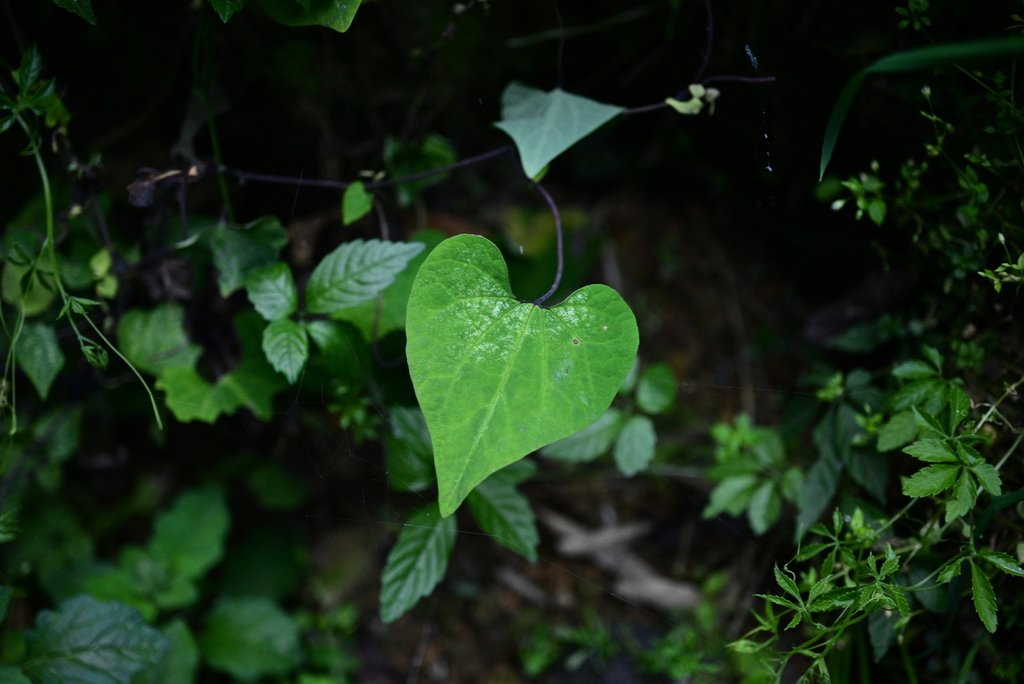
Aristolochia tuberosa
Aristolochia tuberosa, commonly known as bei she sheng (背蛇生), is a species of herbaceous plant in the family Aristolochiaceae that is native to China and Vietnam.
From the article Aristolochia tuberosa on Wikipedia (CC BY-SA), quoted section by section
Description
It is a climbing perennial herb with tuberous roots of fusiform or spherical structure. Its leaves are cordate and hairless, typically 8-14 × 5-11 cm, with palmate venation. The stems are angled and hairless, and the petioles are 7-10 cm in length. The male and female reproductive structures are fused into a single gynostemium, and it produces ovoid seeds measuring around 4 × 3 mm. One to three flowers form on each axil, with blooming occurring from November to April and fruiting from June to October.
Range & habitat
It occurs in several provinces across southwestern and south-central China, including Guangxi, Guizhou, Hubei, Hunan, Sichuan, and Yunnan. It is also native to Vietnam. The plant is known to grow in mountainous limestone areas, as well as in thickets and valleys, at elevations ranging from 100-1600 meters.
Wikipedia: “Distribution and habitat”
At the table
In traditional medicine, the tuber of Aristolochia tuberosa, also known as zhu sha lian (珠砂莲), is used for general medicinal treatments and for healing of snake bites.
== References ==
Wikipedia: “Medicinal uses”
Toxicity
Plants within the genus Aristolochia, such as Aristolochia tuberosa, contain the compound aristolochic acid. When ingested, this compound has been shown to cause kidney damage and disease, and is associated with increased risk of bladder cancer. Increased regulatory warnings over time have led to the banning or regulation of aristolochic acid-containing products in most countries. However, cases of toxicity are still reported, particularly in parts of Asia and the Balkans.
Where it lives
Recorded sightings
—
geo-referenced records in GBIF, from museums, herbaria and field observers.
Drag the globe to turn it. Dots are where records exist, not a range map; darker means more records.
In the stacks
Searching the stacks…
Every page naming Aristolochia tuberosa in the Biodiversity Heritage Library →
This page is assembled live from iNaturalist, GBIF, Wikipedia, the Source Library and the Internet Archive. It is not yet part of the hand-edited codex. iNaturalist taxon 189471.