- Animals
- ›Arthropods
- ›Hexapods
- ›Insects
- ›Winged and Once-winged Insects
- ›Butterflies and Moths
- ›Butterflies
- ›Brush-footed Butterflies
- ›Admirals and Allies
- ›Limenitidini
- ›Moduza
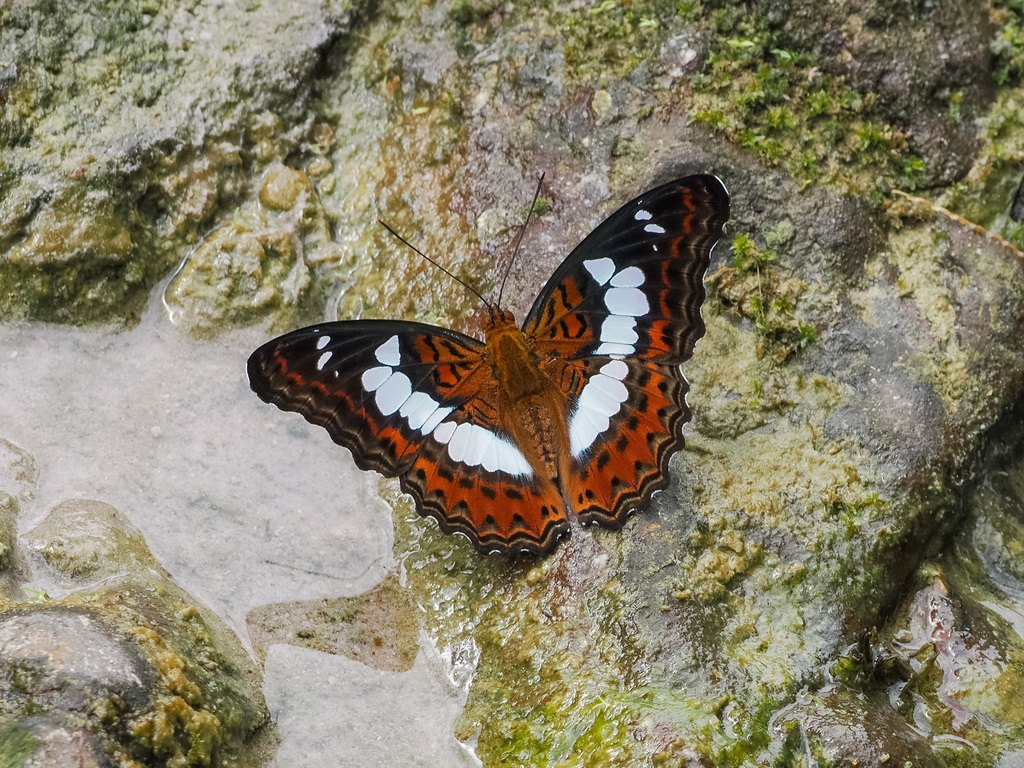
Commander
Moduza procris
Moduza procris, the commander, sometimes included in the genus Limenitis, is a medium-sized, strikingly coloured brush-footed butterfly found in South Asia and Southeast Asia. It is notable for the mode of concealment employed by its caterpillar and the cryptic camouflage of its pupa.
From the article Moduza procris on Wikipedia (CC BY-SA), quoted section by section
Description
The commander has a wingspan of about 6 to 7.5 cm (2.4 to 3.0 in). The upperside of its wings are a bright reddish brown. Towards the centre of the wing are broad white spots. In flight, one can see a bright red brown butterfly with a white band forming a V shape. There are also a few white spots scattered on the wings. Its hindwings have crenulated margins. The undersides of the wings are a whitish grey toward the base and have a row of dull reddish brown and a row of black spots along the margins. The male and female are similar in appearance.
Male and female. Upper side, ground colour rich ferruginous-red, the basal area slightly tinged with olivescent yellowish-ferruginous. Cilia alternately black and white. Forewing with three black slender bars crossing the cell, and three similar bars below the cell between the basal interspaces of the middle and lower medians; beyond the cell is a large outwardly-oblique pure bluish-white more or less triangulate spot followed by a transverse discal macular band, broadest in the dry-season brood, composed of a series of large broad pure bluish-white spots proceeding from the costa to the posterior margin, of which the upper five are subapical and disposed obliquely outward, the third and fourth being ovate, the upper two very slender and divided by the second subcostal branch, the fifth much the smallest; the next four are disposed som …
Range & habitat
Sri Lanka, Peninsular India, the Himalayas east of the Dun valley, through Kumaon, Nepal, Sikkim to Assam, Arunachal, and onto Myanmar. Locally abundant, it is common from Sri Lanka to Maharashtra. It is rare in Gujarat and far more common in the Himalayas.
Wikipedia: “Range within India”
What it does
The commander is generally found in forested regions having moderate to heavy rainfall. It usually keeps to low elevations, that is, up to 900 metres (3,000 ft) into the hills. It is fond of open glades, roadsides and clearings in forests. It is abundant along watercourses in dry and moist deciduous forests. It is also found close to villages or wherever its larval host plant Mussaenda frondosa is found. It is most common in the post-monsoon months and winter. The commander can often be spotted basking with its wings pressed flat on exposed stones in streambeds. Individuals settle down on an exposed perch high up in the trees during the heat of the day. At this time it can be seen defending its territory and driving intruding butterflies away. This butterfly has a swift flight with rapid wingbeats and alternate spurts of smooth gliding. A powerful flier, it nevertheless flies for short distances at a time. Being wary, it maintains its distance and is best caught when engrossed in mud-puddling or feeding from flowers. It regularly visits flowers from low-lying herbs to high up in the trees. Though this is a mud-puddling species, in Borneo and probably elsewhere, adults do not visit carrion or old fruit to drink liquids.
Host plants. …
Wikipedia: “Ecology”
Listen
Looking for field recordings…
Where it lives
Recorded sightings
—
geo-referenced records in GBIF, from museums, herbaria and field observers.
Drag the globe to turn it. Dots are where records exist, not a range map; darker means more records.
In the stacks
Searching the stacks…
Every page naming Moduza procris in the Biodiversity Heritage Library →
This page is assembled live from iNaturalist, GBIF, Wikipedia, the Source Library and the Internet Archive. It is not yet part of the hand-edited codex. iNaturalist taxon 182754.