- Plants
- ›Vascular Plants
- ›flowering plants
- ›Dicots
- ›Mints, Plantains, Olives, and Allies
- ›pedalium family
- ›Sesamothamnus
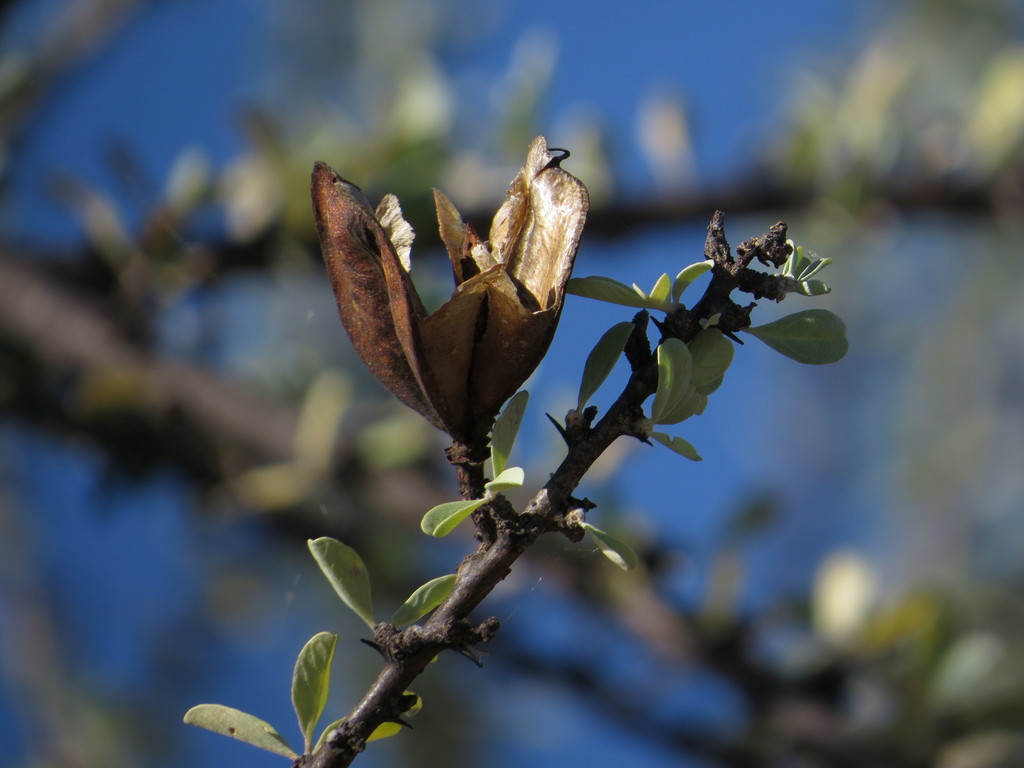
Eastern Sesamebush
Sesamothamnus lugardii
Sesamothamnus lugardii, the Transvaal sesame-bush or sesambos, is a species of plant in family Pedaliaceae, endemic to southern Namibia, eastern Botswana, southern Zimbabwe, and Kruger National Park in the Transvaal. It is a soft-stemmed shrub that grows alone or in scattered, small groups in hot, dry areas. The plant can grow to 4 meters in height with a very thick lower trunk, up to 1 meter in diameter, from which arise several thick branches. Flowers are...
From the article Sesamothamnus lugardii on Wikipedia (CC BY-SA), quoted section by section
Description
Sesamothamnus lugardii is a multi-stemmed, succulent, spiny shrub or small tree that grows up to 4 m (13 ft) tall. The trunk is characteristically swollen at the base, reaching up to 1 m (3.3 ft) in diameter, and tapers into thick, ascending branches reminiscent of a baobab. The bark is described as dark yellowish-green, papery in texture. Leaves are obovate (egg-shaped with the narrower end at the base), occurring in two forms: alternate and petiolate on long shoots, or sessile and clustered (fasciculate) on short shoots. The leaves fold upward along the midrib, are green above and paler below, with both surfaces covered in short, greyish hairs.
The flowers are large and showy, solitary in the leaf axils. They are trumpet-shaped with a long, curved corolla tube measuring approximately 10 cm (3.9 in) in length, and possess a spur at the base. The flowers are white, pink, or cream-colored, often with a purplish tinge on the exterior. Flowering occurs from September to December. The fruit is a flattened, woody capsule, notched at the base, containing winged seeds.
Range & habitat
Sesamothamnus lugardii is native to southern Africa. Its range includes southern Zimbabwe, eastern Botswana, the Limpopo, Mpumalanga, and North West provinces of South Africa. While earlier sources sometimes included Namibia, modern taxonomic treatments limit its range to Zimbabwe, Botswana, and South Africa. It is not endemic to South Africa. The species grows in hot, dry areas, often occurring alone or in scattered, small groups. It is found in a variety of habitats, including alluvial plains, Kalahari sand, rocky soils, and areas with hard loamy soil. Associated plant species include Commiphora, Catophractes alexandri, Acacia tortilis, Acacia senegal, Balanites, Salvadora australis, and Mundulea sericea.
Wikipedia: “Distribution and habitat”
What it does
The floral traits of S. lugardii suggest specialization for pollination by long-tongued hawkmoths. Flowers open in the evening, are large, sweetly scented, and pale in color, all characteristics of a moth pollination syndrome. Research has identified the convolvulus hawkmoth (Agrius convolvuli) as the primary pollinator. This species possesses a proboscis long enough to access the nectar at the base of the 10 cm (3.9 in) corolla tube while simultaneously interacting with the reproductive structures. The plant is an obligate outcrosser, meaning it relies entirely on cross-pollination by A. convolvuli for successful sexual reproduction. Fruit set is affected by florivory (flower predation). In a study conducted at Mapungubwe National Park, predation of flowers by scarab beetles resulted in low fruit set, whereas a population at a nearby private reserve with negligible florivory showed higher fruit set. Herbivory by meso- and mega-herbivores significantly impacts mature shrubs. However, the species demonstrates resilience through bark recovery and epicormic resprouting. Seedlings are rarely observed in wild populations. A study comparing populations between 2005 and 2014 noted a decrease in the number of seedlings, suggesting either sporadic recruitment patterns or a demographic bottleneck limiting establishment.
Wikipedia: “Ecology and pollination”
Where it lives
Recorded sightings
—
geo-referenced records in GBIF, from museums, herbaria and field observers.
Drag the globe to turn it. Dots are where records exist, not a range map; darker means more records.
In the stacks
Searching the stacks…
Every page naming Sesamothamnus lugardii in the Biodiversity Heritage Library →
This page is assembled live from iNaturalist, GBIF, Wikipedia, the Source Library and the Internet Archive. It is not yet part of the hand-edited codex. iNaturalist taxon 181972.