- Plants
- ›Vascular Plants
- ›flowering plants
- ›Dicots
- ›Legumes, Milkworts, and Allies
- ›Legumes
- ›Faboideae
- ›Phaseoleae
- ›Phaseolinae
- ›Dipogon
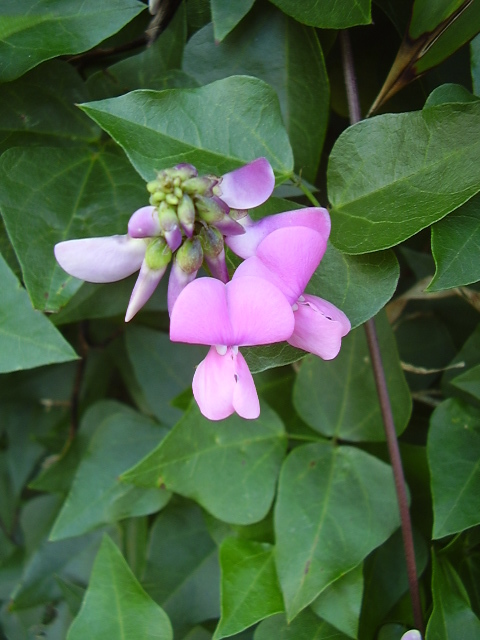
Okie bean
Dipogon lignosus
Dipogon lignosus, the okie bean, Cape sweet-pea, dolichos pea or mile-a-minute vine, is a species of flowering plant in the legume family, Fabaceae. It is the only species classified in the monotypic genus Dipogon which belongs to the subfamily Faboideae.
From the article Dipogon lignosus on Wikipedia (CC BY-SA), quoted section by section
Description
Dipogon lignosus is climbing woody, herbaceous perennial which becomes woody towards the base. The soft green stems climb over nearby structures, shrubs or trees, and can grow up to 2 m tall, extending a long way horizontally if possible. Its leaves are dark to medium green above, paler below and are composed of three diamond shaped leaflets which have a wide set base before tapering to a fine point. Each leaflet has its own stalk. The flowers are typical for the pea family and are pink, mauve, magenta and purple in colour, growing on the tips of new growth stems in short, dense racemes with long peduncles. Flowering occurs throughout spring and summer, i.e. August to January in its native South Africa. The pods are flat and sickle-shaped, each containing four to six seeds, and are formed soon after flowering. In warmer climates this is an evergreen, but it may develop a deciduous habit in areas where are subject to frosts.
Range & habitat
Dipogon lignosus has a native range that covers the Western Cape and Eastern Cape in South Africa where it prefers milder areas where it is not subjected to frost. It is an invasive weed in Australia and New Zealand and in some areas control of D. lignosus can be mandated.
Wikipedia: “Distribution”
How it is grown
Dipogon lignosus has been widely cultivated outside of South Africa from as far back as the early nineteenth century. Areas where it has been used in horticulture include Europe, Madeira, Azores, Sri Lanka, Australia, California and temperate regions of South America.
Wikipedia: “Horticulture”
Where it lives
Recorded sightings
—
geo-referenced records in GBIF, from museums, herbaria and field observers.
Drag the globe to turn it. Dots are where records exist, not a range map; darker means more records.
In the stacks
Searching the stacks…
Every page naming Dipogon lignosus in the Biodiversity Heritage Library →
This page is assembled live from iNaturalist, GBIF, Wikipedia, the Source Library and the Internet Archive. It is not yet part of the hand-edited codex. iNaturalist taxon 181739.