- Animals
- ›Chordates
- ›Vertebrates
- ›Mammals
- ›Therians
- ›Placental Mammals
- ›Primates, Rodents, and Allies
- ›Rodents
- ›Squirrels, Dormice, and Mountain Beavers
- ›Squirrels
- ›Ground and African Tree Squirrels
- ›Holarctic Ground Squirrels
- ›Ictidomys
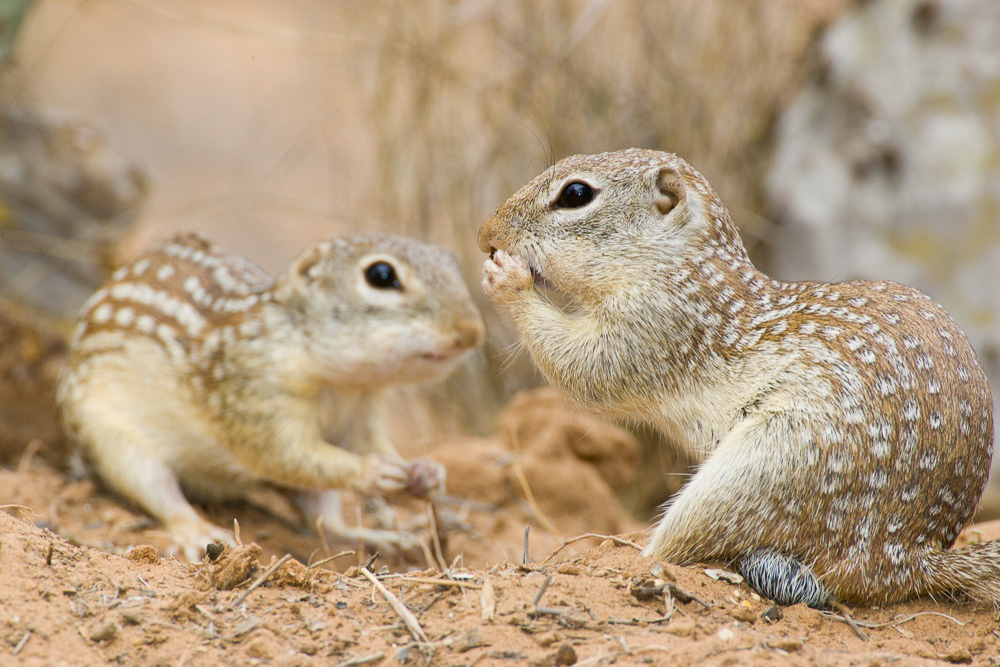
Rio Grande Ground Squirrel
Ictidomys parvidens
The Rio Grande ground squirrel (Ictidomys parvidens) is a species of squirrel in the family Sciuridae. It is found in the southwestern United States (Texas and New Mexico) and in northeastern Mexico.
From the article Rio Grande ground squirrel on Wikipedia (CC BY-SA), quoted section by section
Description
The Rio Grande ground squirrel is predominantly brown with nine broken rows of squarish white spots on its back. Its spotting is less distinct than the spotting on the thirteen-lined ground squirrel. It varies in body length from 29.9 centimetres (11.8 in) to 35.2 centimetres (13.9 in)
Range & habitat
The Rio Grande ground squirrel is found in grasslands and scrub habitat from southwestern New Mexico to northern Zacatecas and east to the gulf coast. In western Texas, it is often associated with mesquite and cholla. While much of its original habitat has been destroyed by humans, it has adapted well to human civilization and can now be found on golf courses and other grassy areas such as the sides of highways. Each squirrel normally has more than one burrow and each of them has as many as five escape tunnels. The tunnels are not marked by a mound of dirt on top. Most burrows have a sleeping chamber for the offspring which is lined with grasses.
Wikipedia: “Distribution and Habitat”
What it does
The Rio Grande ground squirrel is omnivorous. Its diet includes seeds, nuts, grains, roots, bulbs, plant stems, leaves, mice, insects, and eggs. It often stores seeds, grains, and nuts in its cheek pouches and takes them back to its den to eat later. In the summer it eats insects. It has also been documented eating roadkill.
Wikipedia: “Diet”
Listen
Looking for field recordings…
Where it lives
Recorded sightings
—
geo-referenced records in GBIF, from museums, herbaria and field observers.
Drag the globe to turn it. Dots are where records exist, not a range map; darker means more records.
In the stacks
Searching the stacks…
Every page naming Ictidomys parvidens in the Biodiversity Heritage Library →
This page is assembled live from iNaturalist, GBIF, Wikipedia, the Source Library and the Internet Archive. It is not yet part of the hand-edited codex. iNaturalist taxon 179987.