- Animals
- ›Arthropods
- ›Hexapods
- ›Insects
- ›Winged and Once-winged Insects
- ›Butterflies and Moths
- ›Butterflies
- ›Gossamer-winged Butterflies
- ›Hairstreaks
- ›Eumaeini
- ›Callophryidina
- ›Satyrium
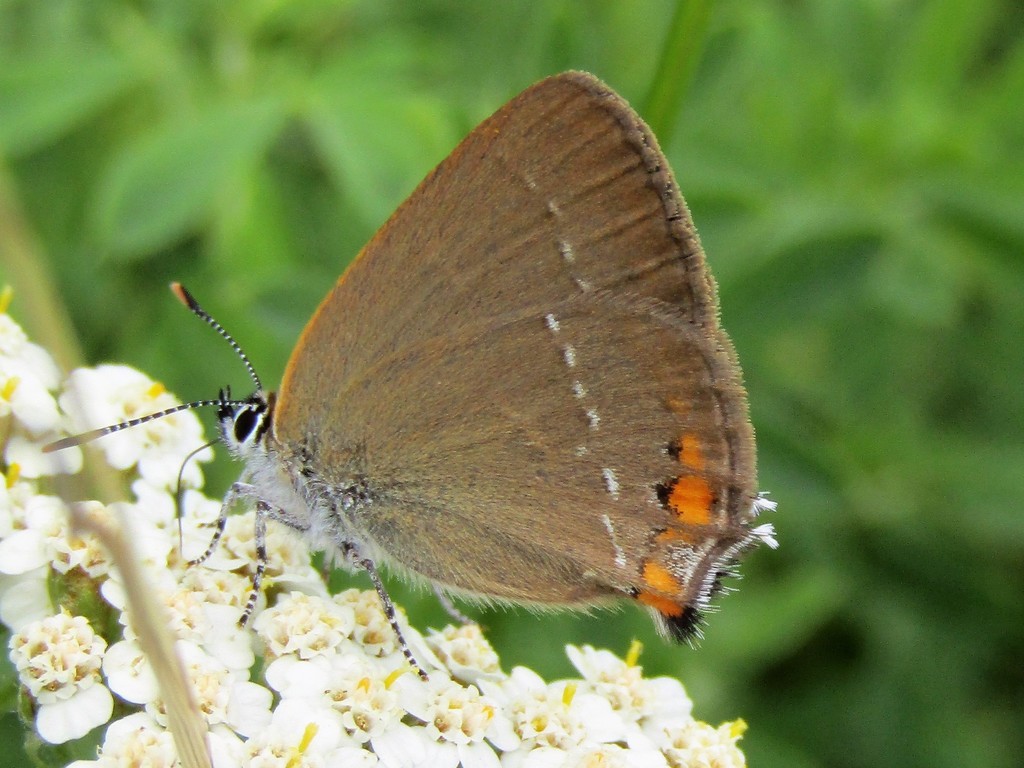
Sloe Hairstreak
Satyrium acaciae
Satyrium acaciae, the sloe hairstreak, is a butterfly in the family Lycaenidae.
From the article Satyrium acaciae on Wikipedia (CC BY-SA), quoted section by section
Description
T. acaciae F. (73b). Smaller than true ilicis, hardly so large as esculi. Above uniformly dark brown, the male bearing 1-3, the female 2-5 small red anal spots. The line of white bars on the underside is straighter, being somewhat curved outward at the anal angle of the hindwing without forming a W. Male without scent-spot. Particularly in Central Europe. From South France to Asia Minor and Transcaucasia; also in Spain, if not confounded with esculi; very local and usually rare. — abdominalis Gerh., from the Black Sea countries, is larger and has a grey instead of brown under surface with the white line broader and continuous, the forewing bearing 1-3 dark spots beneath before the hind angle. — gerhardi Stgr. (73 c) is still larger and the hindwing beneath bears blue and black spots with hardly noticeable red edges, instead of a red band. These spots are separated from the edge of the wing by a usually very distinct white marginal line. At Mardin and Aintab. — beccarii Verity, from Florence, is a very small, dwarfed, form; almost tailless, the white line of the underside nearly obsolete. — Larva pale yellowish green or grass-green, with black head, two yellowish subdorsal lines and, further laterad, small pale oblique spots; in May adult on blackthorn, especially small bushes which grow on sunny slopes: the larva can be obtained by beating. …
Wikipedia: “Description from Seitz”
Listen
Looking for field recordings…
Where it lives
Recorded sightings
—
geo-referenced records in GBIF, from museums, herbaria and field observers.
Drag the globe to turn it. Dots are where records exist, not a range map; darker means more records.
In the stacks
Searching the stacks…
Every page naming Satyrium acaciae in the Biodiversity Heritage Library →
This page is assembled live from iNaturalist, GBIF, Wikipedia, the Source Library and the Internet Archive. It is not yet part of the hand-edited codex. iNaturalist taxon 179672.