On eBird ↗
Golden White-eye
Live sightings near you, the range map, bar charts of when it is seen, and Macaulay Library photos and recordings.
Golden White-eye
Cleptornis marchei
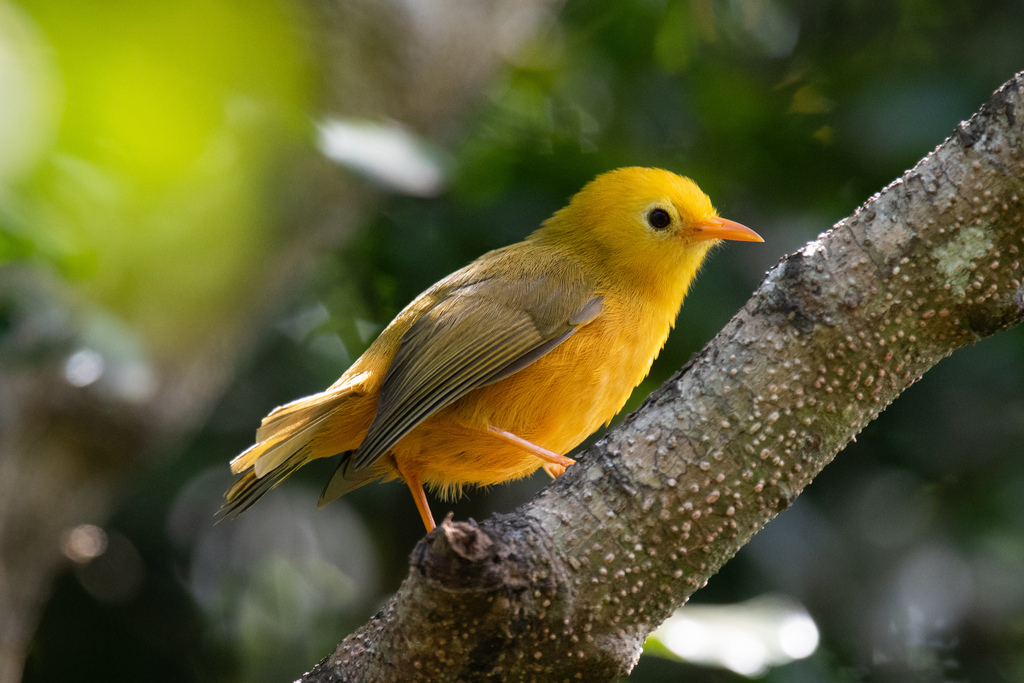
The golden white-eye (Cleptornis marchei) is a species of bird in the white-eye family, Zosteropidae. It is the only species within the genus Cleptornis. The golden white-eye was once considered to be a honeyeater in the family Meliphagidae and although it is now known to be a white-eye, its position within that family is still uncertain. The species is restricted to the islands of Saipan and Aguijan in the Northern Mariana Islands, where it is sympatric (shares its range) and competes with the related bridled white-eye. The golden white-eye has golden plumage and a pale eye-ring. It feeds on insects, fruit, and nectar and forages in pairs or small family groups. The bird is monogamous and lays two eggs in a small cup nest.
Fossil evidence shows the golden white-eye once also occurred on Tinian and Rota but was extirpated in those locations through the impact of human activities. Despite its current abundance on Saipan and Aguijan, and the fact that it has among the highest recorded densities for any bird, it is nevertheless considered to be Endangered. It is threatened by the invasive brown tree snake, which has become established on nearby Guam, and this predator is expected to cause a rapid decline in the population if it reaches Saipan. Efforts are under way to control the snakes and breed the white-eye in zoos.
From the article Golden white-eye on Wikipedia (CC BY-SA), quoted section by section
Description
The golden white-eye differs from the other white-eyes in having large eyes and an outermost primary wing feather that is not reduced (as it is in the other species). It is a large white-eye, 14 cm (5.5 in) long and weighing around 20 g (0.7 oz). The species has bright, unmistakable plumage, with: an orange-yellow head coupled with a pale eye-ring; a yellow-green back, wings, and tail; and golden orange undersides. The bill and legs are also orange. The plumage of both sexes is similar; the males can be told from the females only when examined in the hand, since the males have longer wings than the females. The juveniles have similar plumage, though duller than the adults', with brownish patches on the face and neck and brown-yellow streaks on the breast. Juveniles also have dusky bills and dull legs. The golden white-eye makes a variety of calls. The song is a long raspy warble, rendered as "séé mé-can you séé mé-I can séé yóú-can you séé mé". The species also makes rasping shorter calls and whistles when in flocks and in flight. Chicks give plaintive whistles when begging for food from adults.
Range & habitat
The golden white-eye is endemic to the Northern Mariana Islands in the western Pacific Ocean, where it currently occurs on the islands of Saipan and Aguijan. Within its range, it occupies a variety of habitats, both natural and man-made. It is common in native forests, particularly limestone forests, but also occurs in open shrubland and suburban areas. On Saipan, the only habitats it is absent from are the marshes around Lake Susupe and grassy savannas.
Wikipedia: “Distribution and habitat”
What it does
Like other white-eyes, the golden white-eye is diurnal. In contrast to the bridled white-eye, which forages in groups and is not territorial, the golden white-eye occurs in pairs or small family groups consisting of a breeding pair and fledged young. The golden white-eye is also territorial, and pairs will sing throughout the day in response to neighbouring pairs. Groups can become aggressive when they encounter one another. The golden white-eye is also aggressive towards the smaller bridled white-eye, chasing it away from food and perches and flying through flocks of them in order to disperse them. While it chases other forest passerines, it is less aggressive towards them, and in fact the rufous fantail seeks out the golden white-eye, foraging behind it to snatch insects flushed by the latter species. The golden white-eye is socially dominant over the bridled white-eyes and rufous fantails, but it is subordinate to the Micronesian myzomela and is chased by that species. It is also occasionally chased by the fantails if it approaches their nests too closely.
Diet and feeding. The golden white-eye is a generalist, feeding on fruit, berries, and insects. Nectar forms part of the diet, and, along with the Micronesian myzomela and the bridled white-eye, the golden white-eye is a pollinator of some trees, albeit not one as important as these other species. …
Wikipedia: “Behaviour”
Listen
Looking for field recordings…
Where it lives
Recorded sightings
—
geo-referenced records in GBIF, from museums, herbaria and field observers.
Drag the globe to turn it. Dots are where records exist, not a range map; darker means more records.
In the stacks
Searching the stacks…
Every page naming Cleptornis marchei in the Biodiversity Heritage Library →
This page is assembled live from iNaturalist, GBIF, Wikipedia, the Source Library and the Internet Archive. It is not yet part of the hand-edited codex. iNaturalist taxon 17540.