On eBird ↗
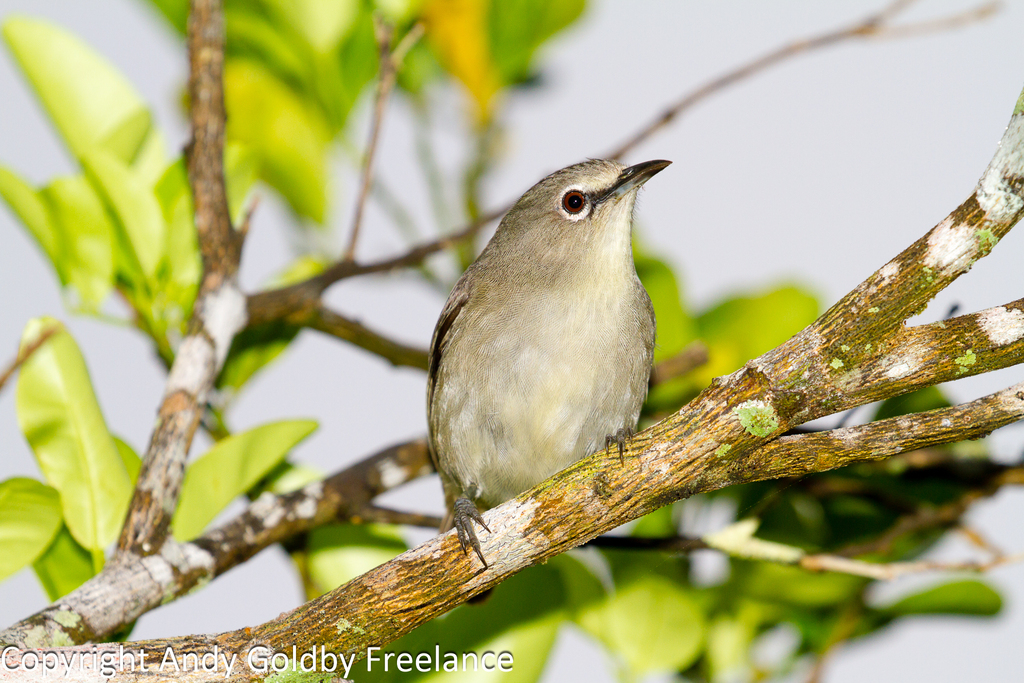
Seychelles White-eye
Live sightings near you, the range map, bar charts of when it is seen, and Macaulay Library photos and recordings.
Seychelles White-eye
Zosterops modestus
The Seychelles white-eye (Zosterops modestus) is a rare warbler-like perching bird from the family of white-eyes (Zosteropidae). It is endemic to the Seychelles. At one time thought to be extinct, it was rediscovered and is now listed as Vulnerable by the IUCN.
From the article Seychelles white-eye on Wikipedia (CC BY-SA), quoted section by section
Description
This ten-to-eleven-centimetre (3.9 to 4.3 in) long bird has a plumage of olive-grey upper-parts and dull-coloured underparts. It is further characterized by a narrow, white eye-ring, a rather long dark-grey tail and a small sharp bill. Its diet consists of insect larvae, locusts, and grasshoppers as well as berries and seeds. The Seychelles white-eye's breeding season is from September to April, in which a clutch of two to seven eggs is laid into a cup-shaped nest. The incubation time is thirteen to fifteen days and the young are fully fledged after eleven to sixteen days. After that, adults look after their young for another two months. The species' melodious and complex song consists of nasal tones. Due to its ecology and foraging habits (in the canopy of high trees) it is difficult to observe. The existence of a complex cooperative breeding system was discovered among Seychelles white-eyes. It is apparently unique among all species of white-eyes and appears as a very peculiar social breeding organisation among birds in general. Within the same breeding territory, the individual composition of nesting groups constantly changes, often involving birds that sometimes also contribute to nests in other territories.
Listen
Looking for field recordings…
Where it lives
Recorded sightings
—
geo-referenced records in GBIF, from museums, herbaria and field observers.
Drag the globe to turn it. Dots are where records exist, not a range map; darker means more records.
In the stacks
Searching the stacks…
Every page naming Zosterops modestus in the Biodiversity Heritage Library →
This page is assembled live from iNaturalist, GBIF, Wikipedia, the Source Library and the Internet Archive. It is not yet part of the hand-edited codex. iNaturalist taxon 17494.