On eBird ↗
Dwarf Vireo
Live sightings near you, the range map, bar charts of when it is seen, and Macaulay Library photos and recordings.
Dwarf Vireo
Vireo nelsoni
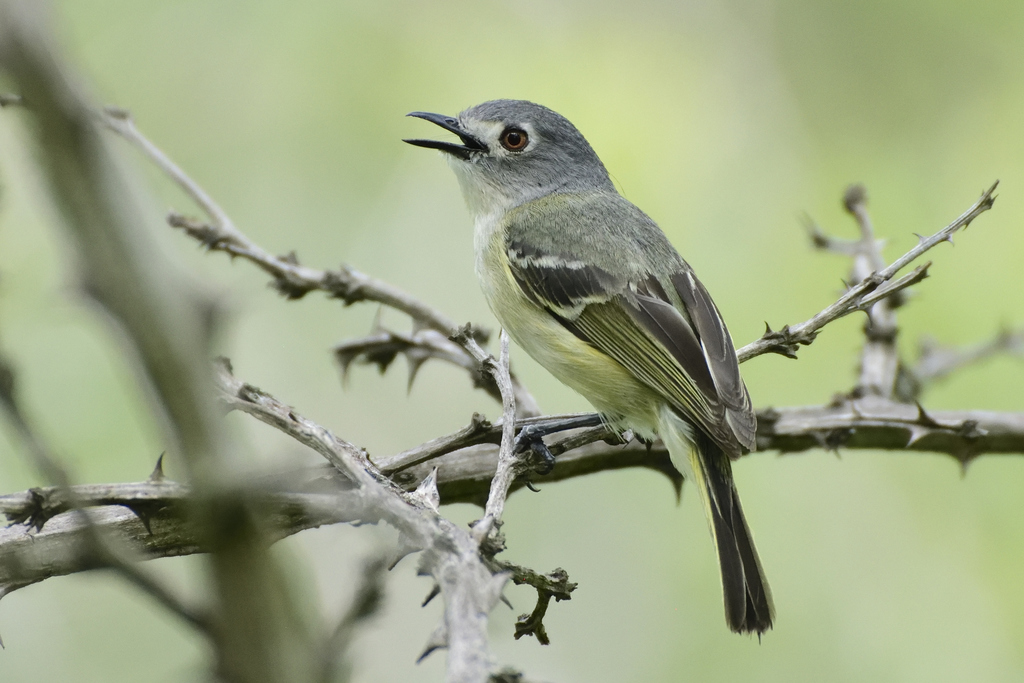
The dwarf vireo (Vireo nelsoni) is a species of bird in the family Vireonidae, the vireos, greenlets, and shrike-babblers. It is endemic to Mexico.
From the article Dwarf vireo on Wikipedia (CC BY-SA), quoted section by section
Description
The dwarf vireo is 10 to 11 cm (3.9 to 4.3 in) long; two individuals weighed 9.2 and 9.4 g (0.32 and 0.33 oz). The sexes have similar plumage. Adult males have a bluish gray crown and adult females an olive crown. Both sexes have grayish white lores and a grayish white eye-ring with a gap above the eye on an otherwise grayish olive to olive face. Their upperparts are grayish olive to olive. Their wing coverts are dusky with grayish white tips that form two wing bars. Their flight feathers are dusky with pale olive gray edges. Their tail is dusky with pale yellowish olive green edges on the feathers. Their throat and underparts are white with a faint grayish wash on the breast. They have a reddish iris, a black or blackish bill, and blue-gray legs and feet.
Range & habitat
The dwarf vireo is found inland in southwestern Mexico from Jalisco and southern Guerrero south to central Oaxaca. It inhabits dry (semi-arid to arid) scrublands that often have oaks. In elevation it ranges between 1,000 and 2,500 m (3,300 and 8,200 ft).
Wikipedia: “Distribution and habitat”
What it does
The dwarf vireo's diet is not known though it is assumed to eat mostly arthropods and some fruit. It typically forages singly or in pairs and typically near the ground.
Wikipedia: “Feeding”
Listen
Looking for field recordings…
Where it lives
Recorded sightings
—
geo-referenced records in GBIF, from museums, herbaria and field observers.
Drag the globe to turn it. Dots are where records exist, not a range map; darker means more records.
In the stacks
Searching the stacks…
Every page naming Vireo nelsoni in the Biodiversity Heritage Library →
This page is assembled live from iNaturalist, GBIF, Wikipedia, the Source Library and the Internet Archive. It is not yet part of the hand-edited codex. iNaturalist taxon 17389.