- Plants
- ›Vascular Plants
- ›flowering plants
- ›monocots
- ›Agaves, Orchids, Irises, and Allies
- ›agave and allies
- ›Century plant subfamily
- ›Yucca
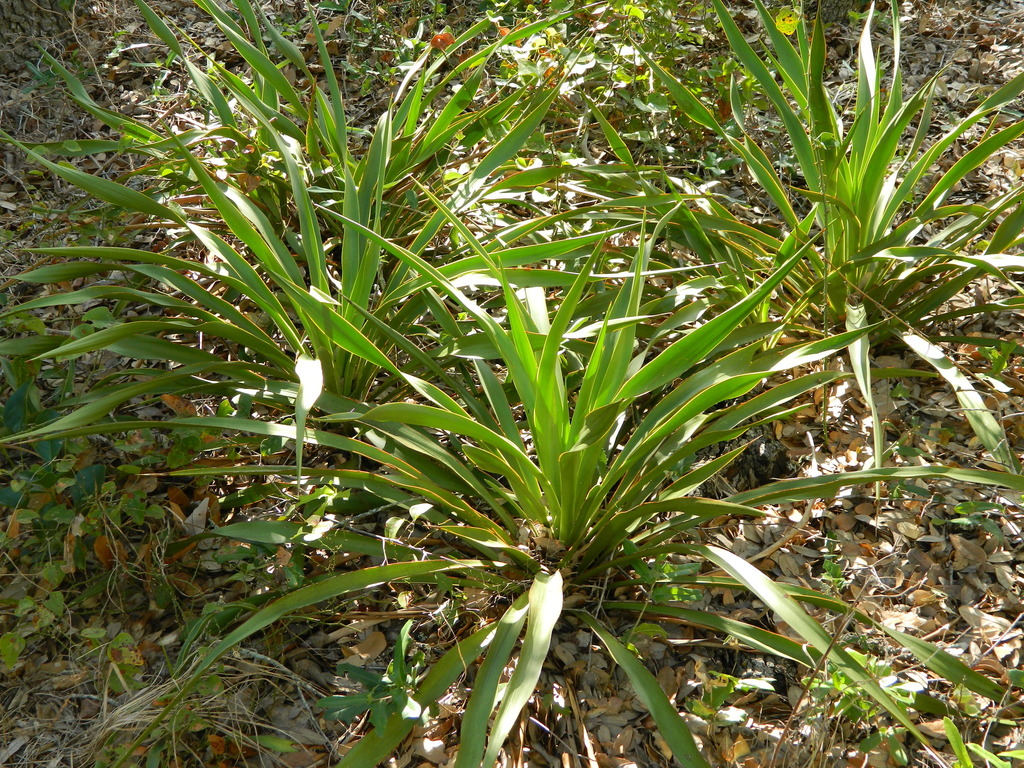
Twisted-leaf Yucca
Yucca rupicola
Yucca rupicola is a plant in the family Asparagaceae, known as the twistleaf yucca, twisted-leaf yucca, Texas yucca or twisted-leaf Spanish-dagger. The species was described by George Heinrich Adolf Scheele in 1850. This is a small, acaulescent plant with distinctive twisted leaves. It is native to the Edwards Plateau region of Texas and also to northeastern Mexico (Coahuila, Nuevo León).
From the article Yucca rupicola on Wikipedia (CC BY-SA), quoted section by section
Description
Yucca rupicola forms colonies of rosettes, lacking trunks above-ground but producing a branched caudex under the surface. Leaves are narrowly lanceolate, slightly succulent, twisted, up to 60 cm long but about 40 mm wide at its widest point. Flowers are pendant (drooping), bell-shaped, white or greenish, and bloom from April through June. The blooming stalk can measure up to 1.8 m tall (6 feet). Fruit is a dry capsule up to 6 cm long that is dull black in appearance.
Range & habitat
Yucca rupicola is native to the Edwards Plateau region of Texas and Coahuila and Nuevo Leon in Mexico. Yucca rupicola grows in rocky, open areas, including limestone ledges, grassy plains, and open woodlands. It grows well in dry, caliche soil in sun or partial shade.
Wikipedia: “Distribution and habitat”
What it does
Yucca rupicola is a larval host for Megathymus yuccae, which feed on the tips of leaves when young and bore down to the root to pupate. The blossoms are also a source of nectar for moths.
Wikipedia: “Ecology”
Where it lives
Recorded sightings
—
geo-referenced records in GBIF, from museums, herbaria and field observers.
Drag the globe to turn it. Dots are where records exist, not a range map; darker means more records.
In the stacks
Searching the stacks…
Every page naming Yucca rupicola in the Biodiversity Heritage Library →
This page is assembled live from iNaturalist, GBIF, Wikipedia, the Source Library and the Internet Archive. It is not yet part of the hand-edited codex. iNaturalist taxon 170393.