- Plants
- ›Vascular Plants
- ›flowering plants
- ›Dicots
- ›Mints, Plantains, Olives, and Allies
- ›Verbena Family
- ›Verbeneae
- ›Verbena
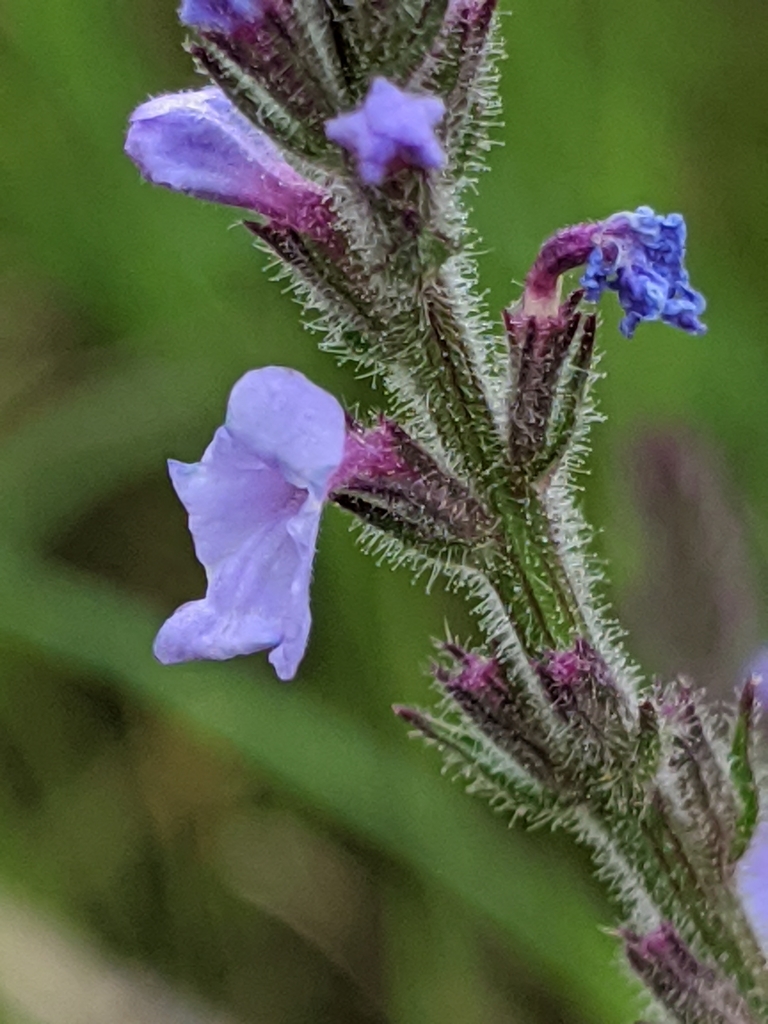
Woolly Vervain
Verbena canescens
Verbena canescens, often called the woolly or gray vervain, is a plant species belonging to the family Verbenaceae.
From the article Verbena canescens on Wikipedia (CC BY-SA), quoted section by section
Description
The canescens in the binomial Verbena canescens, refers to the fine, grayish-white hairs (canescence) covering the plants' green parts. The plant is herbaceous and reaches about 16 inches tall (~40 cm). The stems, instead of being round in cross-section, are squarish. Leaves are longer than wide and their margins are incised with large teeth or shallow lobes. Several pinkish purple to blue flowers may arise at stem tips, with each flower having below it a leaf-like, sometimes deeply lobed bract. Flower corollas display a somewhat bisymmetrical floral symmetry—they're zygomorphic.
Range & habitat
In the US, Verbena canescens occurs mainly in central and southern Texas but turns up here and there introduced elsewhere in warmer parts of the country. This is seen on the map of research-grade observations of the species on the species page at the iNaturalist website. That map also indicates that Verbena canescens occurs throughout Mexico's interior highlands, the Mexican Plateau.
Wikipedia: “Distribution”
Where it lives
Recorded sightings
—
geo-referenced records in GBIF, from museums, herbaria and field observers.
Drag the globe to turn it. Dots are where records exist, not a range map; darker means more records.
In the stacks
Searching the stacks…
Every page naming Verbena canescens in the Biodiversity Heritage Library →
This page is assembled live from iNaturalist, GBIF, Wikipedia, the Source Library and the Internet Archive. It is not yet part of the hand-edited codex. iNaturalist taxon 170143.