- Plants
- ›Vascular Plants
- ›flowering plants
- ›Dicots
- ›honeysuckles, moschatels, and allies
- ›honeysuckle family
- ›Valerians and Allies
- ›Valeriana
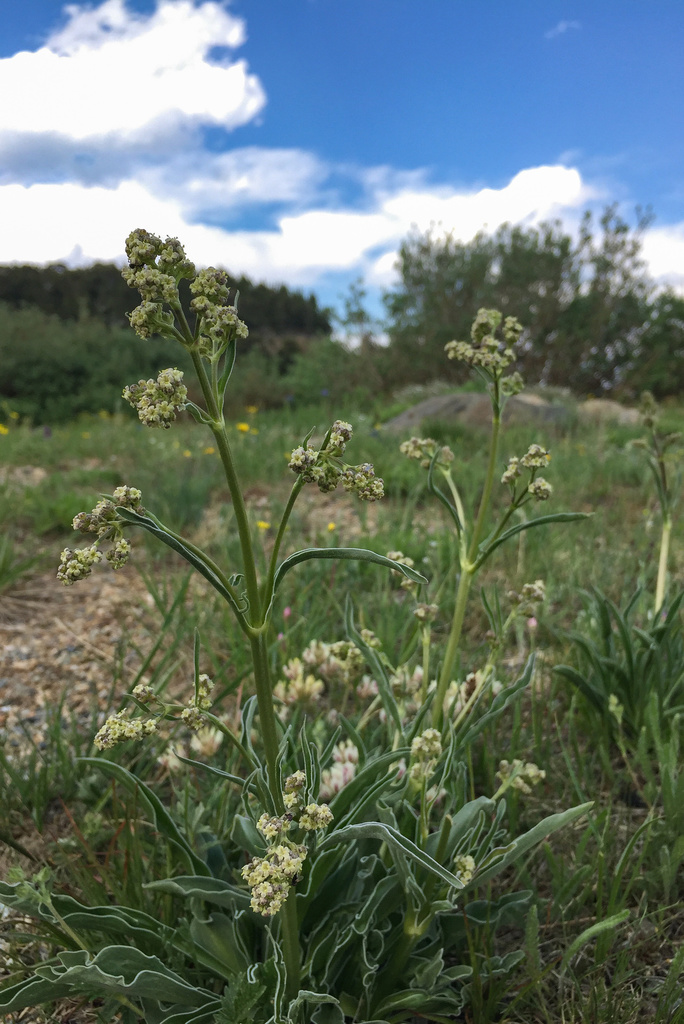
edible valerian
Valeriana edulis
Valeriana edulis, the tobacco root or edible valerian, a species in the Caprifoliaceae family, is a dioecious perennial flowering plant native to western and central North America. Despite its common name, tobacco root is not closely related to tobacco, but is instead more closely related to elderberry, honeysuckle, and teasel (Caprifoliaceae s.l.).
From the article Valeriana edulis on Wikipedia (CC BY-SA), quoted section by section
Description
Edible valerian is a long-lived herbaceous plant. It has a long, often forked, cone shaped taproot that can be 0.8 to 3 centimeters thick. The exterior of the root is black, but its inside is bright yellow. Atop the root it has a short, branched caudex covered by deep brown to almost black bases of leaves from prior years. The stems will have two to six leaf pairs, but most of a plant's leaves are basal. The leaves are occasionally as short as 6 centimeters (2.5 in), but more often are 10 to 40 cm (4–15.5 in). Their width is typically 0.3–4.2 cm with rare instances of reaching 6.5 cm. Inflorescences are born on one to four elongated, sparsely leaved stems usually around 0.5–1.5 meters tall. Flowers are small (0.5 mm diameter for pistillate flowers, 2.5–3.5 mm diameter for stamenate flowers) and cream or white. In the US and Canada blooming can be as early as June or as late as August. In Mexico subspecies procera blooms and goes to seed in August and October.
Range & habitat
The native range of edible valarian is separated into two populations in North America. An eastern population that grows in the Midwestern United States in southeastern Minnesota, Iowa, southern Wisconsin, northern Illinois, northwest Indiana, Ohio, and southern Michigan. This also extends across the international border into southwestern Ontario. This eastern population is classified as variety ciliata and grows in swamps and bogs largely in areas that were glaciated though also in the Driftless Area in southwestern Wisconsin. The western population's northernmost extent is in southern British Columbia. In the United States it is found in eastern Washington and Oregon, through much of Idaho, and western Montana. In South Dakota it is only recorded in three western counties, but it is widespread in Wyoming and the western, mountainous counties of Colorado. It is also widespread in Utah and Nevada, but is not found in California. It is native to both Arizona and New Mexico. To the north it is all subspecies edulis, but the range overlaps in areas of Mexico with subspecies procera. In the northwest it only grows in Sonora. In the northeast it is known from Chihuahua, Coahuila, Durango, San Luis Potosí, Hidalgo, and Aguascalientes and is also in the state of Veracruz on the gulf. …
Wikipedia: “Range and habitat”
What it does
The small, shallow flowers of edible valerian make its pollen and nectar resources available to a wide range of small, generalist pollinators. In Colorado, solitary bees, flies, and moths are the most frequent floral visitors. Growth data indicate that individual plants may live up to 300 years.
Conservation status. The conservation organization NatureServe evaluated edible valarian in 1987 and found the species to be secure (G5) at the global level. The subspecies V. e. ciliata was listed as Endangered in Canada in 2018. Population extinctions in Ontario were primarily caused by wetland habitat degradation and loss to urban development and agriculture. Competition from invasive reed canary grass may be responsible for declining abundance at the largest extant population. In the United States, V. e. ciliata is not federally protected, but is considered a vulnerable variety (T3) by NatureServe when evaluated in 2000. At the state-level, it is listed as critically imperiled (S1) in Indiana, and Ohio, though the state of Ohio lists it as an endangered species as Valeriana ciliata. It is state threatened in Minnesota, and Michigan, and as a species of Special Concern in Wisconsin and Iowa. It is not listed only in Illinois.
Wikipedia: “Ecology”
At the table
Edible valerian has long been used as food. One of the earliest written accounts is from the journal of explorer John Charles Frémont in the 1840s:
I ate here, for the first time, the kooyah, or tobacco root, (Valeriana edulis) the principal edible root among the Indians who inhabit the upper waters of the streams on the western side of the mountains. It has a very strong and remarkably peculiar taste and odor, which I can compare to no other vegetable that I am acquainted with, and which to some persons is extremely offensive. It was characterized by Mr. Preuss as the most horrid food he had ever put in his mouth; and when, in the evening, one of the chiefs sent his wife to me with a portion which she had prepared as a delicacy to regale us, the odor immediately drove him out of the lodge; and frequently afterwards he used to beg that when those who liked it had taken what they desired, it might be sent away. To others, however, the taste is rather an agreeable one, and I was afterwards always glad when it formed an addition to our scanty meals. …
Wikipedia: “Uses”
Where it lives
Recorded sightings
—
geo-referenced records in GBIF, from museums, herbaria and field observers.
Drag the globe to turn it. Dots are where records exist, not a range map; darker means more records.
In the stacks
Searching the stacks…
Every page naming Valeriana edulis in the Biodiversity Heritage Library →
This page is assembled live from iNaturalist, GBIF, Wikipedia, the Source Library and the Internet Archive. It is not yet part of the hand-edited codex. iNaturalist taxon 170113.