- Plants
- ›Vascular Plants
- ›flowering plants
- ›monocots
- ›lilies, supplejacks, and allies
- ›Herb-Paris, False Hellebores, Trilliums and allies
- ›Parideae
- ›Trillium
- ›Sessilia
- ›Trillium cuneatum
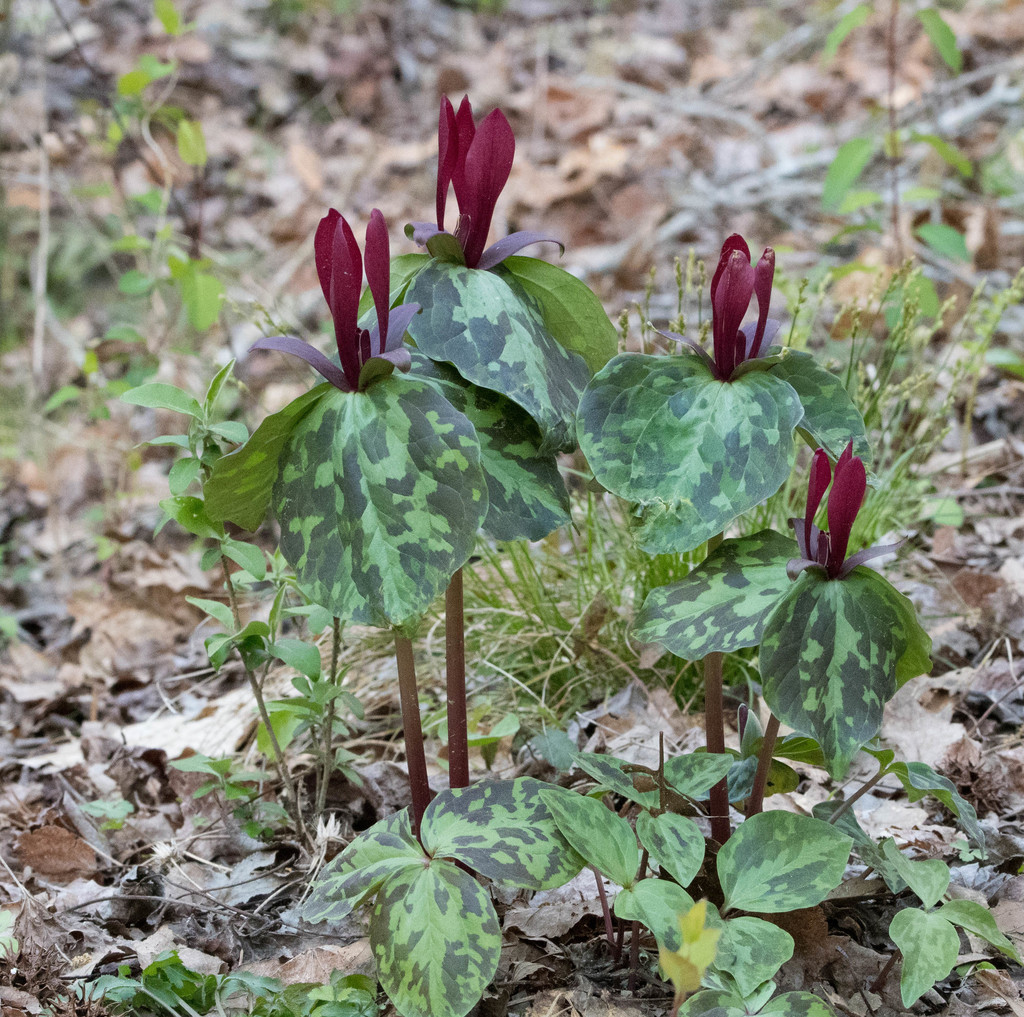
spotted wakerobin
Trillium maculatum
Trillium maculatum, the spotted wakerobin or spotted trillium, is a species of flowering plant in the family Melanthiaceae. It is a member of the Trillium cuneatum complex, a closely related group of sessile-flowered trilliums. The species is endemic to the southeastern United States, ranging across Alabama, Georgia, South Carolina, and northern Florida.
From the article Trillium maculatum on Wikipedia (CC BY-SA), quoted section by section
Description
Trillium maculatum is a perennial, herbaceous, flowering plant that persists by means of an underground rhizome. Like all trilliums, it has a whorl of three bracts (leaves) and a single trimerous flower with three sepals, three petals, two whorls of three stamens each, and three carpels (fused into a single ovary with three stigmas). It has a sessile flower (no flower stalk), erect petals, and mottled leaves. Its flower petals are deep red or reddish-purple but occasionally yellow.
Range & habitat
Trillium maculatum is endemic to the southeastern United States, ranging across South Carolina, Georgia, Alabama, and northern Florida.
Wikipedia: “Distribution and habitat”
Where it lives
Recorded sightings
—
geo-referenced records in GBIF, from museums, herbaria and field observers.
Drag the globe to turn it. Dots are where records exist, not a range map; darker means more records.
In the stacks
Searching the stacks…
Every page naming Trillium maculatum in the Biodiversity Heritage Library →
This page is assembled live from iNaturalist, GBIF, Wikipedia, the Source Library and the Internet Archive. It is not yet part of the hand-edited codex. iNaturalist taxon 169993.