- Plants
- ›Vascular Plants
- ›flowering plants
- ›monocots
- ›lilies, supplejacks, and allies
- ›Herb-Paris, False Hellebores, Trilliums and allies
- ›Parideae
- ›Trillium
- ›Delostylis
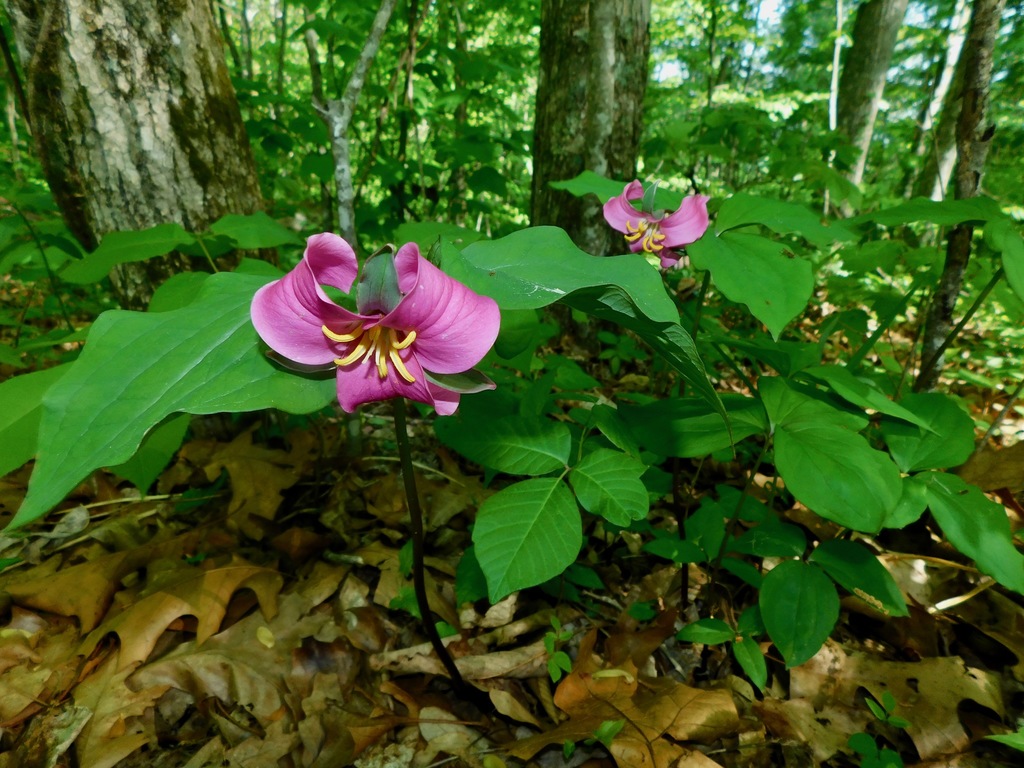
bashful wakerobin
Trillium catesbaei
Trillium catesbaei, also known as bashful wakerobin or rosy wake-robin, is a spring flowering perennial plant found in the southeastern United States. Like most trilliums, it prefers moist, humus-rich soil in shade. Its northern limit includes the Great Smoky Mountains and other parts of North Carolina and Tennessee. Most of its populations are in the Piedmont from North Carolina to Alabama, under deciduous trees such as American beech, various oak and hickory species, and tulip poplar....
From the article Trillium catesbaei on Wikipedia (CC BY-SA), quoted section by section
Description
Trillium catesbaei is a perennial herb spreading by means of underground rhizomes. Stems are up to 45 cm tall, with white, pink, or rose-colored flowers that sometimes turn darker pink as they get older. Sometimes the flowers are hidden behind green or yellow bracts (hence the "bashful" part of one of the common names).
Range & habitat
Trillium catesbaei is found in the southeastern United States. Like most trilliums, it prefers moist, humus-rich soil in shade. Its northern limit includes the Great Smoky Mountains and other parts of North Carolina and Tennessee. Most of its populations are in the Piedmont from North Carolina to Alabama, under deciduous trees such as American beech, various oak and hickory species, and tulip poplar. Its southernmost natural occurrence is in Escambia County, Alabama.
Wikipedia: “Distribution and habitat”
Where it lives
Recorded sightings
—
geo-referenced records in GBIF, from museums, herbaria and field observers.
Drag the globe to turn it. Dots are where records exist, not a range map; darker means more records.
In the stacks
Searching the stacks…
Every page naming Trillium catesbaei in the Biodiversity Heritage Library →
This page is assembled live from iNaturalist, GBIF, Wikipedia, the Source Library and the Internet Archive. It is not yet part of the hand-edited codex. iNaturalist taxon 169983.