- Plants
- ›Vascular Plants
- ›flowering plants
- ›Dicots
- ›Mallows, Rock Roses, and Allies
- ›Mallow and Hibiscus Family
- ›Linden subfamily
- ›Tilia
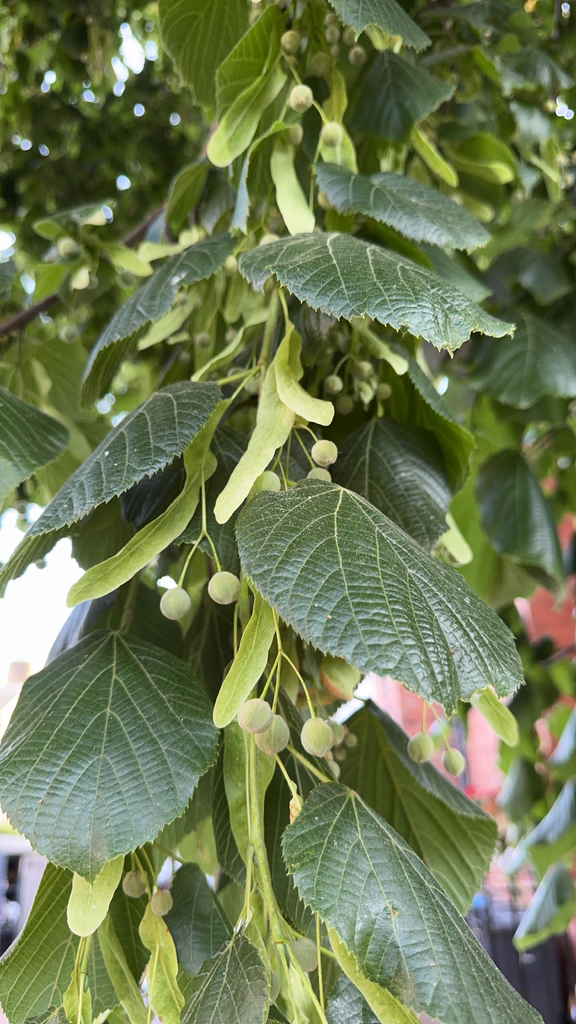
Bigleaf Linden
Tilia platyphyllos
Tilia platyphyllos, the large-leaved lime, broad-leaved lime, or large-leaved linden, is a species of flowering plant in the family Malvaceae (Tiliaceae). It is a deciduous tree, native to much of continental Europe including southwestern Great Britain, typically growing on limestone-derived soils. It is not native in Scotland or Ireland, but is naturalised there. The name "lime", possibly a corruption of "line" originally from "lind", has been in use for centuries and also attaches to other species of Tilia. It is not, however, closely related to the lime fruit tree, a species of citrus. The specific epithet platyphyllos (Greek: πλατύφυλλος) means "with broad leaves" in Greek.
From the article Tilia platyphyllos on Wikipedia (CC BY-SA), quoted section by section
Description
Tilia platyphyllos is a narrowly domed tree with a moderate growth rate, and can eventually attain a height of 40 metres (130 ft), though more typically 20–25 m tall when open-grown away from other trees. The reddish-brown young stems later develop dark grey bark with fine fissures and furrows. The branches spread upwards at wide angles. The twigs are reddish-green and slightly pubescent. The foliage consists of simple, alternately arranged leaves. As indicated by its common name, this tree has larger leaves than the related Tilia cordata (small-leaved lime), 6 to 9 cm (exceptionally 15 cm) long and broad. They are ovate to cordate, mid to dark green above and below, with white downy hair on the underside (except in subsp. pseudorubra), particularly along the veins, tapering into a mucronate tip. The margin is sharply serrate, and the base cordate; the venation is pinnate along a midrib. The pubescent petiole is usually 3–4 cm long, but can vary between 1.5–5 cm. The autumn foliage is yellow-green to yellow. The small, fragrant, yellowish-white flowers are arranged in drooping, cymose clusters in groups of 3 to 4. Their whitish-green, leaf-like bracts have an oblong-obovate shape. The geniculate peduncles are between 1.5–3 cm long. The hermaphroditic flowers have 5 sepals and 5 petals, numerous stamens, but no staminodes. The superior ovary is 2–10 locular with one smooth style. …
How it is grown
Tilia platyphyllos is widely planted throughout the temperate world as an ornamental tree in parks and city streets. Numerous cultivars are available, including 'Aurea', (golden leafed), 'Fastigiata', 'Laciniata' (seemingly torn leaves), 'Örebro' (columnar), 'Princes Street' (narrow crown), 'Rubra' (red twigged), 'Tortuosa' (twisted branches), and 'Tiltstone Filigree' (upswept branches). The cultivar 'Rubra' has gained the Royal Horticultural Society's Award of Garden Merit.
Wikipedia: “Cultivation”
Where it lives
Recorded sightings
—
geo-referenced records in GBIF, from museums, herbaria and field observers.
Drag the globe to turn it. Dots are where records exist, not a range map; darker means more records.
In the stacks
Searching the stacks…
Every page naming Tilia platyphyllos in the Biodiversity Heritage Library →
This page is assembled live from iNaturalist, GBIF, Wikipedia, the Source Library and the Internet Archive. It is not yet part of the hand-edited codex. iNaturalist taxon 169761.