- Plants
- ›Vascular Plants
- ›flowering plants
- ›Dicots
- ›Sunflowers, Bellflowers, Fanflowers, and Allies
- ›Sunflowers, Daisies, Asters, and Allies
- ›Asteroideae
- ›Helenieae
- ›Tetraneurinae
- ›Tetraneuris
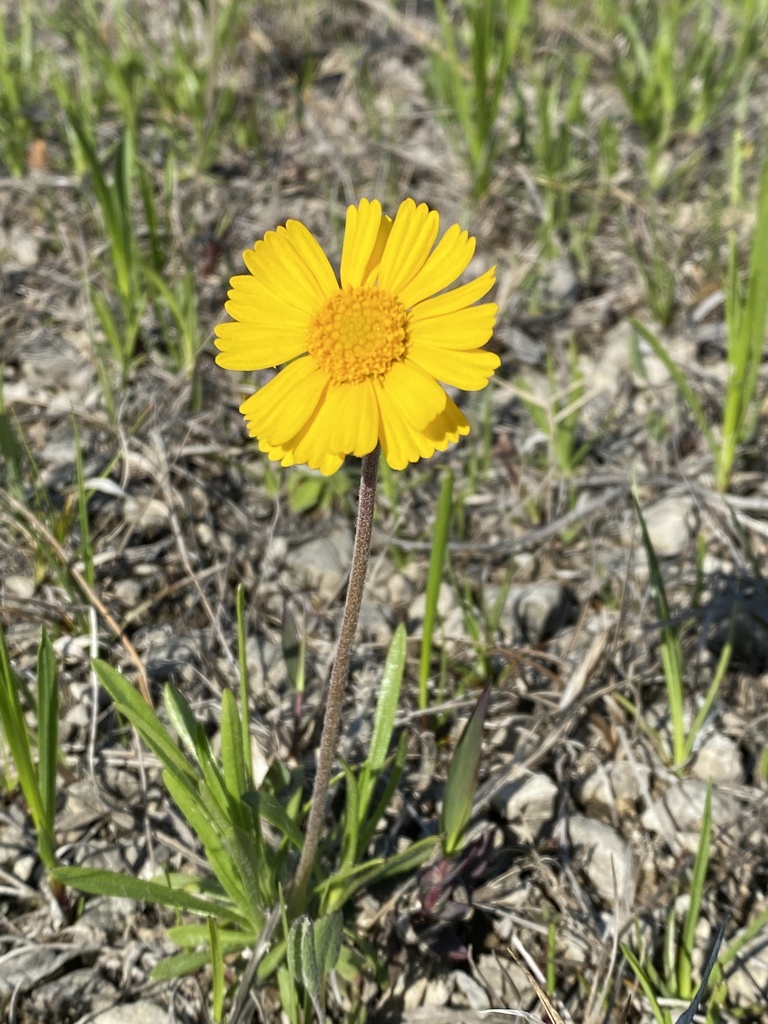
lakeside daisy
Tetraneuris herbacea
Tetraneuris herbacea is a rare species of flowering plant in the aster family known by the common names eastern fournerved daisy, lakeside daisy, fournerved starflower, and Manitoulin gold. It is native to and endemic to the Great Lakes region in North America, where it is present in Ontario, Ohio, Michigan, and Illinois. It is threatened by habitat destruction and degradation by several forces, including limestone quarrying, recreational activity, fire suppression, and construction. It is a federally listed threatened species of the United States and of Canada.
From the article Tetraneuris herbacea on Wikipedia (CC BY-SA), quoted section by section
Description
Tetraneuris herbacea is a perennial herb growing from a branching caudex with one or more erect stems measuring 6 to about 35 centimeters (2.4-14.0 inches) tall. The leaves are located around the base of the plant and have rubbery, glandular blades. The inflorescence is a single flower head borne on a hairy peduncle. The head contains 50-250 yellow disc florets surrounded by 7-27 (occasionally 0) yellow ray florets each ray measuring 1 or 2 centimeters (0.4-0.8) in length. The fruit is an achene tipped with a pappus of scales.
What it does
Tetraneuris herbacea is known from just a few natural and introduced populations. In Ontario there are about 20 populations all located at the shores of Lake Huron on the Bruce Peninsula and Manitoulin Island. In Ohio, the plant only occurs naturally in Ottawa County, where it can be found at the Lakeside Daisy State Nature Preserve, a protected area named in its honor. There is an introduced population on Kelleys Island, Ohio, as well. In Illinois, naturally occurring lakeside daisies were last seen in 1981, and today the daisies occurring there are introduced populations in nature preserves. In Michigan there is one population in Mackinac County on the Upper Peninsula, which may or may not be naturally occurring. Tetraneuris herbacea occurs on alvars, a type of limestone pavement with little plant cover. These rocky outcrops have thin, alkaline soils and are quite dry in the dry seasons, making them inhospitable for many other plant species, so the lakeside daisy grows in unshaded full sun. In Michigan the habitat is based on tufa and marl, different types of limestone substrate. Tetraneuris herbacea is threatened by the loss of its habitat. The limestone plain where it grows naturally in Ohio, the largest population within the bounds of the United States, is privately owned by a quarrying company that mines the rock. …
Wikipedia: “Ecology”
Where it lives
Recorded sightings
—
geo-referenced records in GBIF, from museums, herbaria and field observers.
Drag the globe to turn it. Dots are where records exist, not a range map; darker means more records.
In the stacks
Searching the stacks…
Every page naming Tetraneuris herbacea in the Biodiversity Heritage Library →
This page is assembled live from iNaturalist, GBIF, Wikipedia, the Source Library and the Internet Archive. It is not yet part of the hand-edited codex. iNaturalist taxon 169625.