- Plants
- ›Vascular Plants
- ›flowering plants
- ›Dicots
- ›Mints, Plantains, Olives, and Allies
- ›Verbena Family
- ›Duranteae
- ›Stachytarpheta
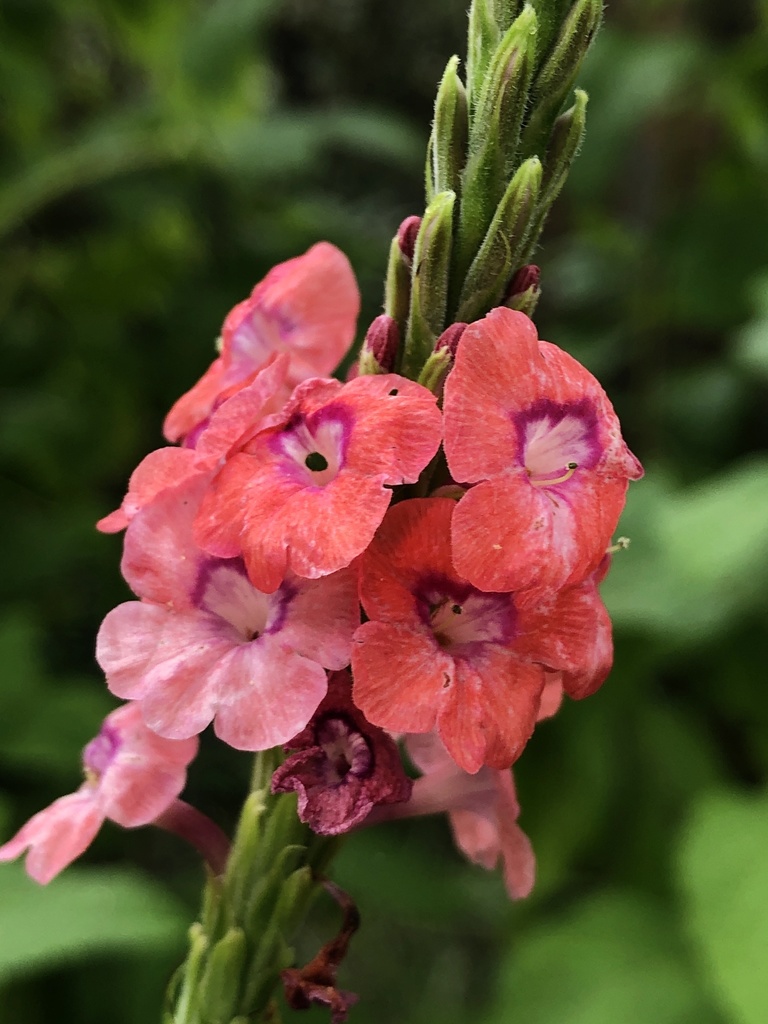
Pink Snakeweed
Stachytarpheta mutabilis
Stachytarpheta mutabilis is a species of flowering plant in the verbena family known by the common names changeable velvetberry, coral porterweed, pink snakeweed, red snakeweed, and pink rat tail. It is native to Mexico, the Caribbean, and South America. It can be found in many other places as an introduced species. It is cultivated as an ornamental plant.
From the article Stachytarpheta mutabilis on Wikipedia (CC BY-SA), quoted section by section
Description
This species is a perennial herb or subshrub generally growing 10 to 20 centimeters tall, sometimes reaching half a meter. The hairy stems have oppositely arranged leaves. The leaf blades are leathery in texture and oblong or lance-shaped. They measure up to 12 centimeters long. The inflorescence is a narrow spike up to 60 centimeters long. The flowers come in many shades of red and pink, or violet (Stachytarpheta mutabilis var. violacea). This species sometimes escapes cultivation and becomes established in the wild. It can be weedy, growing in disturbed habitat such as pastures and roadsides. This plant is an introduced invasive species in Fiji, Hawaii, Queensland, and Singapore. The flowers are attractive to a variety of insects. The butterflies Ornithoptera priamus poseidon and Papilio ulysses have been observed foraging on the plant, as has the bee Amegilla sapiens. Parts of the plant contain the iridoid glycoside ipolamiide, which inhibits insect predation on the plant.
== References ==
Where it lives
Recorded sightings
—
geo-referenced records in GBIF, from museums, herbaria and field observers.
Drag the globe to turn it. Dots are where records exist, not a range map; darker means more records.
In the stacks
Searching the stacks…
Every page naming Stachytarpheta mutabilis in the Biodiversity Heritage Library →
This page is assembled live from iNaturalist, GBIF, Wikipedia, the Source Library and the Internet Archive. It is not yet part of the hand-edited codex. iNaturalist taxon 169323.