- Plants
- ›Vascular Plants
- ›flowering plants
- ›Dicots
- ›nightshades, bindweeds, gooseweeds, and allies
- ›nightshade family
- ›nightshades and allies
- ›nightshades and jaltomatas
- ›Solanum
- ›Leptostemonum
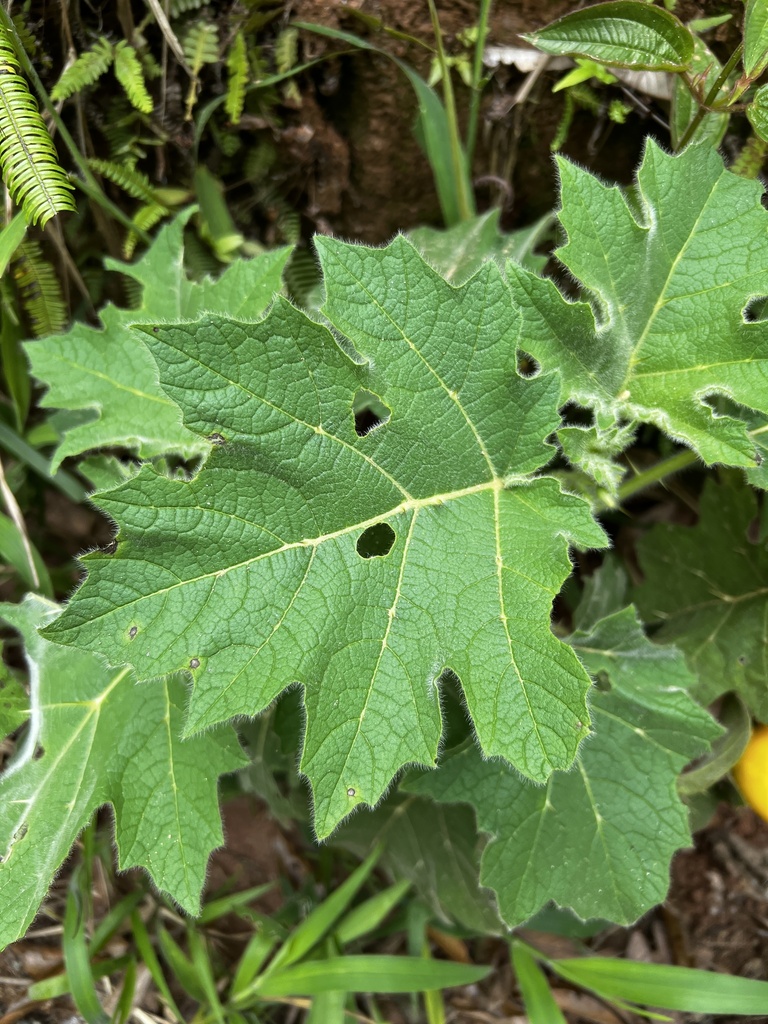
nipplefruit
Solanum mammosum
Solanum mammosum, commonly known as nipplefruit, fox head, cow's udder, or apple of Sodom, is an inedible Pan-American tropical fruit. The plant is grown for ornamental purposes, in part because of the distal end of the fruit's resemblance to a human breast, while the proximal end looks like a cow's udder. It is an annual in the family Solanaceae, and part of the genus Solanum, making the plant a relative of the eggplant, tomato, and potato. This poisonous fruit is native to South America, but has been naturalized in Southern Mexico, Greater Antilles, Central America, and the Caribbean. The plant adapts well to most soils, but thrives in moist, loamy soil.
From the article Solanum mammosum on Wikipedia (CC BY-SA), quoted section by section
Description
The plant has thin simple leaves occurring in alternating branching patterns with prominent venation. Hairy thorns cover the stem and branches of the plant. The inflorescence contains five to eight purple elongating buds. The fruit is a berry type, and has waxy yellow skin with reddish-brown seeds. The plant is propagated by the distribution of seeds.
At the table
The fruit has been embraced by Eastern cultures. It is primarily used as decorative foliage for religious and festival floral arrangements in Asia. The fruit is imported for the creation of Chinese New Year trees, due to their golden colored fruit and the belief that the five "fingers" on the fruit represent longevity for the family. In Chinese culture, the plant is known as five-fingered eggplant (五指茄) and in Japan it is known as horned eggplant (ツノナス), fox eggplant (キツネナス), or foxface (フォックスフェイス). The juice of the fruit can be used as a detergent in place of a washing powder, making it similar to the soap nut. The Kofan People of Colombia and Ecuador use the plant as an insect repellent, primarily against cockroaches. The fruit works as a repellent because of the toxicity of steroidal glycoalkaloid. Although the mature fruit is poisonous, it can be cooked and eaten like a vegetable when it is unripe. It provides a good source of calcium, phosphorus, iron and vitamin B. One way that the fruit can be prepared is boiling the whole fruit and drinking the juices once boiled. In the Philippines, not only is the fruit eaten, but the leaves are also prepared as a tea considered to be anodyne, a mild narcotic.
Wikipedia: “Uses”
Where it lives
Recorded sightings
—
geo-referenced records in GBIF, from museums, herbaria and field observers.
Drag the globe to turn it. Dots are where records exist, not a range map; darker means more records.
In the stacks
Searching the stacks…
Every page naming Solanum mammosum in the Biodiversity Heritage Library →
This page is assembled live from iNaturalist, GBIF, Wikipedia, the Source Library and the Internet Archive. It is not yet part of the hand-edited codex. iNaturalist taxon 169074.