- Plants
- ›Vascular Plants
- ›flowering plants
- ›Dicots
- ›Sunflowers, Bellflowers, Fanflowers, and Allies
- ›Sunflowers, Daisies, Asters, and Allies
- ›Asteroideae
- ›Millerieae
- ›Milleriinae
- ›Sigesbeckia
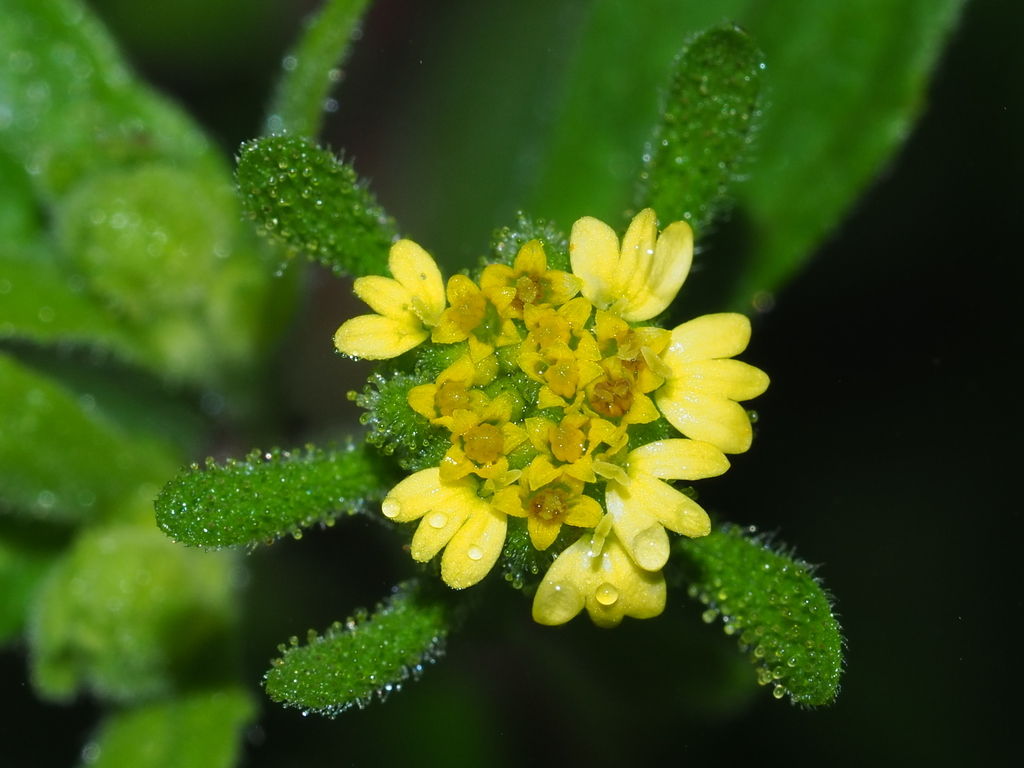
Eastern St Paul's-wort
Sigesbeckia orientalis
Sigesbeckia orientalis, commonly known as Indian weed or common St. Paul's wort, is a species of flowering plant in the family Asteraceae. It is a small, upright, sparsely branched shrub with yellow flowers and widespread in Asia, Africa and Australia.
From the article Sigesbeckia orientalis on Wikipedia (CC BY-SA), quoted section by section
Description
Sigesbeckia orientalis is an annual, upright herb or subshrub, about 0.4–1.5 m (1 ft 4 in – 4 ft 11 in) high, usually multi-branched with reddish coloured, hollow stems. The leaves may be triangular-shaped, lance-shaped to broadly lance-shaped, and up to 2–17 cm (0.79–6.69 in) long, 1–7 cm (0.39–2.76 in) wide, petiole up to 2 cm (0.79 in) long, underside has small, yellow glands. The upper and lower surface of the leaf blade is sparsely hairy, the margin has pointed to rounded teeth, larger teeth nearer the base, gradually narrowing, base wedge-shaped, and rough on both surfaces. The yellow or orange flowers are borne in clusters of about 15 sessile flowers per head, about 10 mm (0.39 in) in diameter, usually containing female and hermaphrodite flowers. There are about 8 ray florets, each ligule 1–2 mm (0.039–0.079 in) long, and 10-15 disc florets. The fruit is a dark brown to black cypsela, 2–3 mm (0.079–0.118 in) long, curved and ridged. Flowering and fruiting occurs all months of the year.
Range & habitat
Sigesbeckia orientalis has a broad distribution in Africa and Asia, but has been widely naturalised outside this range. There is debate whether the species is native to Australia.The National Herbarium of New South Wales accepts the species as native. It is a widespread species in Australia growing on river banks and on shallow, stony locations.
Wikipedia: “Distribution and habitat”
Where it lives
Recorded sightings
—
geo-referenced records in GBIF, from museums, herbaria and field observers.
Drag the globe to turn it. Dots are where records exist, not a range map; darker means more records.
In the stacks
Searching the stacks…
Every page naming Sigesbeckia orientalis in the Biodiversity Heritage Library →
This page is assembled live from iNaturalist, GBIF, Wikipedia, the Source Library and the Internet Archive. It is not yet part of the hand-edited codex. iNaturalist taxon 168955.