- Plants
- ›Vascular Plants
- ›flowering plants
- ›Dicots
- ›Legumes, Milkworts, and Allies
- ›Legumes
- ›Faboideae
- ›Sesbanieae
- ›Sesbania
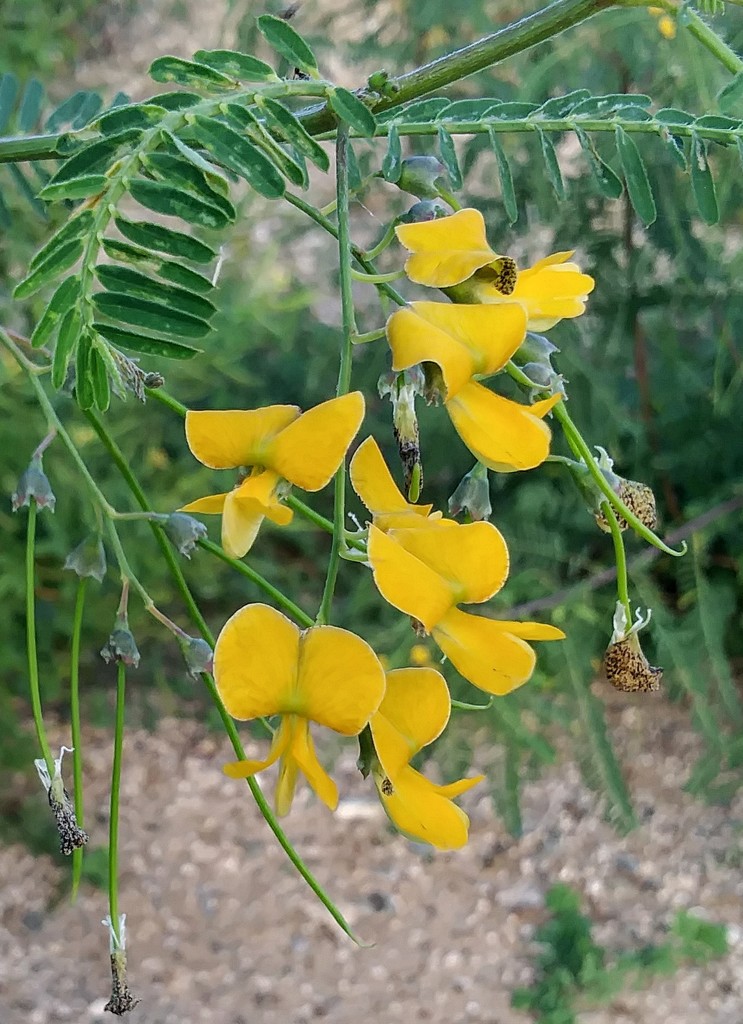
Sesbania sericea
Sesbania sericea is a species of flowering plant in the family Fabaceae. It is a herb or subshrub with yellow flowers and dehiscent fruits. The species is native to Africa and the Arabian Peninsula.
Sesbania sericea was described in 1809, and is listed as of Least Concern by the IUCN.
From the article Sesbania sericea on Wikipedia (CC BY-SA), quoted section by section
Description
Sesbania sericea is an annual or perennial herb or subshrub. It grows 1–3 metres (3.3–9.8 ft) tall. The stems have a reddish tinge. The leaves are 5–12 centimetres (2.0–4.7 in) long, and have five to fifteen pairs of leaflets. The leaflets are oblong to elliptical, papery, 1–2.5 centimetres (0.39–0.98 in) long, and 0.3–0.8 centimetres (0.12–0.31 in) wide. The inflorescence is a raceme that grows up to 6 centimetres (2.4 in) long. The calyx is broadly bell-shaped, and 3–5 millimetres (0.12–0.20 in) long. The corolla is yellow. The standard is widely ovate, and up to 12 millimetres (0.47 in) long. The wings and keel are the same length as the standard. The fruit is a dehiscent, slightly curved, 12–16 centimetres (4.7–6.3 in) long, 2.5–3 millimetres (0.098–0.118 in) wide legume. The seeds are cylindrical, light brown, and around 3 millimetres (0.12 in) long.
Range & habitat
Sesbania sericea is native to Africa (Angola, Benin, Burundi, Chad, Republic of the Congo, Democratic Republic of the Congo, Ethiopia, Gabon, Ghana, islands in the Gulf of Guinea, Ivory Coast, Kenya, Malawi, Mali, Mauritania, Niger, Nigeria, Senegal, Somalia, Sudan, South Sudan, Tanzania, Togo, and Uganda) and the Arabian Peninsula (Oman, Saudi Arabia, and Yemen). It has been introduced to the Bahamas, Belize, north-east Brazil, Cambodia, Colombia, Cuba, Egypt, French Guiana, Guatemala, Guyana, Hispaniola, India, Jamaica, Java, Laos, the Leeward Islands, Myanmar, Puerto Rico, Réunion, the Seychelles, Sri Lanka, Suriname, Thailand, Trinidad and Tobago, Venezuela, (including the Venezuelan Antilles), Vietnam, the Windward Islands, and the United States (Florida and Texas). The species grows at elevations of up to 850 metres (2,790 ft), in old rice fields, moist and temporarily flooded areas, river banks, lagoon sides, and lakes. It is often found near Typha.
Wikipedia: “Distribution”
At the table
Sesbania sericea is used for animal food, medicine, and for fuel. It is used to poison fish.
Wikipedia: “Uses”
Where it lives
Recorded sightings
—
geo-referenced records in GBIF, from museums, herbaria and field observers.
Drag the globe to turn it. Dots are where records exist, not a range map; darker means more records.
In the stacks
Searching the stacks…
Every page naming Sesbania sericea in the Biodiversity Heritage Library →
This page is assembled live from iNaturalist, GBIF, Wikipedia, the Source Library and the Internet Archive. It is not yet part of the hand-edited codex. iNaturalist taxon 168864.