- Plants
- ›Vascular Plants
- ›flowering plants
- ›Dicots
- ›Nances, Willows, and Allies
- ›willow family
- ›Salix
- ›Vetrix
- ›Lanatae
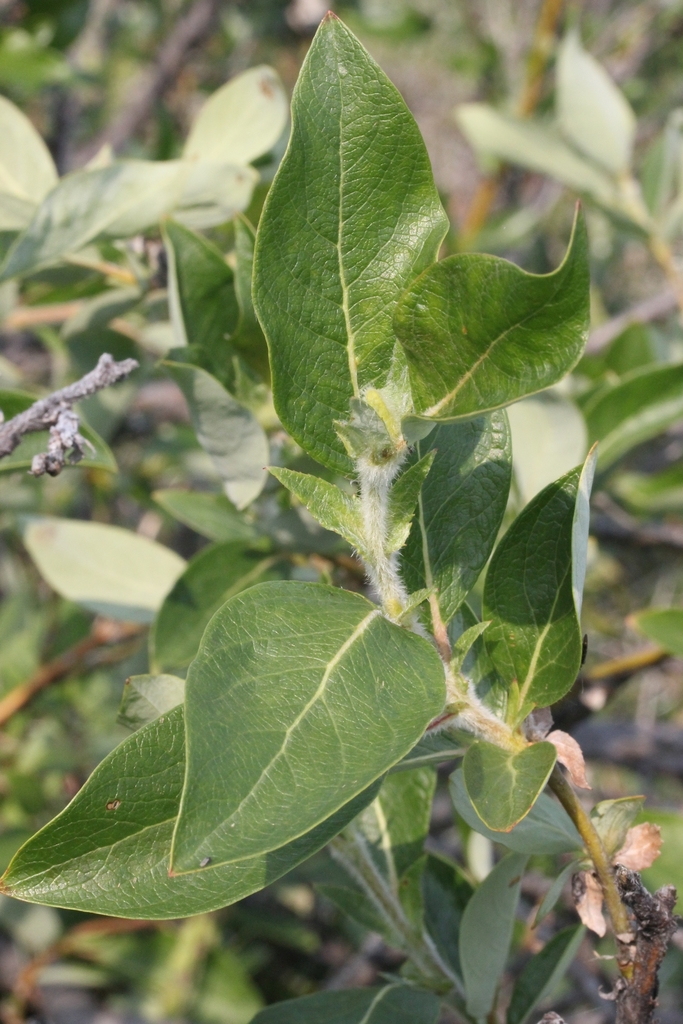
Richardson's willow
Salix richardsonii
Salix richardsonii is a species of flowering plant in the Salicaceae, or willow family. It is known by the common names Richardson's willow and woolly willow. It is native to Russia and northern North America, where it occurs in Alaska and northern Canada. Some authorities consider it to be a subspecies, Salix lanata subsp. richardsonii (Hook.) A. K. Skvortsov rather than a species itself.
This willow is a branching shrub which forms dense thickets that grow to about 1 to 2 m (3.3 to 6.6 ft) tall, but is known to reach 6.5 m (21 ft) . Along with S. pulchra and S. alaxensis, it is the tallest willow in the Arctic Archipelago. The stems of this species have smooth, hairless bark, but the young twigs are very hairy. The wood becomes brittle as it ages. This species is dioecious, with male and female reproductive structures on separate individuals. The inflorescence is a catkin. The catkins appear before the leaves in the spring. The flowers of S. richardsonii are typically pollinated by bees. The seeds are viable for only a short period of time and germinate immediately upon contact with the moist substrate. Natural hybrids can be formed with other willows, such as S. barclayi and S. calcicola, with the hybrid Salix calcicola × S. richardsonii reportedly found on Southampton Island.
Where it lives
Recorded sightings
—
geo-referenced records in GBIF, from museums, herbaria and field observers.
Drag the globe to turn it. Dots are where records exist, not a range map; darker means more records.
In the stacks
Searching the stacks…
Every page naming Salix richardsonii in the Biodiversity Heritage Library →
This page is assembled live from iNaturalist, GBIF, Wikipedia, the Source Library and the Internet Archive. It is not yet part of the hand-edited codex. iNaturalist taxon 168356.